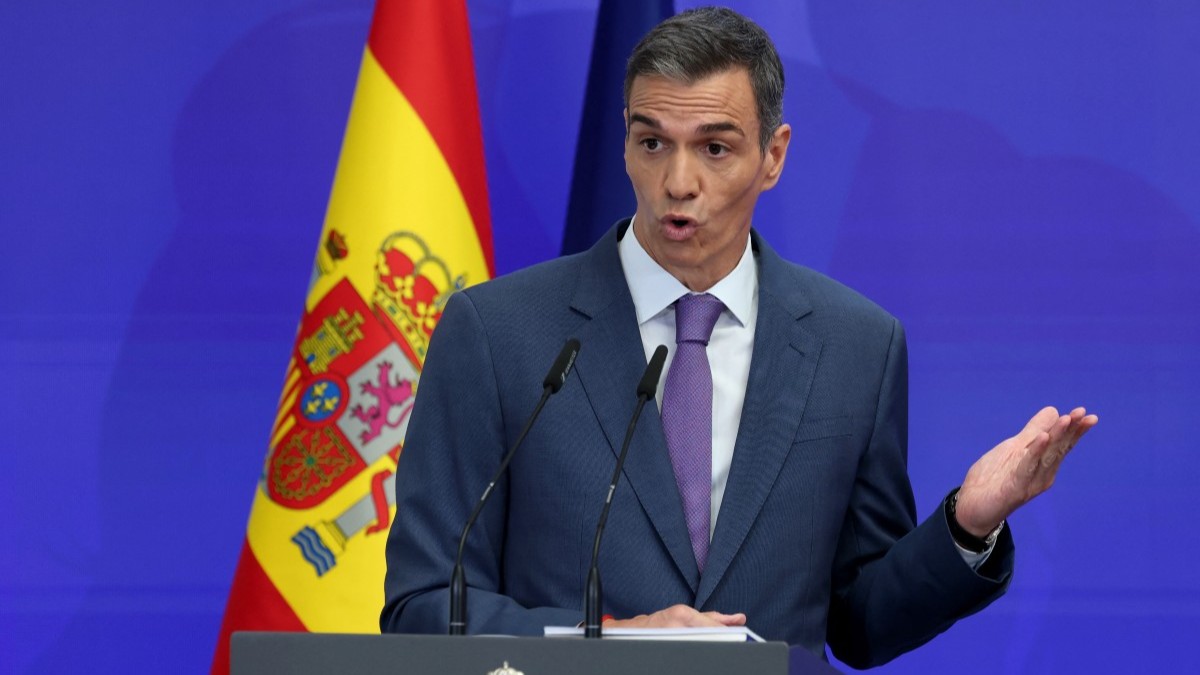
Spain’s Prime Minister Pedro Sánchez speaks at a biannual press conference at La Moncloa Palace in Madrid on July 28, 2025.
Pierre-Philippe Marcou / AFP
Pedro Sánchez is facing the most delicate summer of his mandate. He is besieged by a series of corruption scandals that reach deep into the PSOE’s core and threaten to undermine his authority both inside and outside the government.
What began as the ‘Koldo case’ has turned out to be a mafia-like scheme with international ramifications, thousands of hours of recordings, and dozens of people implicated, including sitting ministers.
In early June, the UCO (Central Operative Unit of the Civil Guard) delivered an explosive report to the judge, with access to more than 17,000 audio files and messages intercepted from Koldo García, former advisor to the party’s ex-organization secretary José Luis Ábalos, and alleged middleman between companies and senior government officials. Among his interlocutors is the current Minister of Transport, Óscar Puente, whose involvement remains unclear but who is mentioned in several key conversations. The last ex-organization secretary, Santos Cerdán, is now in jail under investigation.
The heart of the investigation revolves around inflated contracts awarded during the pandemic, but the inquiry has gone much further. According to the Anti-Corruption Prosecutor’s Office, the network used shell companies in the Dominican Republic to launder money, which was then repatriated to Spain in cash and distributed among high-ranking officials linked to the PSOE. Protected witnesses have identified direct relatives of Koldo García as the ones tasked with collecting the money on the Caribbean island.
It has also been revealed that Sánchez has taken 582 official flights in five years, 63 of which are to the Dominican Republic. Although the government claims these were technical stopovers, a recent ruling by Spain’s Transparency Council forces Moncloa to disclose the complete list of passengers, destinations, and reasons for 122 flights taken in 2023 and 2024. There is growing suspicion that some of those trips may have served to cover up private movements or travel of individuals implicated in the scheme.
To shield itself, the Council of Ministers fast-tracked a new official secrecy law last week, concentrating classification powers in the Office of the Prime Minister. The decision has caused deep unrest even within the PSOE, with Defence Minister Margarita Robles refusing to relinquish authority from the intelligence agency (CNI). Opposition parties and legal experts warn that the new law could block future investigations and protect those responsible for institutional corruption.
All this while the president attempts to project normalcy from his summer residence on the Canary Island of Lanzarote. But neither the sun nor the Atlantic is enough to dissipate the political stench emanating from Ferraz. On the verge of the new political season, Sánchez is facing his term’s most severe political deterioration, with a divided PSOE, an outraged public, and a judiciary preparing for high-level indictments. And all signs indicate the worst is yet to come.
Meanwhile, the scandals have yet to officially reach Brussels, where both socialist and popular allies appear eager to turn a blind eye to the alleged systematic violations of the rule of law — a development that would spark a genuine scandal within the European Union.