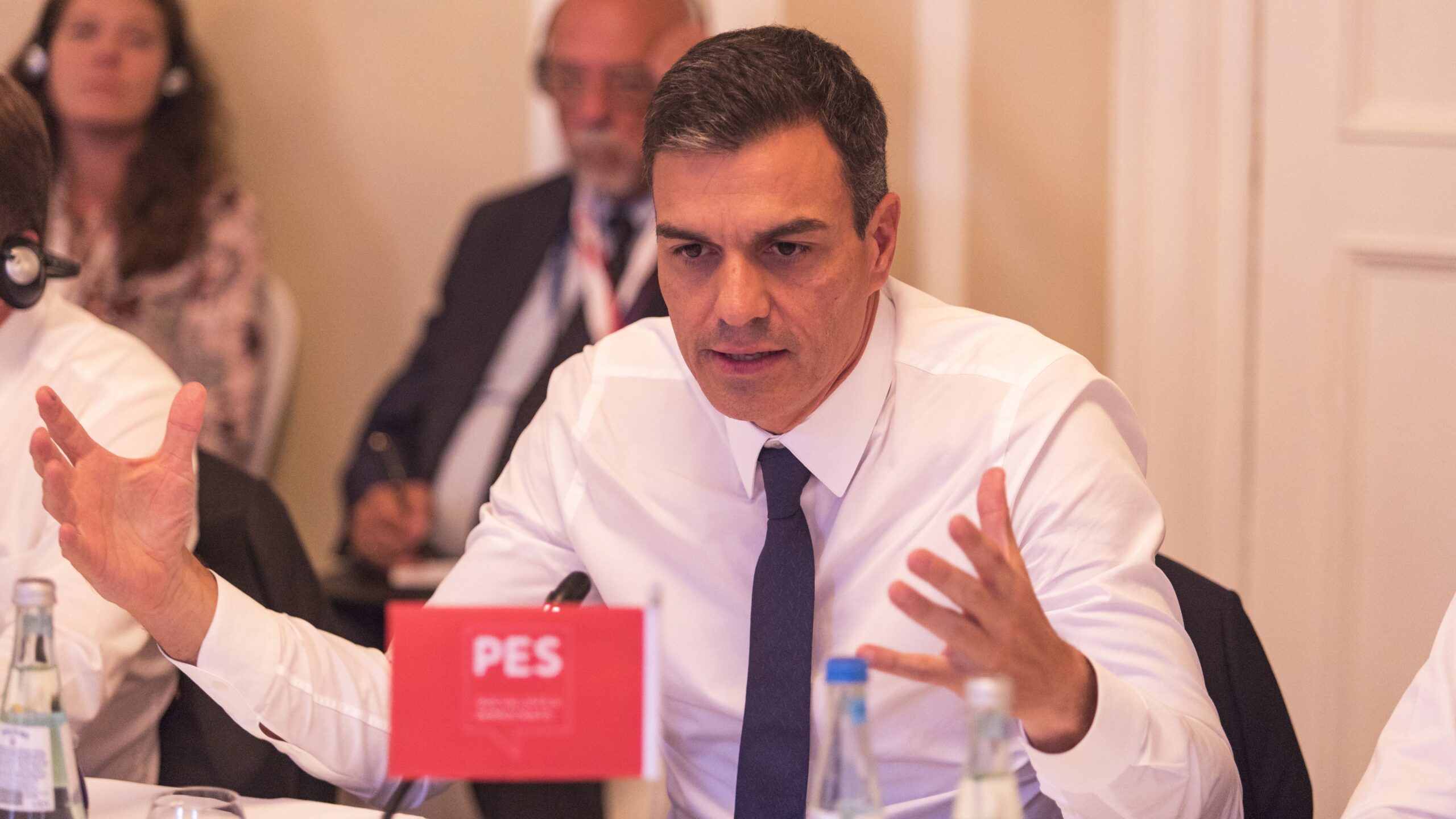
Spanish Prime Minister Pedro Sánchez in 2022
Arne Müseler / arne-mueseler.com / CC-BY-SA-3.0
The corruption scandals engulfing Prime Minister Pedro Sánchez’s inner circle have now reached Brussels’ response threshold. Brussels, traditionally cautious in commenting on internal matters of Western member states (not so much when it comes to ‘black sheep’ like Hungary or earlier, Poland), has broken its silence and issued a stark warning: if the misuse of EU funds is confirmed in the so-called Koldo case, the Commission will take action.
The European Commission has reminded that it possesses strong tools to protect the common budget, ranging from payment suspensions to recovering embezzled funds. It is a welcome change that the Commission for once may start putting those tools to use not to discipline countries whose citizenry voted the wrong way. The EU’s Anti-Fraud Office (OLAF) and the European Public Prosecutor’s Office (EPPO) have already been alerted, given the possibility that EU funds were misappropriated through rigged public contracts in the PSOE’s orbit.
The Commission spokesperson stated there was zero tolerance of misuse of public funds, and the same is expected from member states, who manage two-thirds of the EU budget. This firmness starkly contrasts with the earlier shielding of the Spanish Socialists, and with the inaction the Spanish government shows in the face of growing evidence of a clientelist network of political-business corruption.
As international pressure grows, President Sánchez has taken refuge in a political strategy that seems to be more about buying time than accountability. In his press appearance on Monday, June 16, rather than offering convincing explanations, he lashed out at the opposition, shifted attention to alleged scandals within the PP and VOX, and reiterated that there is no evidence of irregular financing within the PSOE.
It is almost inconceivable that the prime minister was unaware of the corrupt practices of close collaborators such as José Luis Ábalos or Santos Cerdán. Sánchez’s attempt to present himself as a deceived victim lasted barely five days. His rhetoric has turned to counterattack: he dares the opposition to file a motion of no confidence, fully aware that his allies—Sumar, ERC, Bildu, Junts—also wish to avoid elections.
The president has activated a political survival plan, as calculated as risky. First, he seeks to secure the support of his partners through private meetings and possible concessions. Then, he will take an international break and appear at various summits—NATO, European Council, and the UN—to cool down the domestic political climate. In July, he will renew the PSOE leadership and appear before Congress. Finally, he will focus on negotiating the 2026 budget to give oxygen to a legislature on life support.
However, the entire plan hinges on one factor beyond his control: the judicial progress of the PSOE case. If the investigations reveal more rigged contracts, more implicated individuals, or irrefutable evidence of irregular financing, the prime minister’s position will become untenable domestically and abroad.
Sources close to the legal proceedings have confirmed to europeanconservative.com that more compromising information will emerge gradually. This Tuesday, June 17, Javier María Pérez-Roldán, lawyer for the association Hazte Oír—one of the popular prosecutions against the PSOE—will speak before the United Nations Council in Geneva to present the case to the international audience.
Many on the Left are already considering letting Sánchez fall to save the PSOE, as the damage caused by the current executive appears irreversible. The Spanish Right is cheering, hoping for a French-style collapse of the Socialists, though such a scenario seems far-fetched in Spain.
If the use of European funds in these schemes is confirmed, Brussels will not only be justified in intervening—it will be compelled to do so. And then, the question will no longer be whether Sánchez knew anything, but how much longer he can remain at the helm of a government surrounded by suspicion.