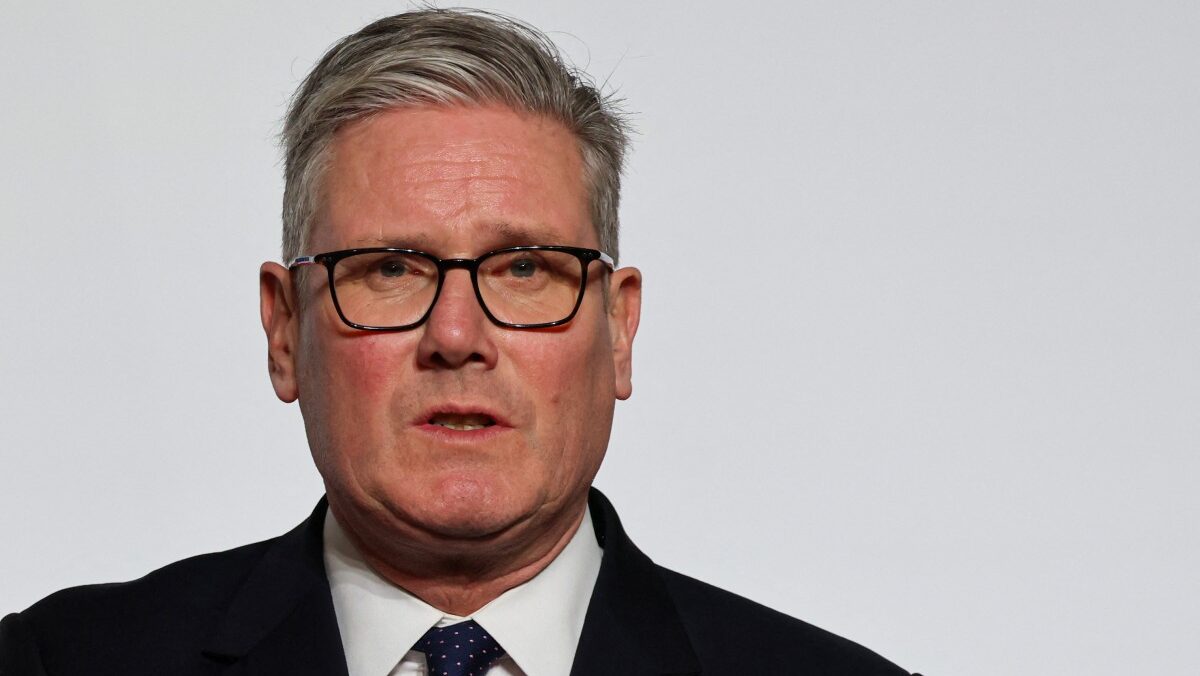
Britain’s Prime Minister Keir Starmer
LUDOVIC MARIN / POOL / AFP
The British Labour government is attempting to increase its control over the electronic information sphere, both threatening to ban Elon Musk’s X and to force platforms providing encrypted chats to give the government a backdoor to screen private messages before encryption.
With the EU’s Digital Services Act and Chat Control, the stated reason was ‘combating disinformation’ and ‘protecting children’; for Keir Starmer, the excuse is the ability of Grok, the X platform’s generative AI, to create non-consensual pornographic ‘deepfakes’ and to intercept messages relating to terrorism and child abuse.
In both cases, the casualty is the open and free exchange of information.
The UK’s move on social media comes close on the heels of Indonesia’s Saturday ban on Grok for “serious violation of human rights, dignity, and the security of citizens in the digital space,” according to The Telegraph—a course of action also not ruled out by the European Commission. Not to be outdone, the UK has threatened to pursue an outright ban on X if Musk does not remove the generative AI function that can create ‘deepfake’ pornographic images.
Musk has emphasized that X addresses illegal content responsibly—for example, by restricting Grok’s image editing to paid subscribers as a response to the controversy—while resisting blanket bans or backdoors that undermine user privacy and free expression, but critics say this doesn’t fully address the issue.
If the only goal was to stop the spreading of ‘deepfakes,’ the Starmer regime could have followed Italy’s example and criminalized the unlawful dissemination of such images and videos rather than threaten the popular social media site with a ban.
UK technology secretary Liz Kendall said in The Telegraph that MPs who oppose such a ban, should X fail to comply with British law, could “either support the action we are taking under the Online Safety Act or they can ally with those who think the creation and publication of sexually manipulated images of women and children is acceptable.” The communications regulator Ofcom is expected to announce its recommended course of action within days .
The British Online Safety Act, passed in 2023, requires all platforms hosting user-generated content—from social networks to forums and news sites—to verify the age of their users. This measure has resulted in adults being forced to upload scans of their ID documents and banking details or undergo facial recognition to access sensitive content. While, in theory, this was intended to prevent minors from accessing pornography or explicit violence, it has in reality been used to censor news, political speech, and critical opinions on mass immigration.
PM Keir Starmer has reportedly reached out to Canada and Australia in an effort to put joint international pressure on Musk over the ‘deepfake’ issue. Australian PM Antony Albanese said the offending AI function “is an example of social media not showing social responsibility. … Australians, and indeed global citizens, deserve better.”
X owner Musk hit back on his own platform on Saturday, asking, “Why is the UK government so fascist?”
Why is the UK government so fascist? https://t.co/sRg979MTQx
— Elon Musk (@elonmusk) January 10, 2026
U.S. Republican congresswoman Anna Paulina Luna said she will introduce a bill of sanctions against Starmer and the UK if the country is successful in banning the social media platform.
Independent UK MP Rupert Lowe, meanwhile, urged the Trump administration to “deploy whatever appropriate power they hold to prevent Keir Starmer from banning X in Britain,” adding, “Free speech must be protected, and such disgusting authoritarianism must be resisted. We need help.”
I urge @elonmusk, @JDVance and the wider American administration to deploy whatever appropriate power they hold to prevent Keir Starmer from banning X in Britain.
— Rupert Lowe MP (@RupertLowe10) January 9, 2026
Free speech must be protected, and such disgusting authoritarianism must be resisted.
We need help.
The EU’s original ‘Chat Control’—an attempt to give governments access to all private messages sent through encrypted platforms—failed to convince member states, leaving the bloc with ‘only’ a somewhat watered-down version that includes “voluntary scanning” of encrypted messages and requires platforms to implement “mitigating measures” approved by national regulators.
The UK’s version under the Online Safety Act provides Ofcom with a powerful legal tool to, if the regulatory body deems it “necessary and proportionate,” issue a notice requiring providers of regulated user-to-user services to use “client-side scanning”—reviewing all private messages prior to encryption.
Lord Hanson of Flint told digital rights newsletter Reclaim the Net that Ofcom is expected to start using these powers as soon as their report is finalized. “We have set a date of April 2026,” he said, “and we expect to act extremely speedily once we have had the report back.”
Given the British government’s treatment of citizens like Lucy Connolly, who spent nine months in prison for one (later deleted) post on X, or Isabel Vaughan-Spruce, who was arrested for praying silently in the ‘wrong’ location, Britons—and indeed global citizens—ought to be more than a little concerned about further restrictions to their privacy and freedom of expression.