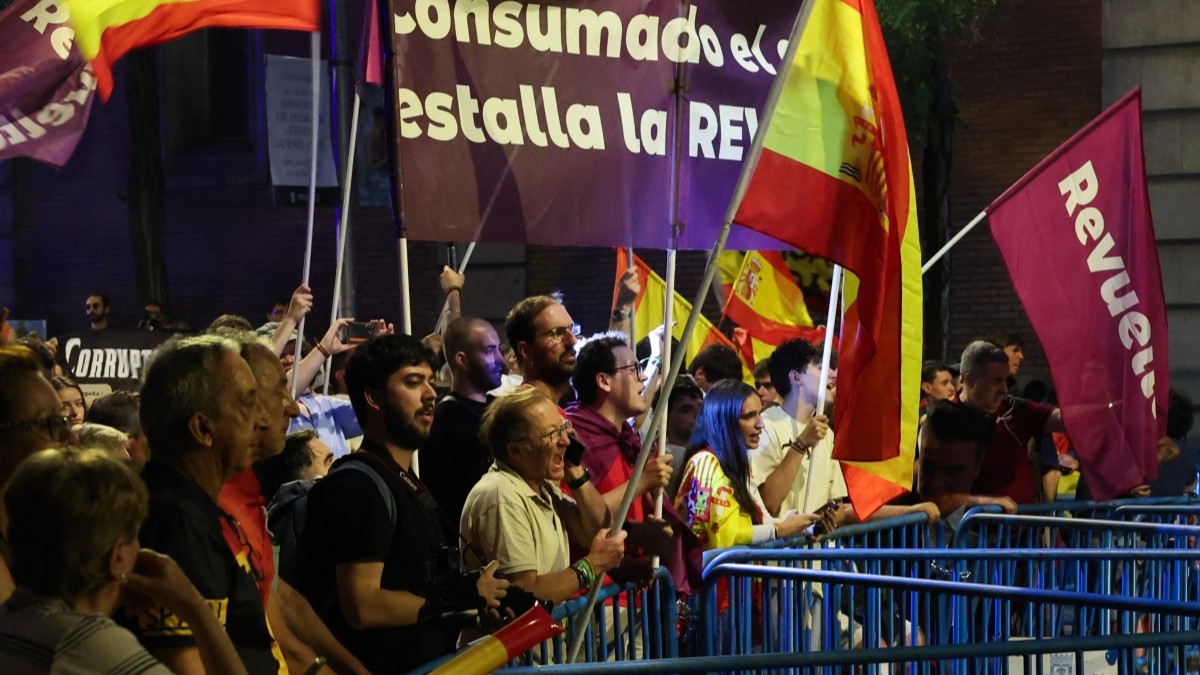
Demonstrators gather near the Spanish Socialist Worker’s Party (PSOE) headquarters in Madrid to demand the resignation of Spain’s Prime Minister Pedro Sánchez in Madrid, on June 13, 2025.
Pierre-Philippe Marcou / AFP
Over the past two decades, Europe’s political landscape has been transformed. What seemed unthinkable just fifteen years ago—that formations of the so-called “New Right” would become the leading political force in voting intentions across several countries—is now a reality.
According to recent polls, parties such as VOX in Spain, Alternative für Deutschland (AfD) in Germany, Freiheitliche Partei Österreichs (FPÖ) in Austria, Rassemblement National (RN) in France, and Reform UK in Britain are topping voter preferences, both overall and, most significantly, among younger voters.
What is driving this? First and foremost, mass, uncontrolled immigration has set off a Europe-wide revolt. Fears of cultural loss and EU overreach are driving calls to take back sovereignty and close the borders. Rising crime, growing lack of safety in once peaceful neighborhoods, and an increase in offences such as sexual assaults have deeply resonated with an electorate that finds no effective responses from traditional parties.
Economic and demographic factors add to this discontent. Since the 2008 financial crisis and its aftermath, Europe has been plagued by uncertainty: inflation, loss of purchasing power, unaffordable housing, job insecurity, and a future that makes it difficult to start a family or secure one’s prospects. Many citizens feel they have no control over their own destiny and that political elites remain detached from their real problems.
With no strong leaders and the old guard running on fumes, these movements are filling the gap. The post–Second World War system—with clearly defined blocs between moderate conservatives and social democrats—seems to be in its final stages and unable to respond to today’s challenges, partly because both sides have become virtually indistinguishable.
Social media has sped up political divides, turning once-fringe voices into messages heard by millions.
However, popularity does not guarantee access to power. While Marine Le Pen’s RN has never led the first round of a presidential election, it has made repeated run-off appearances—only for rival parties to unite to keep her from the Élysée Palace. Even after topping the first round of the 2024 legislative elections, the RN was again blocked from power by a broad anti-Le Pen alliance.
A similar situation occurs in Germany, where the AfD is isolated by a “firewall” where other parties refuse to enter coalitions with it. In the UK, although Reform UK leads in the polls, the first-past-the-post electoral system has until now made it difficult to convert that support into seats. The FPÖ is well placed in Austria, but can only govern if other parties agree to work with it. We have already seen how, despite winning the most votes in previous elections, the establishment parties eventually formed a government to keep them out.
The paths for these forces to govern boil down to two scenarios: an overwhelming victory that forces centrist parties to negotiate with them, or an outright majority, which, for now, seems unlikely in most countries. Even so, their political impact is evident: they shape agendas, force debates, and push traditional parties to harden their stance on immigration, crime, or national sovereignty. Whether this influence will go beyond rhetoric will become clear sooner rather than later.