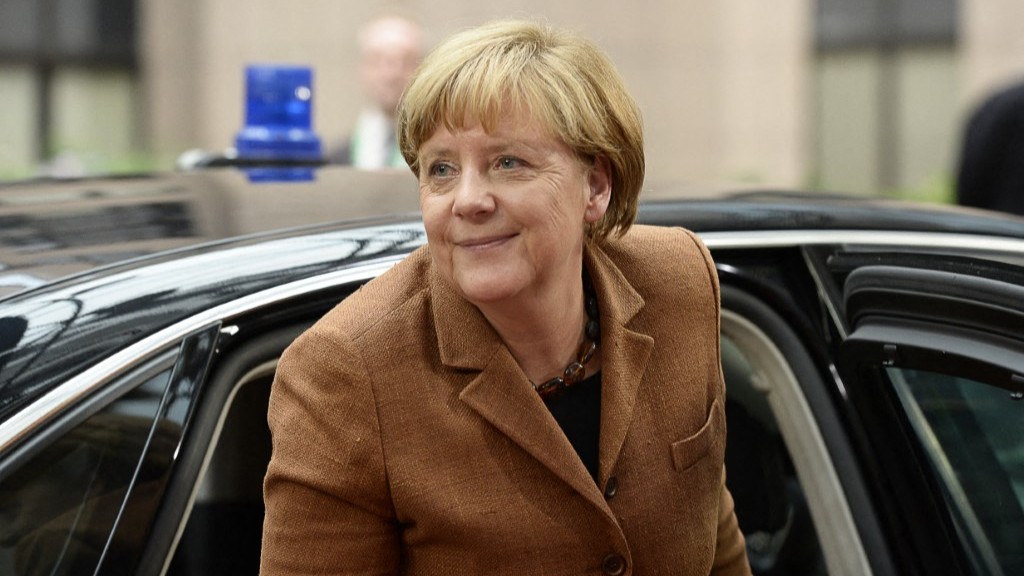
Germany’s Chancellor Angela Merkel arrives to attend an European Union (EU) emergency summit on the migration crisis with a focus on strengthening external borders at the EU Headquarters in Brussels, on September 23, 2015.
Thierry Charlier / AFP
On September 5, 2015, after Angela Merkel uttered the now infamous words “Wir schaffen das” (“We can do it”) on August 31st, Germany’s borders were effectively opened to hundreds of thousands of asylum seekers waiting in Austria and Hungary. With that gesture, celebrated by left-wing media as a show of humanity, one of the most convulsive stages of contemporary Europe began: the era of mass immigration. Today, a decade later, the data, the social problems, and the political transformations prove that the decision marked a turning point in the continent’s history.
More than one million people arrived in the European Union that year, mainly from Syria, Iraq, and Afghanistan. Germany received more than 440,000 asylum applications, Sweden 156,000, and Austria 88,000. Routes were saturated: Greece became the main entry point, Italy and Spain endured massive landings, and Hungary built fences to stop the flow—something harshly criticized at the time but now proven to be the only effective way to resist migratory suicide.
Thousands died—and continue to die—in the Mediterranean, yet the official narrative focused on “solidarity” and the promise that these newcomers would sustain the European welfare state. Today, those who once promoted open borders tell us that the system has failed and that massive cuts are needed, ‘discovering’ that the immigrants do not contribute to the sustaining of the welfare system but overwhelm it.
On New Year’s Eve 2015 in Cologne, the mass sexual assaults committed by groups of immigrants made visible to millions of citizens the cost of the so-called “welcome culture.” Rising crime, urban ghettos, and overstretched social services marked the years that followed.
The 10th anniversary of that crisis makes clear how the European project never recovered. Eastern states such as Hungary and Poland reinforced their borders and clashed with Brussels, refusing to accept mandatory refugee quotas. In Germany, trust in traditional parties collapsed, and the AfD—then in an internal crisis—re-emerged to become a decisive force in national and European politics.
The consequences spread across the continent: the rise of parties critical of immigration in Italy, France, the Netherlands, and Spain reflects a profound shift in public opinion. The Eurocratic ideal of open borders proved incompatible with citizens’ sense of security, and the so-called “refugee crisis” turned into a crisis of legitimacy for the European Union.
The promises that newcomers would pay pensions or fill labor shortages crashed against the reality of societies struggling with integration. A decade later, Germany debates imposing mandatory contribution years on its own retirees to sustain the system, while the costs of immigration—housing, subsidies, healthcare, education—continue to skyrocket.
At the same time, the cultural fracture is undeniable: entire neighborhoods transformed, religious tensions, rising crimes linked to sexual violence or drug trafficking, and the creation of a parallel population living outside the European identity. Statistics confirm it: unemployment rates and dependency on public aid among immigrants who arrived since 2015 remain far higher than the national average.
Brussels insists it has learned from 2015 and has announced a “new migration pact” with detention centers in third countries and a stronger Frontex for 2026. But the truth is that while external borders continue to weaken, human-trafficking mafias thrive, and millions in Africa and Asia see Europe as their destination, convinced the gates will never truly close.
Ten years on, it has become clear that mass immigration did not solve Europe’s problems—it multiplied them. The open-door policy has left a continent more divided, more insecure, and more dependent on community structures incapable of protecting its people.
Europe cannot afford another lost decade. The memory of 2015 should be warning enough: when governments abdicate their duty to protect, the citizens pay the price.