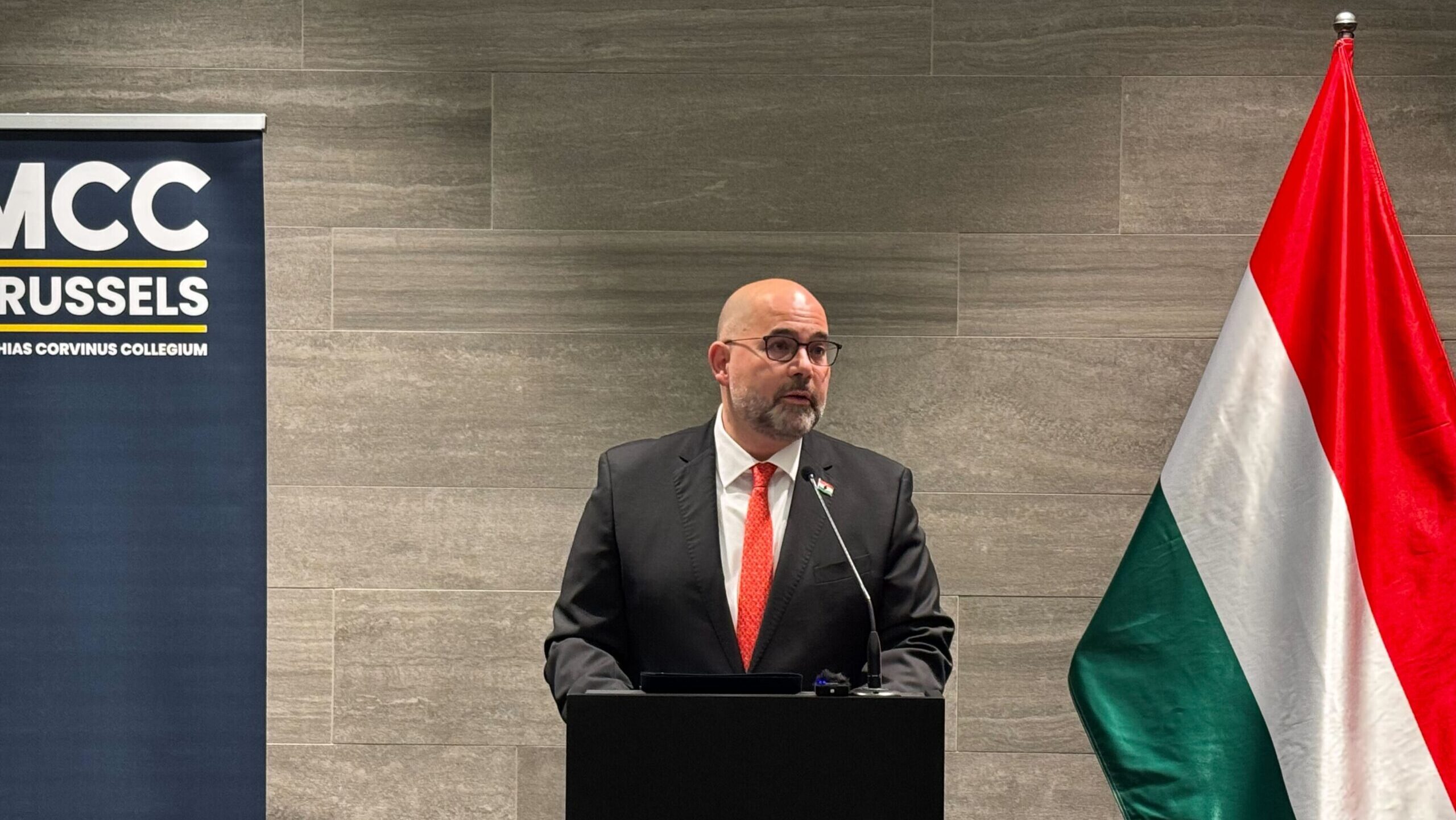
Dr. Tamás Iván Kovács, Ambassador of Hungary to Belgium.
Javier Villamor / europeanconservative.com
“In the 21st century, the Hungarians are back.” With these words, Professor Frank Furedi, Executive Director of MCC Brussels, closed a commemorative event that honored the heroes of the 1956 Hungarian Revolution—a moment that continues to define Europe’s moral struggle between freedom and submission.
The event, hosted by His Excellency Dr. Tamás Iván Kovács, Ambassador of Hungary to Belgium, brought together scholars and diplomats to recall the courage of the Hungarian people who rose up against Soviet domination.
In his opening address, Ambassador Kovács paid tribute to the men and women who “fought not only for Hungary’s independence but for the dignity of all nations living under oppression.” He reminded the audience that the legacy of 1956 is both historical and personal. The Ambassador himself was one of the young Hungarian freedom fighters whose image appeared on the cover of TIME magazine as Man of the Year in 1957. “That photograph,” he said, “came to symbolize not only the courage of a nation but the rebirth of its soul. It stands for Hungary’s belief that freedom is never lost—only waiting to be reclaimed.”
Kovács also paid homage to the more than 6,000 Hungarians who found refuge in Belgium after the revolution was crushed, noting how “they brought Hungary with them—its language, its culture, its faith.” Their story, he said, “is a living example of integration rooted in dignity and loyalty.”
Next, Jakub Moroz, Polish theatre critic and broadcaster, reflected on the deep bond between Poles and Hungarians—“a shared destiny,” as he called it, “forged in the struggle against tyranny.” Moroz underlined that the memory of 1956 transcends national boundaries: “The Hungarian Revolution reminded the world that freedom is contagious—that when one nation stands up, others are inspired to follow.” He warned, however, that new forms of ideological control threaten Europe today, “not through tanks and prisons, but through censorship disguised as virtue and conformity masked as progress.”
Finally, Professor Frank Furedi delivered an emotional and reflective speech, recalling the events of October 23, 1956: “It began as a student demonstration of solidarity with striking workers in Poland. Before the day was out, the people of Budapest were demanding the resignation of the government and the withdrawal of Soviet troops.”
He shared his memories as a nine-year-old walking through the streets of Budapest: “I can still recall the powerful sense of exhilaration that swept people into the streets—filled with excitement, confidence, hope and, above all, the feeling that anything was possible. I was nine, but on that night and in the weeks that followed, I did not feel like a child.”
Quoting the philosopher Hannah Arendt, Furedi recalled that the greatness of the revolution “does not depend on victory or defeat,” because “what happened in Hungary happened nowhere else.” Those twelve days, he said, “gave more history than the twelve years since the Red Army had liberated the country from Nazi domination.”
Turning to the present, Furedi warned of “Orwellian totalitarian-minded individuals who refuse to debate, who try to shut everything down by branding others as fascists.” He drew a direct line between the moral clarity of 1956 and the challenges of the modern West. “When we look at Hungary in the 21st century,” he concluded, “we can definitely say that the Hungarians are back.”
As applause filled the room, the audience was reminded that the revolution’s legacy endures not in monuments but in conviction—in a nation that still defends its freedom, its culture, and its Christian identity against the tides of ideological conformity.
Nearly seventy years later, Hungary’s message remains the same: liberty is fragile, memory is sacred, and faith in one’s nation is the surest safeguard of both.