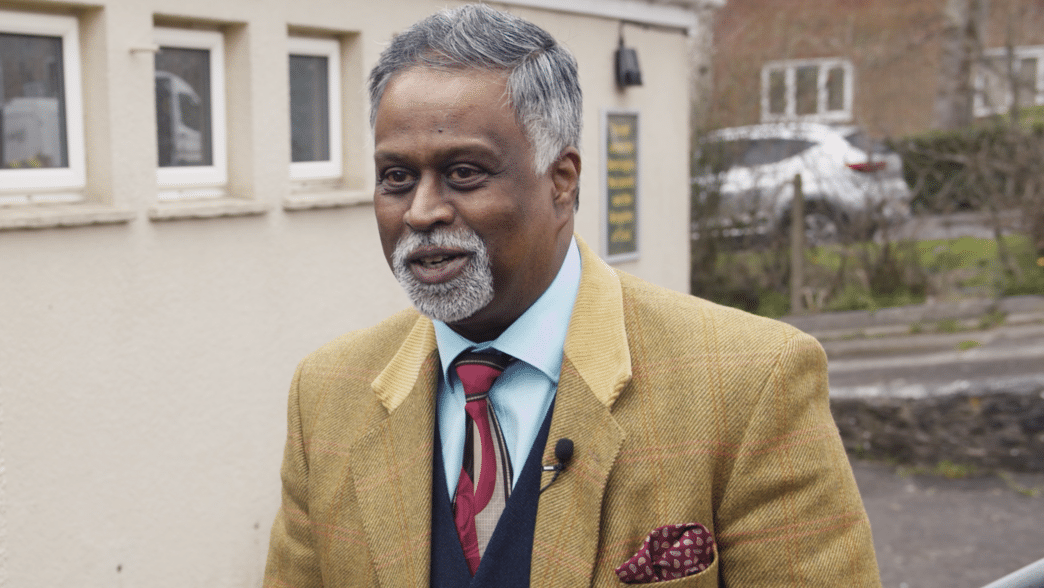
The image is difficult to reconcile with a consolidated democracy: a Christian pastor handcuffed in the centre of Bristol after answering a question about Muhammad during a public preaching. Yet that is exactly what happened to Dia Moodley.
Pastor Dia’s second arrest, in November 2025, when he compared Christian theology on the afterlife to other religions, including Islam. During the course of this he pointed out the Islamic teaching that men receive 72 virgins in heaven.
The pastor, speaking to europeanconservative.com, maintains that his case is not an isolated incident but part of a pattern of police conduct based on an expansive—and selective—interpretation of public order legislation.
The origin of the proceedings dates back to a street preaching event in 2024. As is customary in his evangelistic method, Dia invited passers-by to ask him any question. In that context, he was asked about the difference between Jesus Christ and Muhammad.
“I am not a politician or an activist. I am a pastor. I just want to preach the Gospel and respond to those who ask,” he explains. His answer included a historical reference to Muhammad’s marriage to a minor, a fact recorded in classical Islamic sources and known in academic circles.
The reaction from part of the public was immediate. On the same day, he was arrested on suspicion of committing religiously aggravated harassment, under the Public Order Act 1986 and the Crime and Disorder Act 1998. He spent up to 13 hours in a police cell before being released without being charged.
For his defence, the issue is not only the arrest but the justification: the equation of subjective offence with criminal conduct. “Our freedom is not only being limited; it is being violated,” the pastor states. “If answering a question with a historical fact can land you in a cell, then something very serious is happening.”
Shortly afterwards, in another episode in the centre of Bristol, Dia again preached while holding a Bible and a copy of the Quran, explaining doctrinal differences between Christianity and Islam. According to his account, several Muslim men reacted violently. One threatened to stab him; another attempted to strike his wife.
The pastor was pushed from the ladder on which he was standing and pinned to the ground while they tried to seize the Quran from him, claiming that “it was their book, not his.”
NEW: Christian pastor threatened with arrest after being assaulted by Muslim men who objected to his peaceful street preaching in Bristol.
— ADF International (@ADFIntl) August 2, 2025
With our legal support, Pastor Dia Moodley is taking action against the police. 🧵
Support him:https://t.co/FCj64Wj8su pic.twitter.com/NZrc2oTJQF
The intervention of Avon and Somerset Police has become one of the most controversial aspects of the case. According to the complaint filed, officers warned the pastor on two occasions that he would be arrested for “breach of the peace,” even though he was the one who had been threatened and assaulted. The man who threatened him with a knife was not arrested at the scene.
“It is shocking that the police said I had breached the peace when I was assaulted. This shows that two-tier policing is a reality in modern Britain,” Dia declared.
A senior inspector later corrected the earlier position and assured him he would not be arrested, but the aggressors were not identified at the time, according to the formal complaint.
The history between the pastor and the local police includes other episodes. In the past, attempts were made to impose restrictions prohibiting him from “making comments about any other religion” besides Christianity. After legal action, the police themselves acknowledged that those limitations were “disproportionate.”
They also destroyed placards bearing biblical quotations following one of his previous arrests. In that case, they apologised and reiterated the apology after a further formal complaint. The pastor is currently considering pursuing legal action that includes a claim for the destruction of that material and for the treatment he received in the more recent incidents.
Paul Sapper, Communications Officer for ADF International supporting the defence, argues that the problem goes beyond an individual case. “What we are seeing is that the process becomes the punishment,” he says. Even if there is ultimately no conviction, months of criminal investigation and the threat of charges create a clear chilling effect.
Sapper believes the police are using public order legislation as a form of “de facto blasphemy laws,” particularly when it comes to criticism or comparisons relating to Islam or issues of gender identity. “In this country, there is a right to freedom of expression. No one should face criminal proceedings for peacefully expressing their convictions in the public square,” he adds.
In his view, terms such as “alarm,” “distress,” or “religious hatred” grant excessive discretion to police authorities. “They are deeply subjective concepts that can be easily misapplied, as in this case.”
Before the latest incident in November 2025, the pastor met with representatives of the United States Department of State to present his experience as a victim of censorship in the United Kingdom.
As legal actions and investigations continue, the Dia case has become a symbol for those who believe the country is experiencing a free speech crisis.
The judicial outcome will not only affect a pastor in Bristol. It will help define the real boundaries of public discourse in one of Europe’s historic democracies.