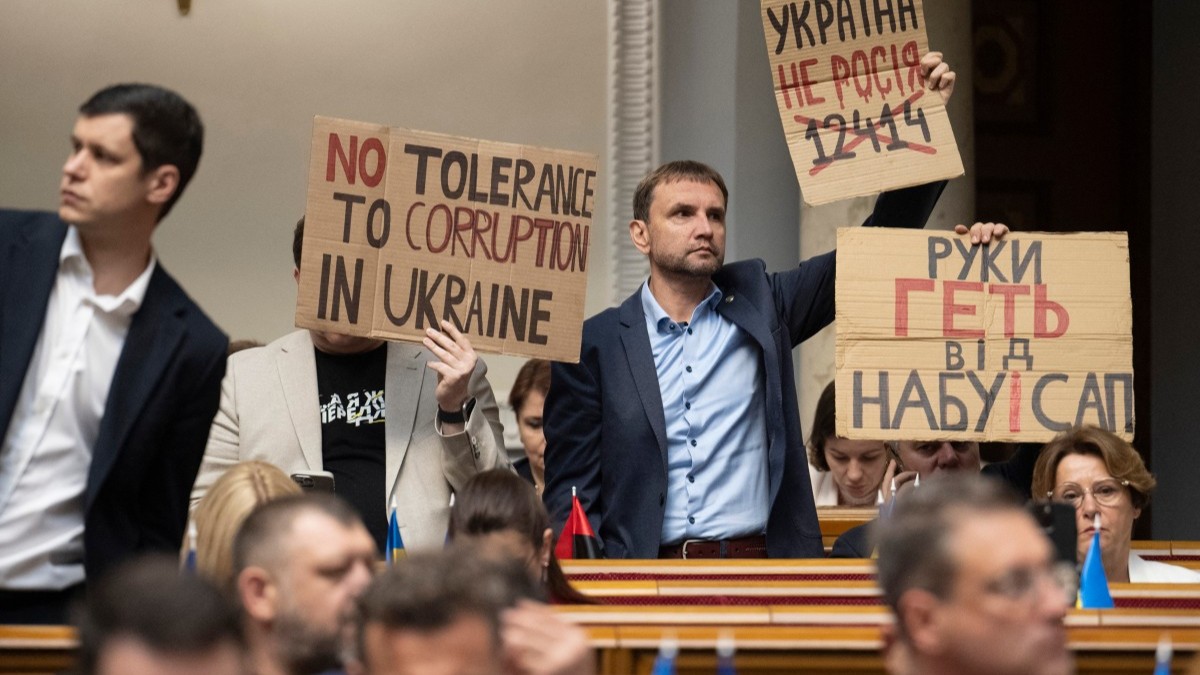
Ukrainian lawmakers protest with placards as they vote on a bill to replace a law that curbed the powers of anti-graft bodies in Kyiv on July 31, 2025.
Andrii Nesterenko / AFP
For nearly three years, the war in Ukraine has been portrayed in the West as a morally clear confrontation: a democracy under siege by an aggressor intent on erasing its sovereignty. In that context, any doubt about the use of the billions allocated to support the Ukrainian state was quickly dismissed as Russian propaganda or as an attempt to weaken the resistance. But the veil is beginning to fall.
Recent international journalistic investigations, together with reports from Ukraine’s own Court of Auditors and warnings from the European Union and the IMF, confirm what had been an open secret for years: corruption remains endemic, and President Volodymyr Zelensky’s government has tried to contain the leaks without deeply reforming a system that is overflowing on all sides.
This reality breaks out at the worst possible moment for Kyiv. Ukraine needs enormous financial flows to sustain its defense and, in the near future, to rebuild critical infrastructure destroyed by the war. But donor confidence erodes as evidence accumulates that international money circulates through an institutional ecosystem full of loopholes, political capture, and oversight bodies neutralized from within.
From the start of the invasion, the United States and, albeit feebly, the European Union as well, demanded strict control mechanisms to ensure their aid would not be lost in the margins of a state historically marked by clientelism. These controls took the form of supervisory boards composed of independent experts—in many cases foreigners—tasked with overseeing major state-owned companies in sectors such as energy, infrastructure, and defense procurement.
However, recent investigations show a systematic pattern. The state apparatus itself rendered those boards ineffective through delays, unfilled vacancies, tailor-made appointments, or statutory changes designed to strip them of real power.
The case of Energoatom, the state company responsible for nuclear energy, is paradigmatic. The formation of its supervisory board was delayed for months, and, when it was finally constituted, the government kept one seat vacant, preventing it from functioning normally. During that period, according to Ukrainian anti-corruption authorities, a scheme of bribes and illegal commissions worth around $100 million was allegedly carried out, involving figures close to the president. When the scandal erupted, the Zelensky administration attempted to place responsibility precisely on that board, even though it had been the government itself that had left it without operating capacity.
The defense sector has not escaped this governance crisis either. The military procurement agency, created in 2024 to end scandals involving inflated contracts and defective equipment, began operating without a fully formed independent board, while managing contracts worth billions. Its first director reported pressure from the Ministry of Defense to approve dubious agreements, including contracts with factories incapable of producing the promised material. After a controversy over faulty mortar rounds, the government rewrote the agency’s statutes to retake control over appointments.
In parallel, the Ukrainian Court of Auditors revealed that between January and September 2025 alone, the EU withheld €5.7 billion and the IMF blocked another $500 million due to the failure to implement committed reforms. The delays affect key areas: the failure to appoint stable and independent directors for customs and the tax service, the absence of legislative reforms allowing anti-corruption institutions to operate with full autonomy, the inability to strengthen the Anti-Corruption Court and the Anti-Corruption Prosecutor’s Office, and the persistence of legal provisions that facilitate the expiration of complex cases. The result is that major corruption cases, some opened as early as 2017, remain without final judgment and may be buried in the coming years.
The situation places the European Union before a dilemma it preferred not to confront during the war. Brussels and several European capitals privately admit that for two years they chose to prioritize political and military support over the demand for deep reforms. That tolerance helped sustain Ukraine in a critical moment, but at the cost of degrading the control and transparency standards the EU requires of any candidate country.