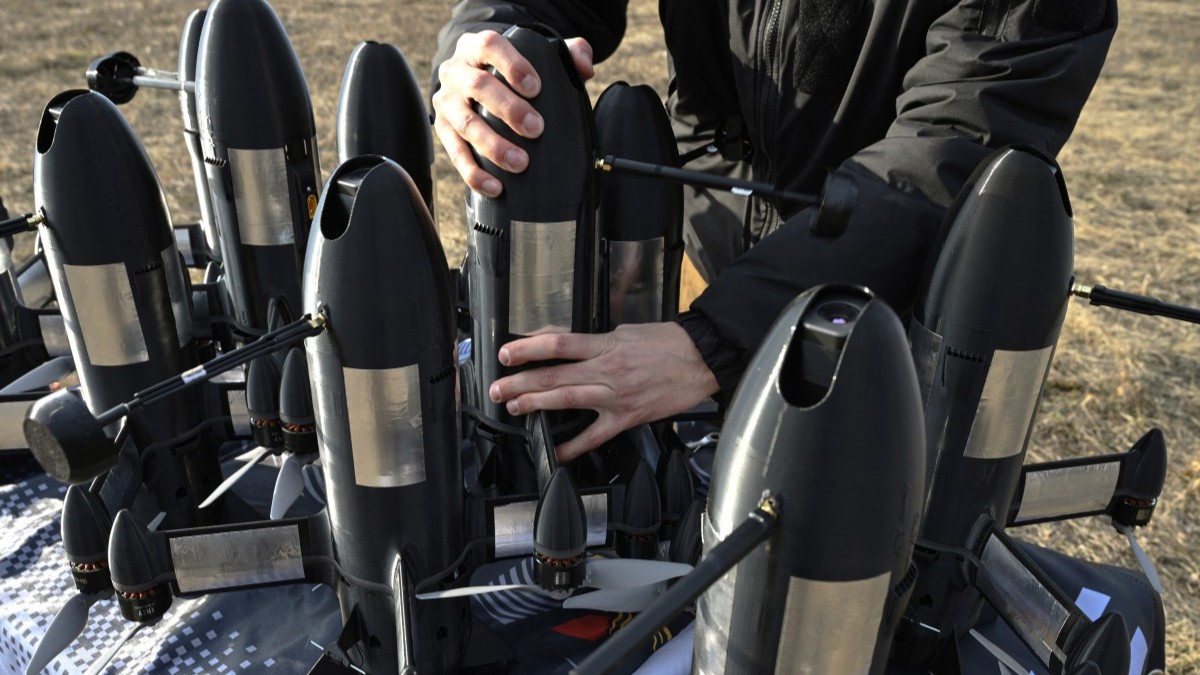
An employee of the Ukrainian SkyFall company checks a P1-Sun interceptor drone before a test flight at an undisclosed location in Ukraine on March 19, 2026.
GENYA SAVILOV / AFP
Saudi Arabia, Qatar and the United Arab Emirates are negotiating ten-year air defense agreements with Ukraine to incorporate into their systems technology and expertise developed during the war with Russia.
The goal is to strengthen their protection against Iranian drones that have struck military bases, oil facilities and airports across the Middle East.
Volodymyr Zelensky concluded his Gulf tour by presenting Ukraine no longer as a country in need of aid, but as a provider of it. Kyiv is offering training, anti-drone systems, electronic warfare and the experience accumulated after four years of confronting the Iranian Shahed drones used by Russia.
The motivation behind these agreements is obvious: to turn a war that has cost Ukraine hundreds of billions and has been largely financed by the West into an exportable industry capable of generating revenue, political influence and new allies outside Europe.
For four years, Ukraine has been the world’s main laboratory for defense against Iranian-made Shahed drones. Russia has launched tens of thousands of those aircraft against Ukrainian cities, power plants and military bases. Necessity forced Kyiv to improvise cheap and effective solutions: interceptor drones, electronic warfare, low-cost radars, warning systems and defense networks assembled with civilian components.
Now Ukraine wants to sell that experience.
The agreements signed with Saudi Arabia and Qatar, and the one that is about to be finalized with the Emirates, have a duration of ten years. They include cooperation in air defense, intelligence sharing, training and possible investments in the Ukrainian drone industry. According to Zelensky, they could be worth “billions” of dollars.
Qatar’s Ministry of Defense confirmed that the deal includes an “exchange of experience in the fight against missiles and unmanned aerial systems.” In other words, the Gulf countries want to learn from an army that has spent years confronting precisely the same Iranian drones that now threaten their refineries, airports and military bases.
It is not difficult to understand why. In recent weeks, Iranian drones have struck facilities in Saudi Arabia, buildings in Dubai and military positions in Iraq. The attack on Prince Sultan Air Base in Saudi Arabia wounded American soldiers and damaged U.S. refueling aircraft.
The Gulf monarchies still depend on Washington’s military protection but they have discovered that traditional air defense systems, designed to intercept missiles or aircraft, do not always work against swarms of cheap drones.
This is where Ukraine comes in.
Kyiv offers a much cheaper answer than the Western one. While a Patriot missile can cost several million dollars, Ukrainians have developed interceptors and electronic systems capable of shooting down drones for a tiny fraction of that price. In a war of attrition, that difference changes everything.
For Zelensky, there is also a deeper political and economic reason. Ukraine knows that its European allies can barely do more. Hungary has blocked new financial packages as long as Ukraine continues to boycott Russian energy supplies to Budapest. In several European countries, domestic pressure is growing against the cost of the war. The United States, for its part, has shifted much of its attention toward the Middle East.
That is why Kyiv is looking for new partners. Saudi Arabia, Qatar and the Emirates have money, need military technology and want to diversify their alliances. Ukraine offers them an attractive combination: real combat experience, cheap production and a willingness to share technology.
The move is smart. Ukraine is trying to stop being merely a recipient of aid and become a useful actor as well. Instead of waiting for more shipments from Europe, it is trying to turn the war itself into an exportable industry.
But this move also raises more than reasonable doubts. Much of the technology Ukraine now wants to sell has been developed thanks to billions of euros and dollars sent by the United States and the European Union.
The anti-drone systems, military innovation centers, production lines and part of the research have been made possible thanks to Western funds provided with one very specific objective: to help Ukraine resist the Russian invasion.
Now Kyiv intends to use that military and technological capital to open new markets, gain influence in the Middle East and attract foreign investment. It is legitimate for a country at war to seek to strengthen its position. But it is fair to ask to what extent Western money intended for Ukraine’s defense is ending up being turned into a tool of its own economic and geopolitical projection.
The issue is especially delicate because Ukraine continues to demand more aid. Kyiv is still asking European governments for Patriot systems, missiles, financing and ammunition. At the same time, it presents its military experience as a high-value export product. It remains to be seen whether it can have its cake and eat it too.