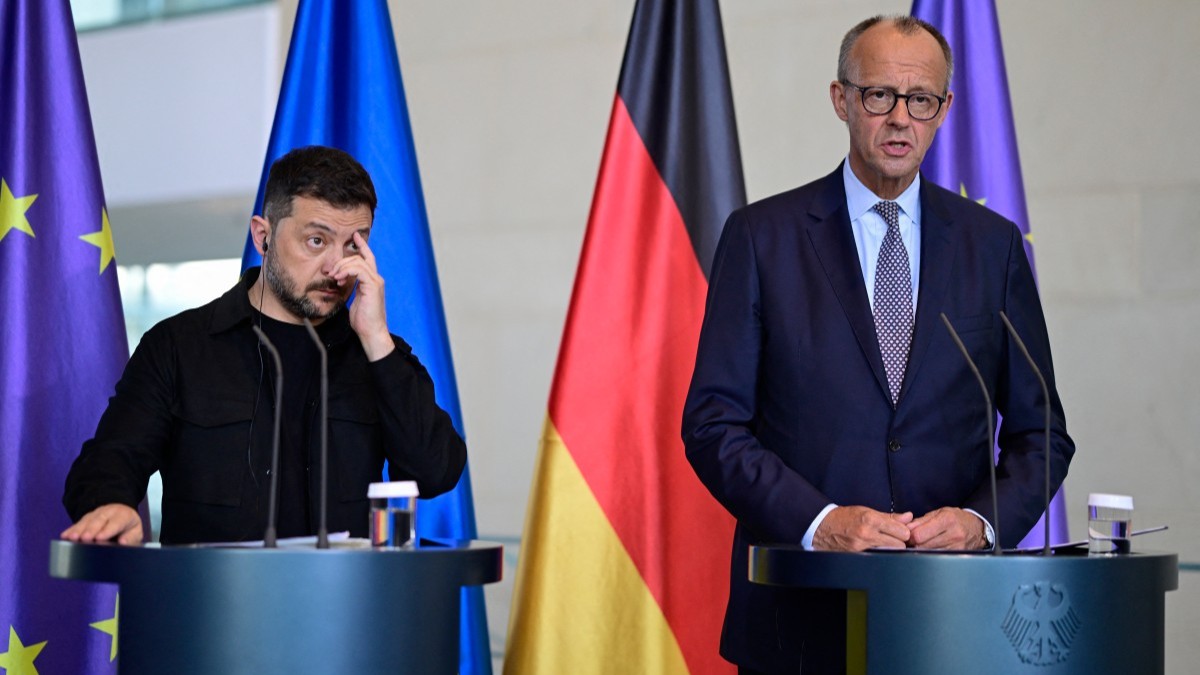
Ukrainian President Volodymyr Zelensky and German Chancellor Friedrich Merz in Berlin on August 13, 2025
John MacDougall / AFP
The winds seem to be changing as we get closer to the historic Trump-Putin summit in Alaska, slated for this Friday, August 15th, as both Kyiv and European leaders are desperately trying to avoid the two global powers deciding the fate of Ukraine above their heads.
While President Zelensky has repeatedly stated territorial concessions could never be part of any peace deal simply because the Ukrainian constitution prohibits it, it seems it’s becoming more and more obvious for every party involved that there would be no ceasefire without at least temporarily ceding the already occupied territories to Russia.
According to German Chancellor Friedrich Merz, Kyiv is now ready to discuss the possibility, lest it risks being decided without its participation. Standing next to Zelensky in Berlin on Wednesday, Merz said Ukraine was finally “prepared to negotiate on territorial issues.”
However, a legal, international recognition of the occupied territories as part of Russia was “not up for discussion,” he added. “The principle that borders must not be changed by force must be upheld,” Merz underlined.
This comes after Trump caused a meltdown in Europe by suggesting that Ukraine and Russia should consider swapping territories occupied by each other, prompting fears that Washington may try to engineer a peace against the wishes of Ukraine.
When it comes to Zelensky, it seems the president deliberately stays vague on what “territorial” negotiations would actually entail. On one hand, he cannot openly admit to considering ceding territory; on the other, there may be no other way to end the conflict.
The same applies to European leaders, who are still reluctant to admit that Kyiv has lost the war on the battlefield, as Hungarian PM Viktor Orbán commented recently. Europe must face the reality on the ground and negotiate accordingly for the sake of peace, he explained.
One of the main points that all major European and EU leaders stressed in the past few weeks is that there should be no decision about the future of Ukraine—much less about any territorial concession—during the talks between the U.S. and Russia without the presence of Kyiv.
According to French President Emmanuel Macron, Trump explicitly promised that it would not be the case during the Anchorage talks on Friday. “There are no schemes for territory swaps on the table,” Macron said after talking to Trump together with the other EU leaders.
Yet, despite the fears and warnings that no concrete steps should be taken, Europe still expects the Alaska summit to open the door for a major breakthrough soon. “There is hope for movement. There is hope for peace in Ukraine,” Merz said during the Wednesday press conference.
All the major European players—leaders of Germany, France, the UK, as well as the EU and NATO—suddenly began talking about joint transatlantic efforts to end the war, seemingly riding on the coattails of Trump, the only leader who had been willing to engage with Russia diplomatically while Europe shut all its doors to Moscow in the past three years.
According to Merz, the next steps should be jointly “increasing the pressure… if there is no movement on the Russian side in Alaska,” adding that Trump shared this position “to a very large extent.”
NATO chief Mark Rutte also stressed on X that Europe and the U.S. were “united in pushing to end this terrible war,” and that “the ball is now in Putin’s court” to see what he has to offer in Alaska.
Great call with @POTUS, @ZelenskyyUA & European leaders ahead of President Trump’s meeting with Putin in Alaska. We are united in pushing to end to this terrible war against 🇺🇦 & achieve just and lasting peace. Appreciate @realDonaldTrump leadership & close coordination with…
— Mark Rutte (@SecGenNATO) August 13, 2025