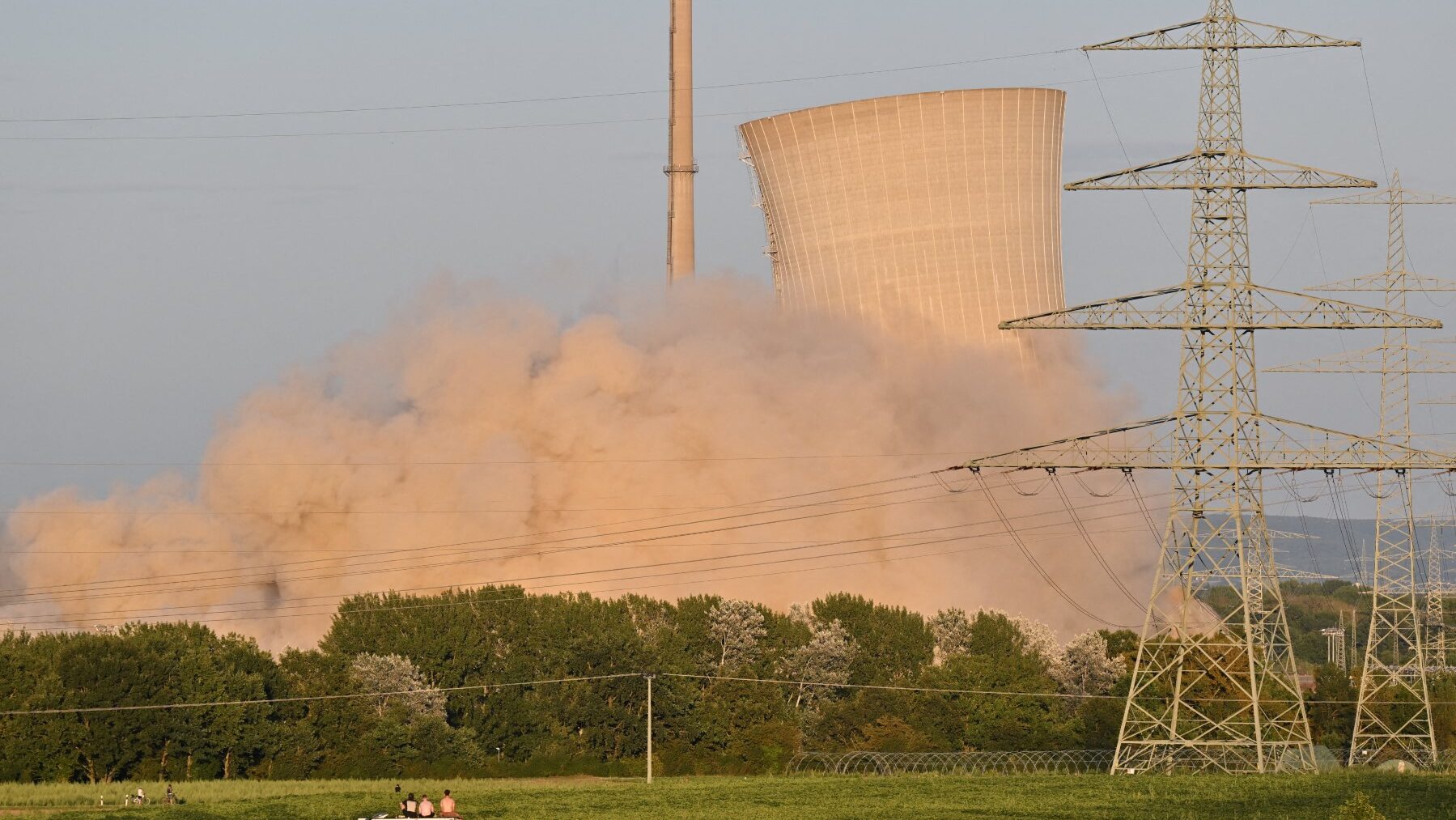
The demolition of the Graferheinfeld nuclear power plant in 2024
DANIEL PETER / AFP
European Commission president Ursula von der Leyen has admitted that Europe made a “strategic mistake” by turning away from nuclear energy—even though she supported the policies that helped push the continent in that direction.
Speaking at an international summit on civil nuclear energy in Paris on Tuesday, von der Leyen said Europe had moved away from a “reliable and affordable source of low-emission energy.”
Europe needs homegrown, low-carbon energy sources.
— Ursula von der Leyen (@vonderleyen) March 10, 2026
Nuclear & renewables together have a key role to play
Nuclear energy is available around the clock, providing electricity all year.
Europe has been a pioneer in nuclear technology.
And can lead again ↓ https://t.co/Eg7gl1548K
The remarks mark a notable shift from the political consensus that dominated Europe for much of the past decade, when nuclear power was steadily sidelined in favour of renewable energy.
They also highlight an awkward political reality.
Many of the leaders now warning about the consequences were themselves involved in the decisions that produced them.
“Europe made a strategic mistake by moving away from a reliable and affordable source of low-emission energy,” von der Leyen said.
She added that electricity prices that are “structurally too high” have become a central challenge for Europe’s economic competitiveness.
Few energy experts would dispute that diagnosis.
What stands out is who is saying it.
After the Fukushima disaster in 2011, Germany adopted one of the most radical energy decisions taken by any advanced economy: the complete phase-out of nuclear power.
The policy, widely known as the Energiewende, received overwhelming support across Germany’s political establishment.
Von der Leyen—then a member of the German government—was among those backing the move.
In other words, one of the politicians now warning that Europe made a “strategic mistake” helped support one of the decisions that most contributed to it.
Her remarks in Paris contained no explicit reflection on that earlier role.
For more than a decade, European energy policy moved away from nuclear power.
Governments instead prioritised renewable energy, pushing nuclear—once a central pillar of Europe’s electricity system—out of political debate in many countries.
The shift is visible in the numbers.
In the early 1990s, roughly one-third of the European Union’s electricity came from nuclear power. Today, the figure is closer to 15%.
Several countries—including Germany, Belgium and Spain—have closed nuclear plants or announced plans to shut them down.
Others, such as France, Finland and several states in Eastern Europe, have tried to preserve their nuclear capacity despite an increasingly hostile political environment.
The consequences became clear after 2022, when the energy crisis triggered by the war in Ukraine sent electricity prices soaring across much of the continent.
Faced with rising costs and growing dependence on external energy suppliers, the European Commission is now attempting to revive parts of Europe’s nuclear industry.
A central element of this strategy is the development of small modular reactors (SMRs), a new generation of nuclear plants designed to be smaller and potentially faster to build.
Brussels hopes the technology could become operational in Europe in the early 2030s.
To encourage private investment, the Commission has proposed a €200 million financial guarantee aimed at reducing the risks associated with innovative nuclear projects.
The funds will come from the EU’s Emissions Trading System.
Von der Leyen also argued that Europe must regain its position in the global race to develop next-generation nuclear technology.
“We have the ambition to move quickly and at scale so that Europe becomes a global hub for next-generation nuclear energy,” she said.
But Europe is no longer leading that race.
The United States, Russia and China have already spent years investing in advanced nuclear technologies and modular reactors.
While Europe debated closing plants, others focused on building new ones.
Rebuilding the industry Europe allowed to shrink will take time.
Closing nuclear plants can be done relatively quickly.
Rebuilding the expertise, supply chains and infrastructure behind them can take decades.
Europe is now trying to rebuild a sector it spent more than a decade dismantling—and many of the politicians admitting the mistake were among those who helped create it.