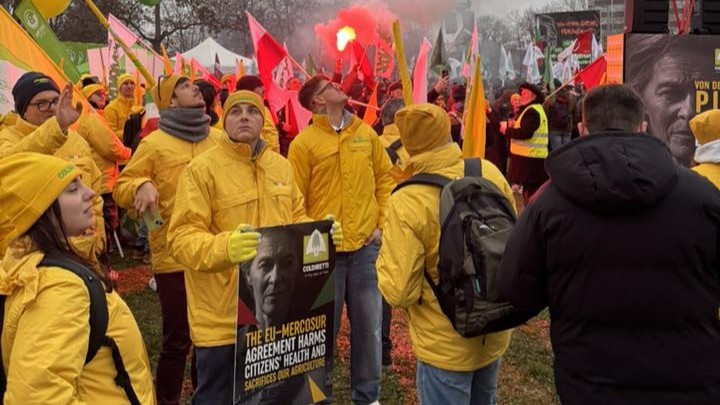
European farmers protesting against the European Commission over the Mercosur trade agreement in Strasbourg on January 20, 2026
Ahogy a Gazda látja on Facebook, January 20, 2026
Strasbourg is experiencing one of those weeks when political tension is palpable both inside and outside the hemicycle. As tractors and banners signal the mass arrival of farmers and livestock producers through Wednesday, the European Commission is facing the latest of a series of motions of censure over the conclusion of the Mercosur trade agreement. The vote on the motion is scheduled for today between noon and 2 p.m.
Everything appears to be shaking, yet the EU executive is likely to retain its position once again, without dispelling the lingering sense of strategic paralysis surrounding the Union.
The motion, tabled by the Patriots for Europe group, is the fourth faced by the Commission led by Ursula von der Leyen in just seven months. This time, however, the German president chose not to attend the debate that took place on Monday evening, delegating the political defence of the agreement to her trade commissioner, Maroš Šefčovič. For many, this gesture was interpreted as a sign of weariness and fatigue; for others, as an indication that Brussels assumes, despite the noise, nothing will ultimately change.
From the rostrum, Šefčovič justified the Mercosur deal as a necessary response to a world increasingly hostile to European trade. In a context marked by the erosion of multilateralism, the threat of new U.S. tariffs, and the fragmentation of global supply chains, the commissioner argued that the agreement sends a clear “political message”: the European Union chooses rules over force, sustainability over exploitation, and strategic partnerships over unilateralism.
The argument is not new, but it is persistent. Brussels portrays Mercosur as a historic opportunity after more than 25 years of negotiations—a geopolitical and economic lifeline in uncertain times. That narrative, however, collides head-on with the perception of large segments of Europe’s productive sectors, particularly agriculture, which view the pact as yet another concession made in the name of an asymmetric globalisation.
The core criticism underpinning the motion of censure centres on unfair competition. Opponents of the agreement warn that the influx of agricultural products from Argentina, Brazil, Uruguay, and Paraguay—produced under environmental and sanitary standards different from those of the EU—threatens the viability of thousands of European farms. Added to this is the controversy surrounding the legal basis chosen by the Commission for ratifying the agreement, seen by some groups as a shortcut designed to bypass national vetoes.
Outside Parliament, discontent has translated into direct action. Farmers and livestock producers are holding a large-scale demonstration in Strasbourg at the time of writing this article, explicitly aiming to pressure MEPs and highlight what they see as a betrayal of the real economy. The contrast could not be starker: while stability and institutional normality are invoked inside the chamber, the atmosphere on the streets is one of open confrontation.
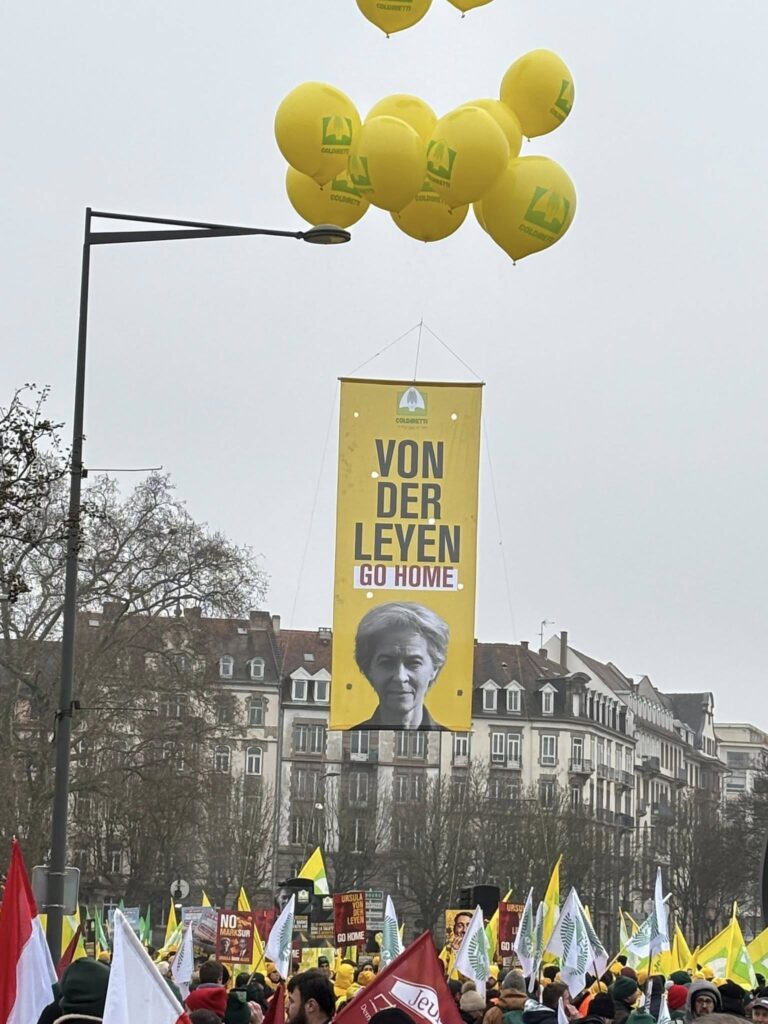
The tension is not confined to politics. Several MEPs have formally proposed requesting an opinion from the Court of Justice of the European Union on the agreement’s compatibility with the Treaties. Should this route advance, the ratification process could be blocked—or at least significantly delayed—adding a further layer of uncertainty to an already volatile dossier.
The parliamentary debate itself unfolded before a half-empty chamber, despite the fact that it was presented as an existential discussion for the future of the Commission. And the motion is bound to be rejected, as were the previous ones.
The Commission insists on projecting an image of continuity and control. Its supporters—Christian democrats, social democrats and liberals—repeat that this is no time for “self-sabotage” amid a global storm. Yet beyond the arithmetic outcome of the vote, the underlying crisis remains unchanged: a Union that reacts late, communicates poorly, and seems unable to align its geopolitical ambitions with effective protection of its strategic sectors.