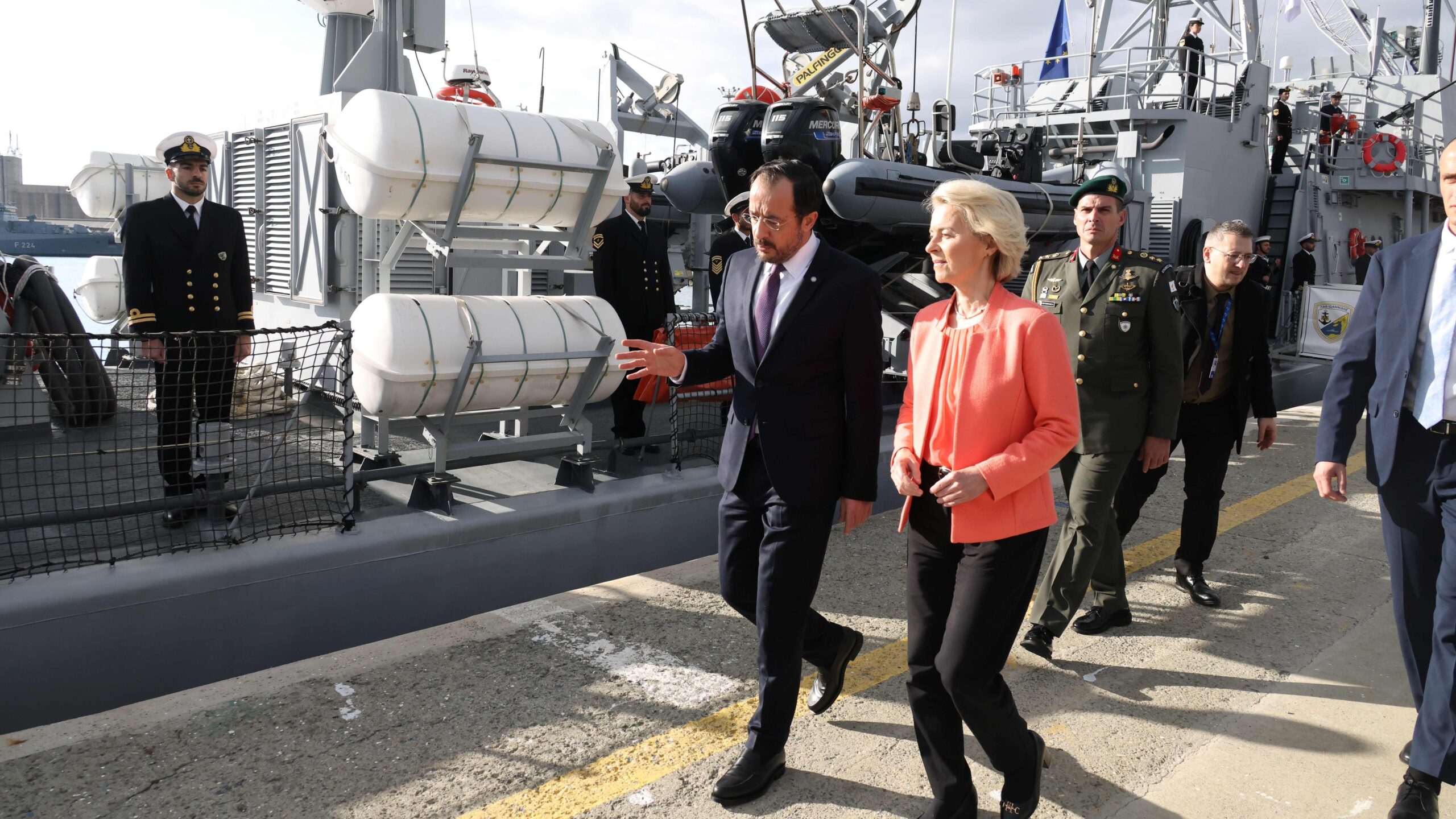
Cyprus’ President Nikos Christodoulides with European Commission President Ursula von der Leyen at the new Limassol port during the EU Commissioners’ visit to the island on January 15, 2026
@CY2026EU on X, January 15, 2026
The European Commission is preparing a new European security strategy, which, according to its president, Ursula von der Leyen, will be presented before next July. The stated aim is to provide an “appropriate response” to the geopolitical and strategic shifts reshaping Europe’s security environment.
In practice, this is yet another attempt to articulate a common vision in an area—security and defence—where the European Union has spent years accumulating documents, roadmaps, and programmes that rarely achieve full consensus or deliver immediate results.
The announcement was made during a visit by the College of Commissioners to Cyprus on Thursday. The island country, roughly one third of which is still occupied by Turkey, currently holds the rotating presidency of the Council of the European Union.
This is Europe’s independence moment. We must seize it.
— Ursula von der Leyen (@vonderleyen) January 15, 2026
By bolstering our defence.
Becoming more competitive.
Strengthening ties with partners.
And taking forward our work to combat illegal migration.
We will work closely with @CY2026EU on this ↓ https://t.co/WWUrn6Ze47
Von der Leyen stressed that the initiative remains at an early, exploratory stage and deliberately avoided defining its precise scope. “It is not prudent to explicitly limit or expand the different topics,” she said, making clear that the document is intended as a broad framework capable of encompassing responses to military threats, geostrategic tensions, and hybrid challenges.
This is neither the first nor likely the last time Brussels has announced a “new approach” to security. In recent years, the Commission has unveiled a defence white paper, a 2030 preparedness roadmap, and ambitious investment plans calling for the mobilisation of up to €800 billion to address capability gaps.
The overall record, however, remains uneven. National priorities diverge, implementation timelines vary, and many initiatives lag behind the pace of international developments.
The SAFE programme also fits into this broader context as one of the financial pillars of the EU’s current security agenda. The Commission has proposed €150 billion in loans to encourage joint defence procurement. Nineteen member states are participating in the mechanism, and eight have already received Commission approval for their allocations. Brussels is now pressing the Council to speed up approvals and enable rapid disbursement, presenting this as evidence that the Union can act more swiftly than in the past.
No time to wait! We are moving ahead with 🇪🇺defence funding for #DefenceReadiness
— Andrius Kubilius (@KubiliusA) January 15, 2026
After detailed analysis, today @EU_Commission approved 8 MSs #SAFE national plans for €38 bln of funding
Next steps: other 11 MSs plans, Council decisions, loan agreements & 15% funding release! pic.twitter.com/Ey5SXLawKr
The political backdrop is decisive for this new proposal. The war in Ukraine, growing instability along the southern flank,k and intensified competition among major powers have strengthened the argument that Europe must assume greater responsibility for its own security. Von der Leyen reiterated the need to maintain “firm and sustained” support for Kyiv, both on the battlefield and at any future negotiating table, using this rationale as a catalyst for deeper European coordination. Crises, once again, work to Brussels’ advantage.
Yet accumulated experience invites scepticism. Every new common strategy runs into the same fundamental obstacle: security remains a core element of national sovereignty. What one member state views as an existential priority may be secondary—or politically sensitive—for another. As a result, many proposals end up diluted into minimal compromises or blocked by internal disagreements.
This latest strategy thus joins a long list of initiatives aimed at giving the Union its own voice on security. The real challenge will not be diagnosing risks—now increasingly evident—but turning policy papers into operational decisions acceptable to all. Once again, Brussels promises a qualitative leap forward. The question is whether this time it will arrive in time, and with sufficient backing, to move beyond declarations of intent.