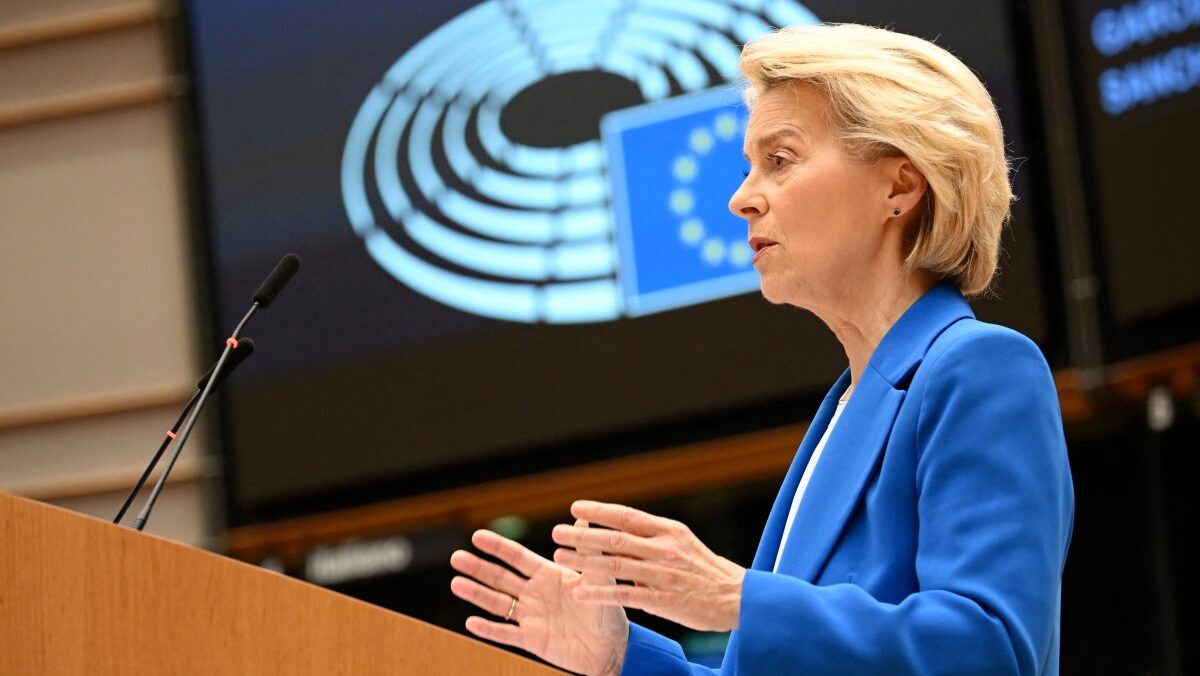
European Commission President Ursula von der Leyen delivers her speech during a debate on the new 2028-2034 Multi-annual Financial Framework at the European Parliament in Brussels on November 12, 2025.
Nicolas TUCAT / AFP
European Commission President Ursula von der Leyen, speaking before the European Parliament on Thursday, November 13th, defended a new package of options to finance Ukraine and acknowledged that the reparations loan plan based on frozen Russian assets could fail. Brussels is scrambling to keep economic and military aid to Kyiv flowing as political will and national budgets across member states begin to run dry.
“We will give a loan to Ukraine, which Ukraine will repay if Russia pays reparations,” explained von der Leyen, presenting a €140 billion scheme that, in practice, implies more debt for Ukraine and an additional financial burden for Europeans. The declared goal is to show that Europe will stand “for as long as it takes” by Kyiv’s side—even at the cost of its own solvency.
The main obstacle comes from Belgium, where the frozen Russian funds are held within the Euroclear system. Prime Minister Bart De Wever refuses to approve the project without full legal guarantees and an equitable distribution of risks among member states. “If the money leaves my country and something goes wrong, I cannot and will not pay €140 billion,” he warned bluntly.
Europe has so much potential. We have to unleash it.
— Ursula von der Leyen (@vonderleyen) November 13, 2025
We’re launching Choose Europe and the Scale-up Fund.
Advancing the Savings and Investment Union.
And proposing the 28th legal regime for innovative companies.
This is vital. This is urgent ↓ https://t.co/4D1GmQTvBZ
The Belgian veto reflects the growing discontent in several European capitals toward a Commission that insists on further indebting the Union. While some northern countries oppose assuming joint liabilities, von der Leyen proposes a “plan B” that includes issuing EU-backed debt supported by the common budget or bilateral loans at the national level.
The new formulas do not change the core of the problem: any future aid translates into more debt and a greater loss of economic autonomy for Ukraine. The repayments would depend on hypothetical war reparations from Moscow—an uncertain and politically unfeasible condition.
“A lasting peace requires a strong and independent Ukraine,” stated von der Leyen. However, the very measures promoted by Brussels point in the opposite direction. Ukraine is increasingly sustained by European funds, dependent on external decisions, and left with no room to rebuild its economy independently.
The tone of von der Leyen’s speech confirms the Commission’s political obsession with the eastern conflict, even in the face of clear evidence of social and budgetary fatigue within Europe. Brussels continues to present aid to Kyiv as a moral duty, although reality shows a continent increasingly divided and with fewer resources to address its own internal crises.
The decision by President Donald Trump to suspend U.S. aid to Ukraine has left the EU alone in facing the financial challenge. Von der Leyen assured that Europe will cover Kyiv’s needs during 2026 and 2027, but she did not explain how those commitments will be funded.
Von der Leyen’s final message—“Europe will stand with Ukraine for as long as it takes”—sounds more like an ideological declaration than a realistic plan. As energy prices, inflation, and industrial decline hit European families, the Commission doubles down on a war with no clear horizon and a model of permanent indebtedness.
Brussels’ rhetoric no longer speaks of solidarity but of endurance. And the more it insists on sustaining Ukraine, the more it exposes the economic and political fragility of the European project itself.