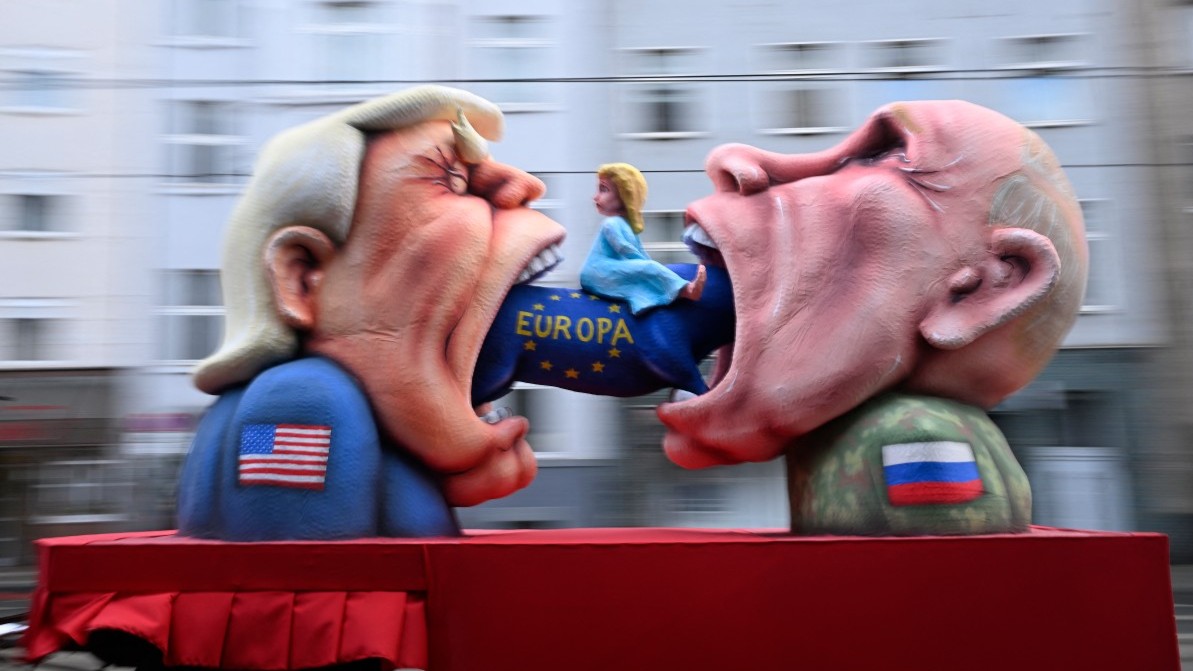
A carnival float designed by German carnival float builder Jacques Tilly features U.S. President Donald Trump (L) and Russian President Vladimir Putin devouring the European Union during the parade to celebrate Rose Monday (Rosenmontag), on February 16, 2026 in Düsseldorf, Germany.
INA FASSBENDER / AFP
The U.S. administration has temporarily authorized the sale and delivery of Russian oil cargoes that were already in transit, in a move aimed at avoiding a new energy shock caused by the war against Iran and the rise in crude prices.
The decision, presented by Washington as a limited and technical waiver, allows for several weeks the completion of operations that had been blocked by the sanctions regime, with the objective of stabilizing the international market and containing the economic impact on the United States and its allies.
Although the permit has a limited scope, the gesture carries strong political significance. For the first time since the tightening of sanctions after the Ukraine war, the White House has openly admitted that, under certain circumstances, Russian oil becomes necessary again for the balance of the global energy system.
The measure comes at a moment of high volatility in the markets, with disruptions in key supply routes and Brent prices above the levels many Western economies can sustain without risking inflation and slowdown. And that means “panic” in political terms.
The U.S. decision inevitably reopens the debate over the strategy the European Union adopted in 2022 to reduce its energy dependence on Russia to a minimum.
After the start of the war, Brussels presented decoupling not only as a strategic objective but also as a moral one.
The reduction of Russian gas and oil imports became one of the pillars of the European response, accompanied by accelerated energy transition plans, diversification of suppliers, and increasingly broad sanctions.
Within a few months, the EU drastically reduced direct imports of oil and gas from Russia, which before the war accounted for roughly 40% of the gas consumed in Europe and about 25% of its oil.
However, from the beginning many experts warned that a complete break with one of the world’s largest hydrocarbon exporters would be extremely difficult to sustain over time. And, moreover, an economic suicide.
The international energy system is interdependent, and removing Russia from the equation does not mean its production disappears, but rather that it changes destination.
Over the last two years, Russian crude has continued to reach the global market through Asia, intermediaries, or refined products, while Europe absorbed higher prices and greater exposure to external crises.
For all the messages launched against Russia, the reality is that its energy kept flowing one way or another.
After Washington’s decision, the difference in approach between the United States and the European Union becomes evident once again.
For the White House, sanctions are a flexible political tool. They are tightened when convenient and relaxed when economic stability requires it. The priority is to avoid excessive domestic damage, even if that means revising previous decisions.
In Europe, by contrast, energy decoupling became a political commitment difficult to qualify. European governments assumed high economic costs to reduce dependence on Russia, and now have less room to correct course without admitting that part of that strategy was based on overly optimistic assumptions.
European industry has faced higher energy prices than its competitors, inflation has been more persistent, and supply security has increasingly depended on external factors, from liquefied natural gas to stability in the Middle East.
While Washington can afford tactical adjustments, Brussels finds itself trapped between the need for pragmatism and the weight of its own narrative.