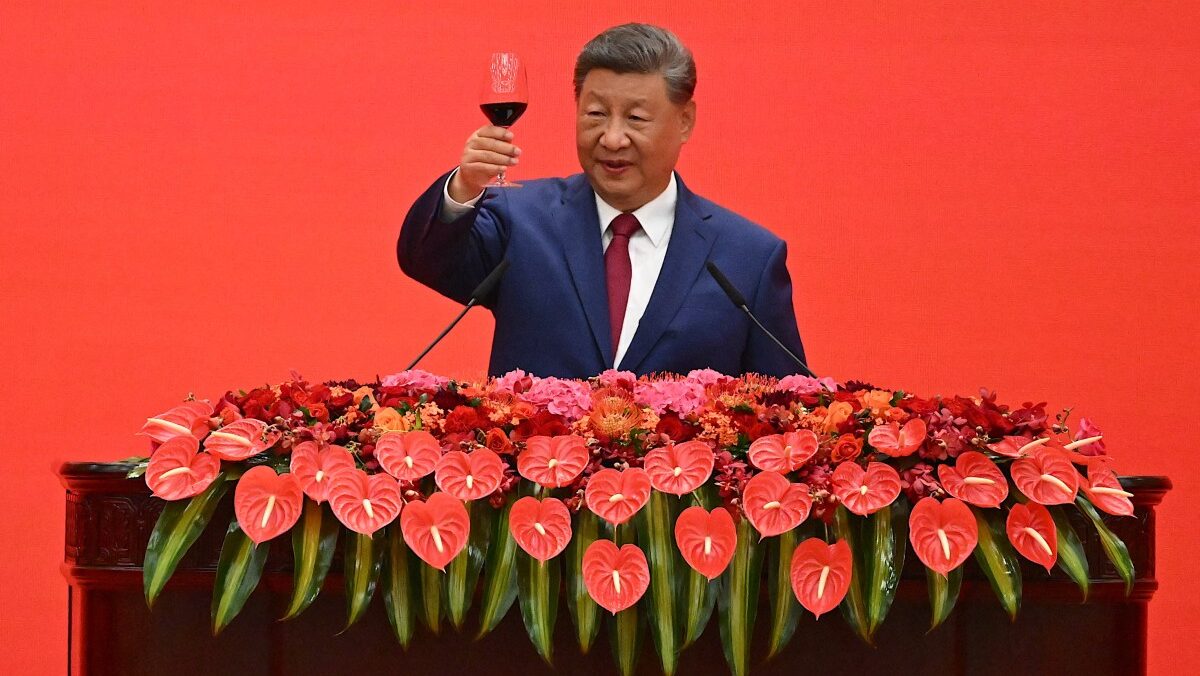
China’s President Xi Jinping gives a toast at a reception in the Great Hall of the People, following a military parade marking the 80th anniversary of victory over Japan and the end of World War II, in Beijing on September 3, 2025.
Jade Gao / AFP
A transatlantic group of conservative thinkers, diplomats, and policy leaders has warned that Europe and the wider Western Hemisphere risk becoming strategically dependent on China unless coordinated action is taken.
The warning comes from the Havel Dialogue, a network led by The Heritage Foundation, that brings together conservative figures from both sides of the Atlantic. Inspired by Václav Havel’s 1994 address on the moral foundation of civilization, the group has met since 2018 to discuss political, cultural, and security issues facing the West, regularly warning about China’s growing influence.
In their latest declaration, the signatories stress that Beijing’s economic and political activities are already eroding sovereignty and weakening democratic resilience in Europe and beyond. “There is no problem with normal economic engagement with China or any other country,” the statement said, “but we must not allow Beijing’s growing presence to foster instability, threaten security, or erode our cherished democratic norms.”
The group noted that Chinese trade with Europe skyrocketed from $92 billion in 2000 to over $676 billion in 2024, making Beijing a key economic partner for many EU states. It cited strategic risks such as port acquisitions, telecommunications contracts, and electric car factories that give Beijing leverage. One example is Hutchison Port Holdings’ stake in Poland’s Gdynia port, which in 2024 was used to block the unloading of U.S. Army equipment—an incident the group said had direct military implications.
The statement also warns of Beijing’s diplomatic tactics, including silencing criticism of human rights abuses, sanctioning European lawmakers, and deepening its ‘no-limits’ partnership with Moscow as Russia wages war in Ukraine.
To counter these threats, the Havel Dialogue urged the transatlantic community and its partners to reduce trade and investment dependencies on China and to uphold four clear principles—the “Four NOs”:
The signatories—ranging from former diplomats and think tank fellows to conservative leaders in North America and Europe—urged policymakers not to underestimate the risks. “China is exploiting the actual needs of countries in the community that are not being filled by other partners,” the statement says. “We must ensure Beijing does not turn these vulnerabilities into permanent dependencies.”