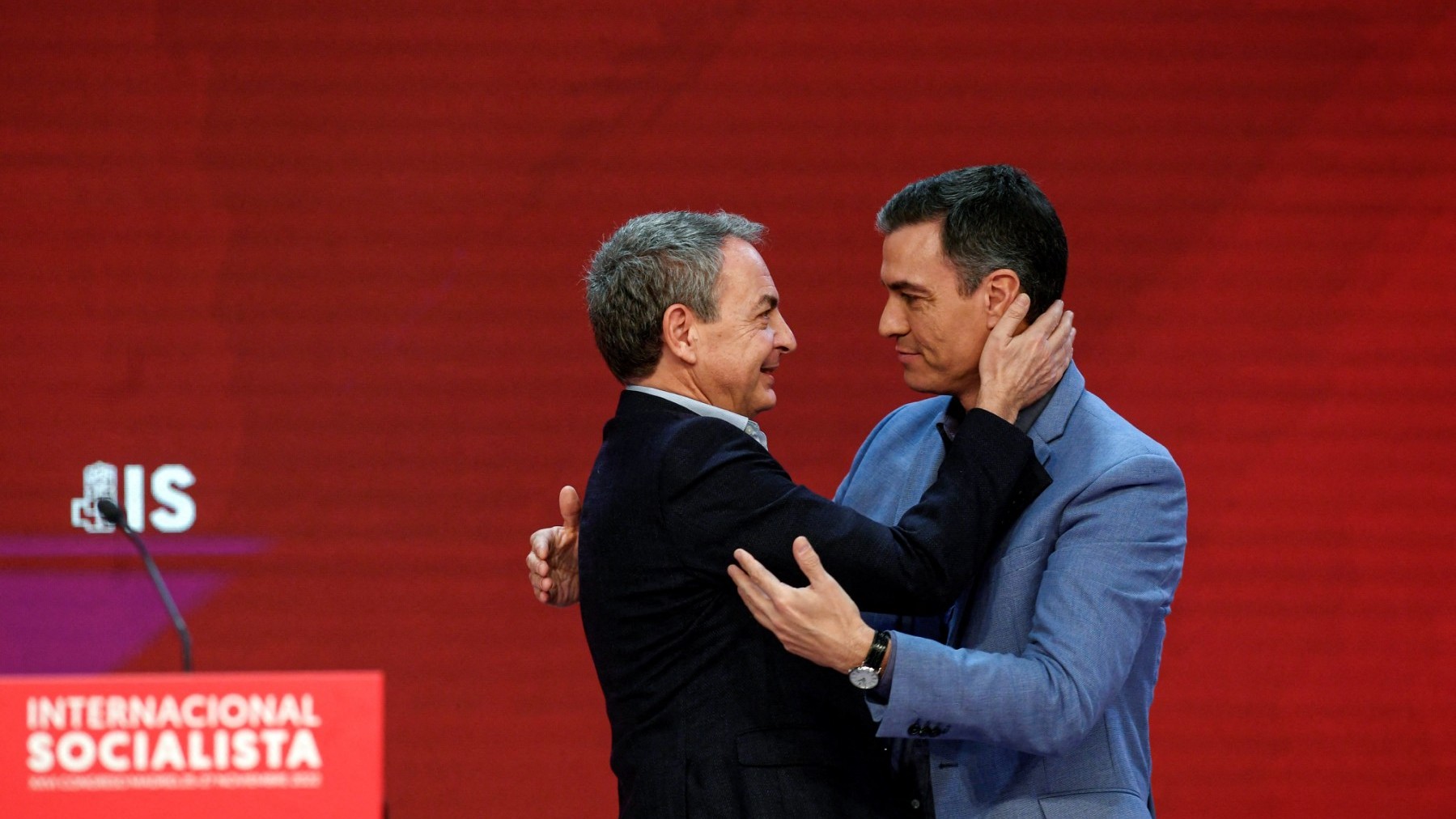
Spanish Prime Minister Pedro Sánchez (R) embraces former Spanish Prime Minister José Luis Rodríguez Zapatero during the 26th Socialist International Congress in Madrid on November 27, 2022.
Óscar del Pozo / AFP
Former Spanish Prime Minister José Luis Rodríguez Zapatero has become an increasingly uncomfortable figure for Washington as Venezuela enters a new phase following the capture of Nicolás Maduro by the United States. Diplomatic sources agree that the U.S. administration is closely reviewing the role Zapatero has played in recent years as a political intermediary for Chavismo, particularly in its dealings with Europe and with the Spanish government.
That scrutiny coincides with the swearing-in of Delcy Rodríguez as acting president of Venezuela. Rodríguez took the oath of office on Monday before the National Assembly, after doing so on Sunday before the Supreme Court, formally assuming the head of state’s duties in a transition process explicitly overseen by the United States.
President Donald Trump publicly warned Rodríguez that she must “do the right thing” and cooperate with the roadmap laid out by Washington, or face consequences “probably greater” than those imposed on Maduro.
Despite this pressure, Delcy Rodríguez maintained a discourse of chavista continuity during her inauguration. She referred to Maduro as the “constitutional president” and denounced what she described as an “illegitimate military aggression” against Venezuela. At the same time, in a prior statement, she called on the United States to work “jointly” on an agenda of cooperation—an ambiguity that reflects the narrow room for manoeuvre facing the new interim executive.
Zapatero’s figure re-emerges in this context as a key—and controversial—element in relations between Caracas and Madrid. For more than a decade, the former Socialist leader has acted as chavismo’s preferred mediator, promoting dialogue initiatives and keeping channels open with the regime even during periods of severe international isolation. From Washington’s perspective, this parallel diplomacy, tolerated in earlier phases, is now an element to be reassessed in a transition the United States intends to manage directly.
Adding to this is Delcy Rodríguez’s own track record with Spain. Her close relationship with sectors of Spanish socialism remains overshadowed by the January 2020 episode in which she entered Spanish territory despite being banned from the Schengen area. The so-called Barajas suitcases affair, never fully clarified, became a symbol of the opaque relationship between Pedro Sánchez’s government and the chavista regime, and is once again gaining relevance in the current scenario.
From Washington, officials stress that the interim president has already established direct contact with the U.S. administration. According to the White House, Rodríguez held a lengthy conversation with Secretary of State Marco Rubio, during which she expressed her willingness to cooperate with the transition process. Trump, however, has made it clear that cooperation is not optional and that any attempt to delay or distort the process will carry personal consequences.
In Spain, the Venezuelan crisis has reopened a deep political divide. The government has condemned U.S. actions as a violation of international law, while the Popular Party has welcomed Maduro’s capture and warned that Delcy Rodríguez represents continuity with the chavista system. In this clash of positions, Zapatero’s role once again moves to the centre of public debate.
Venezuela’s transition is therefore unfolding under a double lens: that of Washington, determined to steer the process, and that of Europe, forced to re-examine its own past policies and mediations. In this new balance, Zapatero’s figure—until now shielded by diplomatic ambiguity—faces growing scrutiny at a decisive moment for Venezuela’s political future and for relations between Caracas, Madrid, and Washington.