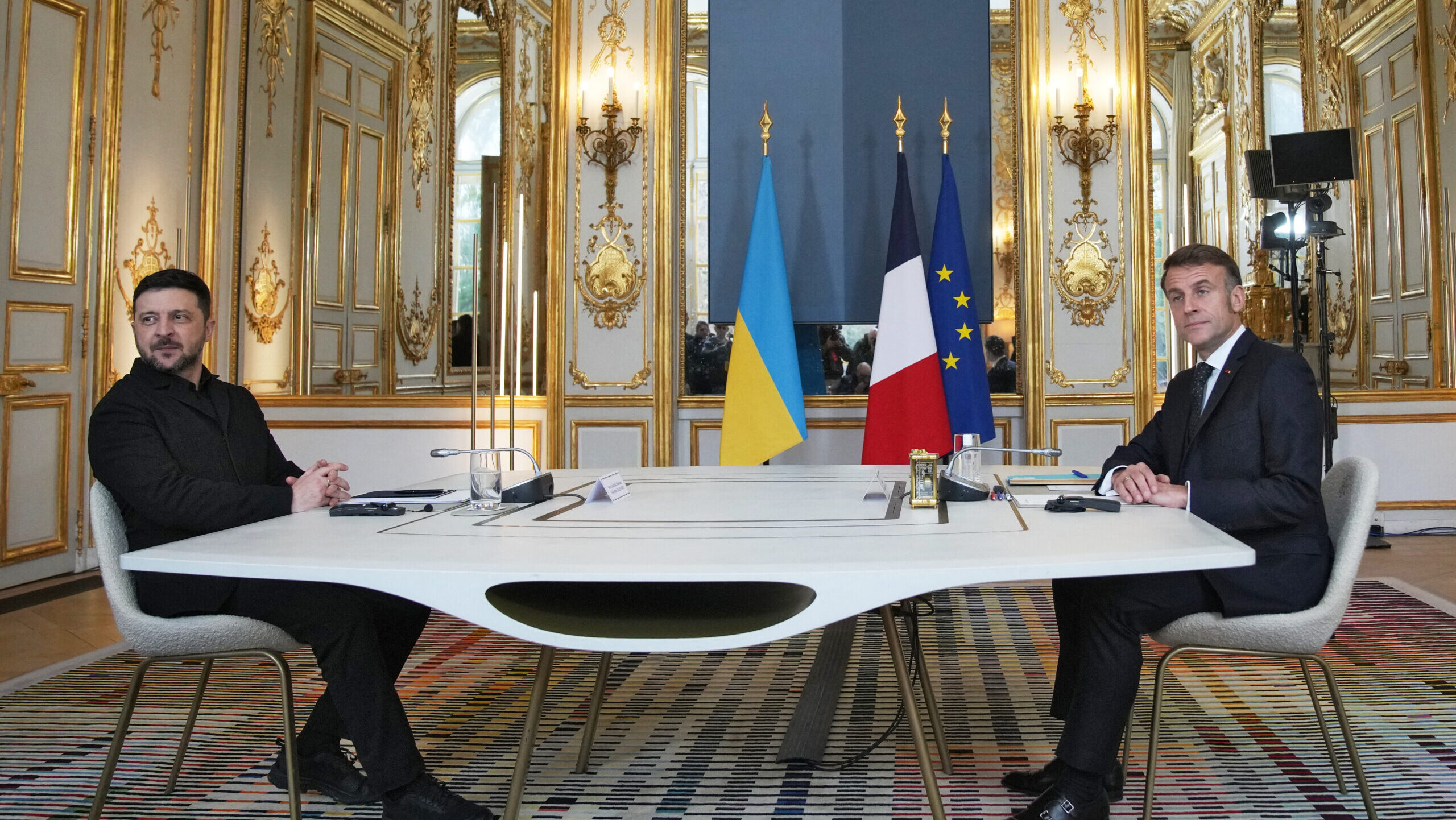
Emmanuel Macron and Volodymyr Zelensky
Photo by POOL / AFP
Volodymyr Zelensky visited Paris on Monday to meet his French counterpart Emmanuel Macron and talk with other European leaders, no doubt boosting the Brussels establishment’s ego about its supposed role in bringing the Ukraine war to an end.
Even the New York Times oversold the discussions, saying that Zelensky had “turn[ed] to Europe.”
In reality, the Ukrainian president appeared to spend much of the afternoon relaying everything that Washington has achieved in recent weeks, since Donald Trump—seemingly inspired by Hungary’s Viktor Orbán—really started pushing for peace talks.
Posting from Paris, Zelensky reported that he and Macron, as well as UK prime minister Keir Starmer, were briefed on “the Ukraine-U.S. delegations’ meeting in Florida” on Sunday.
Earlier in the day, Zelensky reported on his conversation with the president of Finland, Alexander Stubb, during which he similarly discussed “our delegation’s work yesterday in the United States,” where “everything was very constructive.”
Europe will have featured more prominently in Zelensky’s discussion with Macron about post-war “security guarantees,” although much of the talk on this is unlikely ever to become a reality.
It is worth noting here that Zelensky himself believes “only” the U.S. and, in particular, President Donald Trump, “have sufficient power to make this war come to an end.”
That’s no doubt in part because, despite some positive signals emerging from recent U.S.-Russia talks, the European Union continues to argue that—as top Brussels diplomat Kaja Kallas put it on Monday—Russia does not want peace. The bloc only says that “we need to make Ukraine as strong as possible,” meaning it wants the war to end not at the negotiation table but on the battlefield.
This week could be pivotal for diplomacy.
— Kaja Kallas (@kajakallas) December 1, 2025
It is clear that Russia does not want peace, and therefore we need to make Ukraine as strong as possible.
My doorstep ahead of today’s Foreign Affairs Council on Defence ↓ pic.twitter.com/SzWnYJy4iw
Similarly, Europe’s establishment leaders made it clear that they were unhappy about Orbán visiting Moscow for talks last week, even though—in the words of Hungarian foreign minister Péter Szijjártó—Budapest follows “a sovereign foreign policy and our decisions are determined by our national interest. Whether they like it in Brussels or not.”