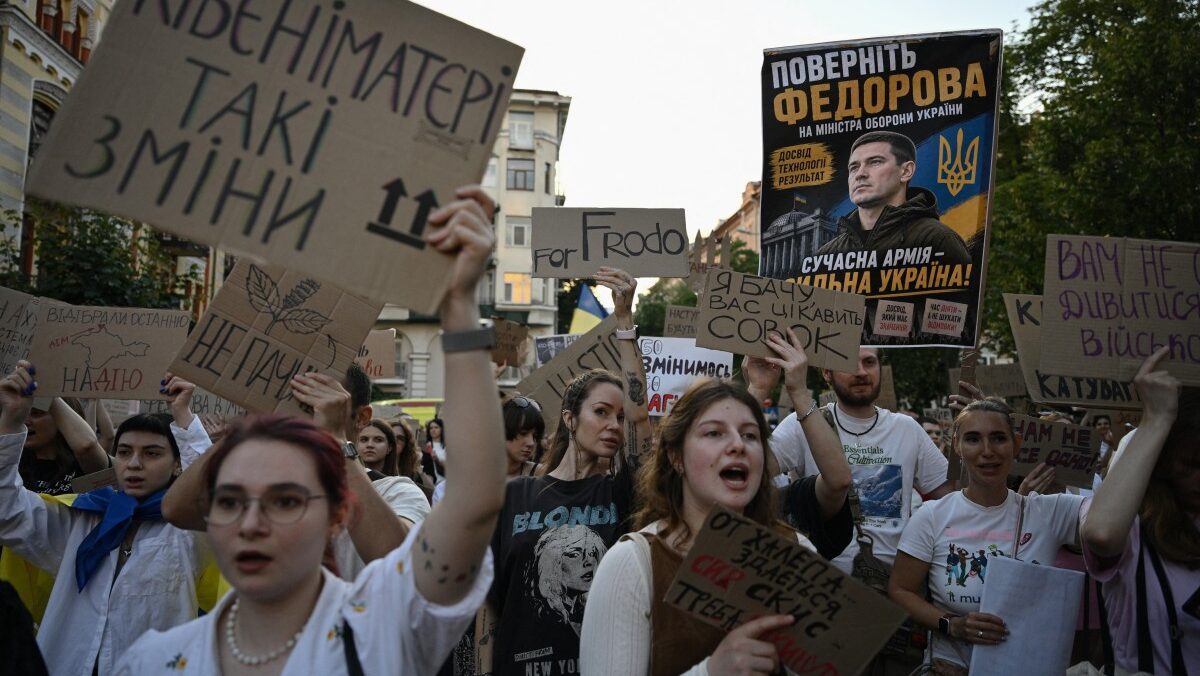
Ukrainian President Volodymyr Zelensky is facing mounting political pressure after days of nationwide protests over the dismissal of Defence Minister Mykhailo Fedorov.
Thousands of people have taken to the streets in Kyiv and at least sixteen other cities since July 16, marking the largest anti-government demonstrations in Ukraine since Russia’s invasion in 2022.
The protests have continued despite martial law, reflecting growing public frustration over the country’s military leadership at a critical stage of the war.
Thirty-five-year-old Fedorov, who served as defence minister for just six months, built a reputation as a reformer focused on military modernisation, defence technology, and drone warfare.
His sudden dismissal last week, announced as part of a wider government reshuffle, came without an official explanation. However, reports indicate that a long-running conflict with Commander-in-Chief Oleksandr Syrskyi over military strategy and command culture lay behind the decision.
In response to the escalating crisis, Zelensky spent the weekend and Monday holding a series of meetings with senior military commanders widely viewed as potential successors to Syrskyi—among them representatives of a younger generation of officers whose careers have been shaped by the war against Russia.
According to media reports, the president also held lengthy talks with Fedorov and offered him several senior government positions focused on defence innovation and military technology. However, sources familiar with the discussions say the former minister rejected those proposals, insisting he would only return as defence minister.
The protest movement has adopted two clear demands: Fedorov’s reinstatement and Syrskyi’s dismissal. Veteran Dmytro Koziatynskyi, one of the organisers, has warned that demonstrators will launch an indefinite nationwide protest unless both demands are met by Friday, July 24.
Criticism of Syrskyi has intensified in recent months. Soldiers, veterans, and civil society groups accuse the officer of relying on a rigid Soviet-style command structure, excessive centralisation, and tactics that have resulted in heavy casualties.
Supporters of leadership change argue that Ukraine needs commanders better suited to modern warfare, particularly the growing importance of drones and decentralised battlefield decision-making.
During his brief tenure, Fedorov had also begun preparing reforms aimed at making military service more attractive, including fixed-term contracts, improved pay, and changes to the heavily criticised mobilisation system.
The country faces a growing shortage of manpower after more than four years of full-scale war. Reports of aggressive conscription tactics have become increasingly common, with videos circulating on social media showing military recruitment officers forcibly detaining men in public.
The practice known as “busification,” whereby draft-age men are forcibly rounded up and taken away in minibuses, is another source of public discontent.
Ukraine’s Human Rights Commissioner has recorded thousands of complaints alleging abuse, unlawful detention, and excessive use of force, while police have also reported a sharp rise in attacks against recruitment officers.
“These officers are hunting for people on the streets and sometimes using quite violent methods,” opposition MP Oleksandr Honcharenko told the BBC.
“When they need an extra 5,000 men, they start grabbing them—and if they refuse it turns into fights on the street,” says military analyst Ivan Stupak.