Pheladi Shai from Pixabay
Freya India: GIRLS®: Generation Z and the Commodification of Everything. Henry Holt and Co., 2026
“My generation grew up parented by a generation who were very liberal, very suspicious of being controlled by religion or social norms or traditional morality,” 26-year-old Freya India told me in a Zoom interview. “We forgot that we are human and we need something to follow. We want to know what’s normal. You have a maybe well-intentioned liberal movement that wants to be skeptical of any kind of authority, any kind of societal boundaries.”
“What you did to young people was say: Well, you need to set your own boundaries. You need to put up your own walls and make up your own morality—which is very hard to do. The only authority left is the market, companies, and industries.” That, in short, is the subject of her new must-read book, published on February 26.
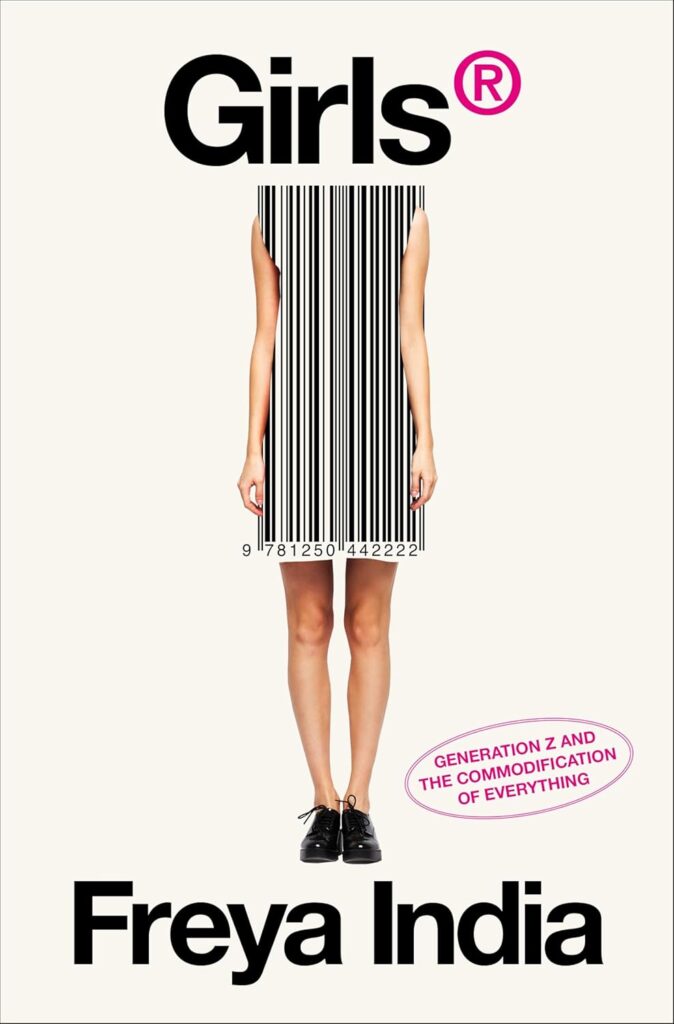
“We were the first generation to learn to flirt on Instagram, to try to find teenage love by swiping,” India writes in the introduction to GIRLS®: Generation Z and the Commodification of Everything. “We were the first to have our faces and bodies ranked and reviewed on social media before we even reached puberty, the first to document our adolescence for an online audience. Our problems were painfully familiar and yet agonisingly different. I realised that the same adults telling me this was nothing new had no advice to give.”
India made a name for herself as an eloquent and insightful writer with a Substack newsletter of over 50,000 subscribers. With the publication of GIRLS, she has established herself as one of the leading voices of her generation. Unlike previous books dealing with the impact of social media by scholars like Jonathan Haidt, GIRLS is a memoir that combines research and analysis with India’s own lived experiences.
India covers the multiplying mental health crises, the rise of social media, eating disorders, the online commodification of every aspect of life and experience. “Over the past 15 years, my generation has not only been broken but reassembled into something consumable, sellable, inanimate,” she writes. Suicide and self-harm rates have spiked, as have eating disorders and depression. There is also the near omnipresence of pornography: about 73% of surveyed teens, she writes, have watched it.
“There are of course many reasons Gen Z is having less sex,” India writes. “But one possibility is this: we are too busy watching strangers have it instead. By the time we were teenagers, girls my age had already grown up seeing women strangled, spat on, and degraded. We learned all we knew about intimacy from what we had been raised on and become addicted to, often since we were pre-teens. Everything we knew about sex came from porn.”
I have been writing about the impact of pornography on relationships and culture for more than a decade, and India’s work on this subject is a must-read for anyone who wants to understand Generation Z, the collapse of relationships, and the growing gender divide. If you do not understand the “porn world,” you don’t understand what life is like for Gen Z. Pornography is the invisible hand behind much of culture. Ubiquitous pornography has driven the sexualization of everything in the online market, from cooking videos to fitness TikToks to personal social media profiles.
“Many of us felt as though we were constantly competing for attention with porn stars, sexualized influencers, and even AI-generated women who would never say no,” India writes. “By the late 2010s, it felt completely unrealistic to expect a boyfriend who wasn’t raised on online porn, didn’t follow half-naked influencers on Instagram, and wouldn’t want you to send him nudes.”
Porn has also made sex more dangerous, with a BBC survey of UK men aged 18 to 39 finding that 71% had “slapped, choked, gagged, or spat on their partner.” This is now normal, and girls are expected to live with it. “As I got older, when I was in my early teen years, that’s when I started to notice what I’ve called ‘gaslighting’ about porn,” India told me in a Zoom interview.
Essentially, if you are a girl or a young woman who has issues with porn or wouldn’t want a partner to watch it or be addicted to it, then you have an insecurity. If you have some instinct about it, that’s yours to deal with it. The main narrative I remember growing up wasn’t so much that porn was complained about or even celebrated that much. It was just taken as this inevitable part of life. It was only as I got older and I actually started to spend time with conservatives and Christians that I ever really heard an opposing perspective on it.
How can we expect a generation that’s been exposed to pornography before puberty, before they’ve held a boy’s hand, before they’ve gone on a date, to be great spouses? To know how to love one another and to know how to commit? To view women not as objects, and to view men not just as monsters?
Pornography shapes both sides of the online discourse. As India observes, there are the women who condemn all men; on the other hand, there are the men who crudely insist that all modern women are essentially prostitutes. Both sides are porn-brained, although this cultural driver is rarely cited or explored. Even many of the extreme ‘trad’ narratives online are remarkably pornographic, a fantasy about silent women who look and act a certain way—objects to be acted upon by men, without minds or wills of their own.
“Some young people are going on their first date at maybe 18, which could be almost a decade after watching violent, hardcore porn,” India said. Her advice to young women is to both listen to their instincts while also trying to be less risk averse. This may seem contradictory, but it is not. Girls who have been socialized to be accepting and ‘nice’ should recognize their own agency and get assertive about their own well-being, especially in a culture where intimacy and sex are defined by Pornhub.
“Young women go into a relationship and they think, If my partner’s addicted to porn, that’s completely their decision,” India said.
They’re free to make their own choices, I can’t impose anything on them. Because we’ve been told we all occupy our own moral universe and you can’t affect anyone else’s. You have girls who have this crippling anxiety, paranoia, and insecurity in relationships, but they’re also being told at the same time, you should not be controlling, you should not be jealous. And also being told that, you know, a strong woman never feels jealous, you know, she doesn’t care.
The kind of ultimate independent woman isn’t bothered if her partner watches porn because she doesn’t get worried. She’s confident enough. I think we really lost something, where we’ve told girls and young women to just basically see their moral instincts as insecurities.
Many right-wing influencers have taken to arguing online that modern women have unrealistically high standards. The reality is that women and girls struggle to find men that meet one very basic standard: He does not look at pornography online and will not cheat on them by watching porn. Many women accept this. As India points out, a key problem in the dating culture today is that many young women have standards that are too low rather than too high.
“I was hoping to get this across in the book: not to be a strong, independent woman who doesn’t need anybody; who doesn’t feel insecure, but to be strong enough to say, ‘no, I have a conviction about this and I can back it up and, and I’m leaving if you can’t live up to it,’” India told me.
It isn’t just porn. In India’s view, the gender discourse has been affected by the sexual revolution in more ways than one.
“Children are being overwhelmed by the opinions of adults that they can consume online,” she said. “You have hardcore pornography, and also the thoughts of really wounded adults, divorcees who have been scarred by relationships. That’s being served up to a 13-year-old’s algorithm. My generation was infantilised, but also forced to grow up really, really quickly: being exposed to seeing strangers having sex from a really young age and exposed to the kind of pessimism and jaded attitudes of the most hurt people online.”
Unlike most books on these subjects, India does not attempt to lay out a policy framework for fixing everything.
“I always find that with books about social media, where they lay it out and it’s so horrific and then you get to the end and it’s like: Put your phone on gray scale and limit your screen time,” she told me. “It’s just so anti-climactic. It was really important to me that I was not someone lecturing young women, saying: This is exactly how you solve it. These are the things I’ve done to be perfect. I felt like it would contradict everything I’ve written in the book. I think if I was 18 and I read a book that was telling me what to do, it wouldn’t be persuasive to me. I was focused on being persuasive.”
India also detailed the loss of religion and community. I asked India how she would describe her own religious beliefs.
“I didn’t grow up religious at all,” she replied. “People have said to me: Oh, you didn’t go to church often? No, I didn’t meet a Christian until I was in my twenties; at least, someone I was close to. It was just not part of my life at all. I also didn’t have a political family, so I didn’t get into it through politics. It was genuinely such a strong feeling of loneliness, anxiety and, as I say in the book, a feeling that I just couldn’t cope and that I needed something to hold onto that was solid.”
My parents divorced, and I feel like that really gave me a sense of no foundation to step off from or to depend on, and I had that feeling all through university and growing up. It was only when lockdown started and I had time to think about it that I realized that there has got to be something else. At the time, I was depending on all these sorts of therapy advice and meditation and affirmations and all this stuff I talk about in the book that kindof helps but doesn’t really fill that void.
I guess now I’m at the start of being more curious about it. Honestly, all of the things that would give me really bad anxiety turned out to be all the things that Christians were talking about. I was anxious about pornography, for example, and I was anxious about all of these trends in modern life that there seem to be a whole worldview about. I think it’s Chesterton that talks about having instincts, and then you find out there’s this whole ancient religion that has answers to it.
Interestingly, India’s experience sounds remarkably similar to that of Louise Perry, who noted in an interview recently that she found herself concluding that Christianity is “sociologically true” while researching her 2022 book The Case Against the Sexual Revolution. India, however, is practicing what she preaches and is careful about providing public details about a profoundly private journey.
“I’m right at the beginning of that, but I’m also in a strange position where I’m cautious of that becoming its own personal brand and then becoming a product, a person who’s like, ‘I’m the Christian conservative, or I’m this,’” she said. “I talk in the book constantly about the pressure on young people to figure things out really quickly and then label it, package, and present it. I keep a lot of it to myself, but I guess how I would describe it is just a newfound curiosity.”
Freya India, like millions of her generation, was exposed to hardcore pornography before she was exposed to Christianity. Like millions of others, she grew up in a culture that offered her everything but her civilizational inheritance. GIRLS is a must-read for those who want to understand her generation—and how the experiment is unfolding.