Suicidal Empathy: Dying to Be Kind, Broadside Books, Jun 18, 2026
In the Austro-Hungarian writer Stefan Zweig’s 1939 novel Beware of Pity (Ungeduld des Herzens), one could closely follow the psychological turmoil raging within the soul of Lieutenant Hofmiller after he asks the host’s daughter for a dance at a social gathering, completely unaware that she is paralyzed. What follows is the lieutenant’s Walk to Canossa, a primary lesson of which is understanding the different types of pity. Through the lieutenant, Zweig demonstrates that pity can be, on the one hand, active, rational, and genuinely helpful. On the other hand, it can be weak, sentimental, and selfish: not truly concerned with saving the other person, but with quickly appeasing one’s own conscience and avoiding the discomfort of confrontation. This sort of virtue signaling, devoid of rationality, ultimately drives both the victim and the benefactor to ruin.
Our age has hardly changed, as we currently live in the cult of empathy, which relates to the second type of pity depicted by Zweig. I recall from my own experience, even during my university times, that it was repeatedly emphasized: if you are not empathetic, you cannot be a good teacher since you must put yourself in the child’s shoes. This is undeniably true but just to a rational extent. Nowadays you cannot even be a corporate executive without empathy, as its absence is said to harm workplace well-being and increase organizational turnover. In fact, even the police are now expected to be empathetic since, according to contemporary progressive narratives, a person exhibiting unlawful behavior is often merely a victim of social circumstances like ‘systemic, white supremacist oppression.’
However, this is one of the greatest fallacies of our time. Empathy is an individual, personal virtue, not a prescriptive behavioral norm—not a universal metric that dictates at all costs how you ought to be. Elevated from the micro to the macro level and made the exclusive basis of state and institutional decision-making, boundless empathy has a self-destructive effect; this is the thesis argued by Gad Saad in his latest book, Suicidal Empathy: Dying to Be Kind.
The parasitic mind saga
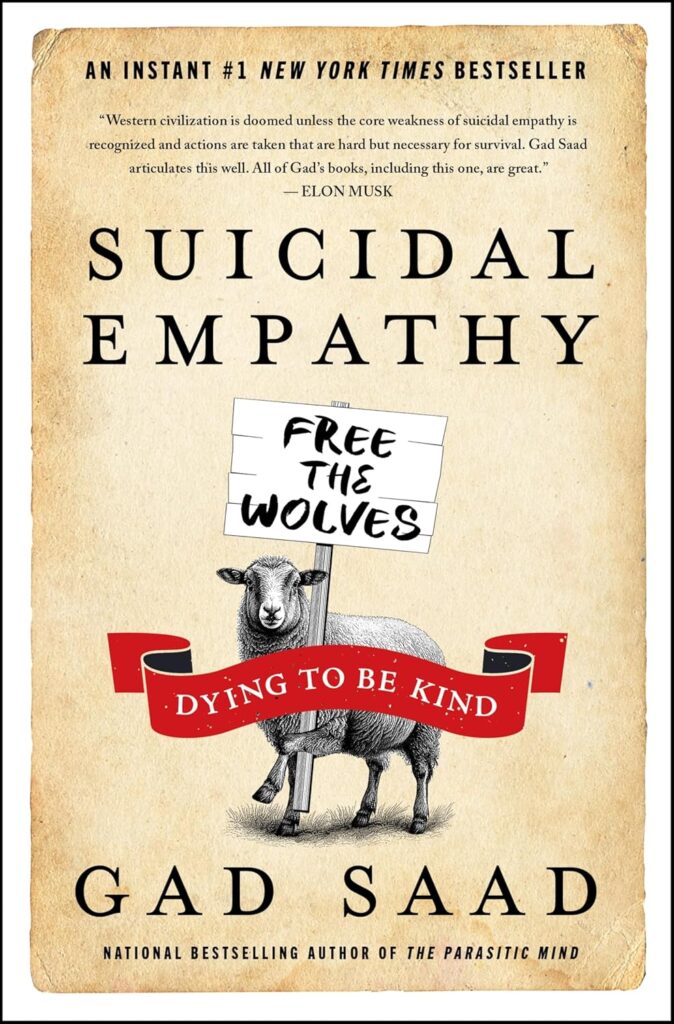
Dr. Saad’s “new volume” fits perfectly with his previous bestseller, The Parasitic Mind; indeed, the foundational premises laid out there continuously echo throughout this work. Suicidal Empathy is a presentation of one of the most severe practical consequences of parasitic ideologies infecting Western institutions and universities. Once society’s intellectual immune system has been dismantled by these mind viruses (such as postmodernism or victimhood culture), and perceived victimhood has been established as the ultimate moral currency, the infected ‘host’ is forced to react with self-destructive empathy.
The ultimate price of this process is the banishment of facts and science. Evolutionary reality and the laws of group dynamics are now routinely sacrificed on the altar of ideological sensitivity. The book brilliantly demonstrates how modern institutions of power (e.g., authorities, media) and academia coerce individuals into denying their own rational experiences and basic biological defense mechanisms simply to appear empathetic and socially acceptable.
After reading the lines above, the reader might justifiably feel that Saad’s book fits perfectly into the classic Spenglerian school of thought regarding the decline of the West. The formula and its outcome seem ostensibly predetermined: the West is bad, it will perish, and there is no solution. Regarding its diagnosis, the book naturally fits into this intellectual framework. However, its analytical toolkit for the problem differs significantly from interpretations that attempt to explain the crisis of Western civilization through economic, demographic, or geopolitical terminology. As an evolutionary psychologist, Saad approaches the issue from the perspective of political psychology, making a provocative yet logically deduced claim: in modern Western societies, empathy has become detached from rationality, transforming from an engine of social cohesion into an instrument of civilizational self-liquidation.
Empathy as a political weapon
It is a fundamental premise of evolutionary psychology that empathy is an adaptive mechanism. Its evolutionary purpose was to ensure the survival of the immediate community, the family, and the tribe—an emotional web that guaranteed interdependence. According to Saad, emotions help us solve grand evolutionary problems. A crucial element of this key to survival is relying on our emotions appropriately for the given situation. This is true for both positive and negative emotions, as either can mislead us under certain circumstances. Because empathy sits on the positive scale, applying it at the wrong time, in the wrong place, and to the wrong degree leads to confusion—or, in the language of psychology, to emotional dysregulation and deception.
Today’s political narratives weaponize empathy. Anyone who appeals to reason, sustainability, or the long-term interests of the community—as opposed to the perceived or real grievances of a momentary victim group—is immediately discredited morally. Thus, empathy ceases to be a virtue and becomes a tool for ideological blackmail. The author then uses specific American examples to demonstrate how all this manifests in contemporary political communication. Saad points out the systemic suppression: rational opinions that do not subordinate themselves to mandatory empathy are now routinely labeled as the work of ‘disinformants’ by the mainstream. Furthermore, the very label of being ‘unempathetic’ has been forged into an independent weapon, becoming one of the most effective tools of social and political stigmatization.
The book catalogues the absurd situations where reality is entirely overridden by virtue signaling. It fits into this distorted framework when severely obese people are hammered with the idea that fatness is beautiful and that fat folds are healthy—all merely to avoid hurting their feelings. The same self-destructive approach prevails when unconditional understanding is demanded toward demographics that pose a danger to society: according to the mainstream, we must be empathetic toward the homeless who make public spaces unliveable or even toward home-invading criminals. If the perpetrator is a person of color born into a supposedly ‘white oppressive environment,’ empathy kicks in, as this person is already considered penalized by society, meaning their law-breaking behavior can instantly be relativized.
The limits of biological determinism
Although the book sometimes uses psychological terms in places and assumes some basic knowledge of psychology, it is distinctly readable and highly accessible to a broader audience. While this naturalistic focus is highly effective for his argument, it steps away from a core foundation of classical thought: the transcendent moral order. If we reject self-destructive empathy solely on the grounds that it is not evolutionarily profitable, we risk losing sight of the spiritual dimension of the Judeo-Christian value system that has long secured the balance of Western civilization—a profound aspect that simply falls outside the scope of the analysis. Nevertheless, this does not diminish the book’s merit in the slightest; it is an exceptional and necessary work exactly as it is.
A way out of self-destruction
Despite all this, at the end of the book, Dr. Saad formulates practical and intellectual guidelines for defending against ‘suicidal empathy.’ He warns us to resist immediate moral self-rewarding—the “empathy dopamine hit”—and not to let isolated, tear-jerking cases blind us to statistical and biological reality. In our decision-making, we must always account for macro-level societal consequences, avoid the false equality bias, and demand reciprocity—otherwise, we become victims of one-sided, parasitic relationships. Empathy is not a universal entitlement: we must choose its targets wisely, rejecting conflict-avoidant, comfortable fence-sitting.
In conclusion, Suicidal Empathy is a ruthless but desperately needed wake-up call for the Western world. It does not call upon us to become callous, but rather to ensure that empathy—this inherently noble human trait—is once again guided by reason and facts. As Saad indisputably summarizes in his concluding remarks, adaptive empathy is a noble virtue, but suicidal empathy is fatal. On both a societal and institutional level, we must find the courage to set boundaries against pathological virtue signaling, for mere good intentions alone do not absolve us from catastrophic consequences.