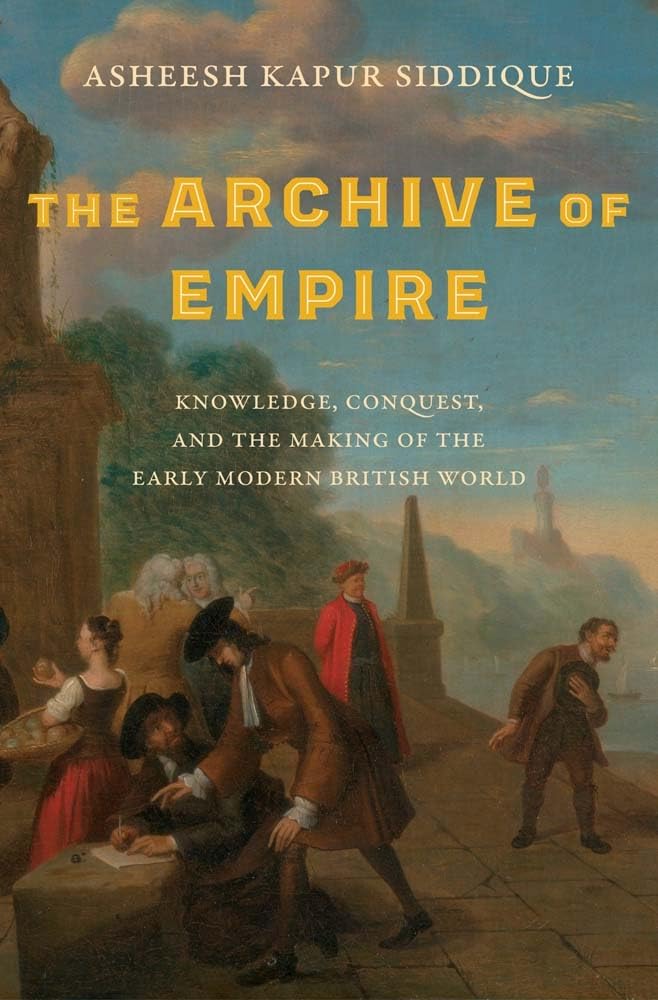
Asheesh Kapur Siddique. The Archive of Empire: Knowledge, Conquest, and the Making of the Early Modern British World. New Haven: Yale University Press, 2024.
Among both the right and the left and the right, there is a common (semi-) conspiratorial narrative. As lamented in works such as Joel Kotkin’s The Coming of Neo Feudalism, Yanis Varoufakis’s Techno Feudalism, and Shoshanna Zuboff’s The Age of Surveillance Capitalism, the world is entering into a period in which all artificial intelligence will manage a mass of deracinated, heavily medicated slaves whose entire lives will be tracked and recorded. Such an idea, once the work of science fiction, now appears to be an increasing reality. At the same time, opponents of this view argue that contemporary bureaucracy is so inefficient and incompetent, and technology seems to increasingly function worse and worse. Artificial Intelligence, moreover, is simultaneously near magically powerful as well as incompetent, and, quite frankly, dumb.
However, the growth of the state, which, oddly, used to be critiqued but is now celebrated by the Left, has been increasing for some time. Moreover, the archiving of information, which, again, was once documented and critiqued by left-wing figures such as Michel Foucault, Alain Badiou, and Giorgio Agamden, is something that has been a perennial part of human government, long before AI, but especially began to increase in the Early Modern era. In his recent work, The Archive of Empire: Knowledge, Conquest, and the Making of the Early Modern British World, University of Massachusetts historian Asheesh Kapur Siddique presents a chronicle of the formation of the early British Empire, paying special attention to how the British utilized archival bureaucracy to manage populations.
Siddique begins his work with the recognition that our contemporary digital and soon-to-be AI-dominated world is one in which information is used to govern and corral the population. Increasingly multiethnic societies are united not by a shared culture, history, or religion but by their data and consumer identity. He identifies the British Empire as the organization that most adeptly handled the problem of administering a large and diverse population since the fall of Rome.
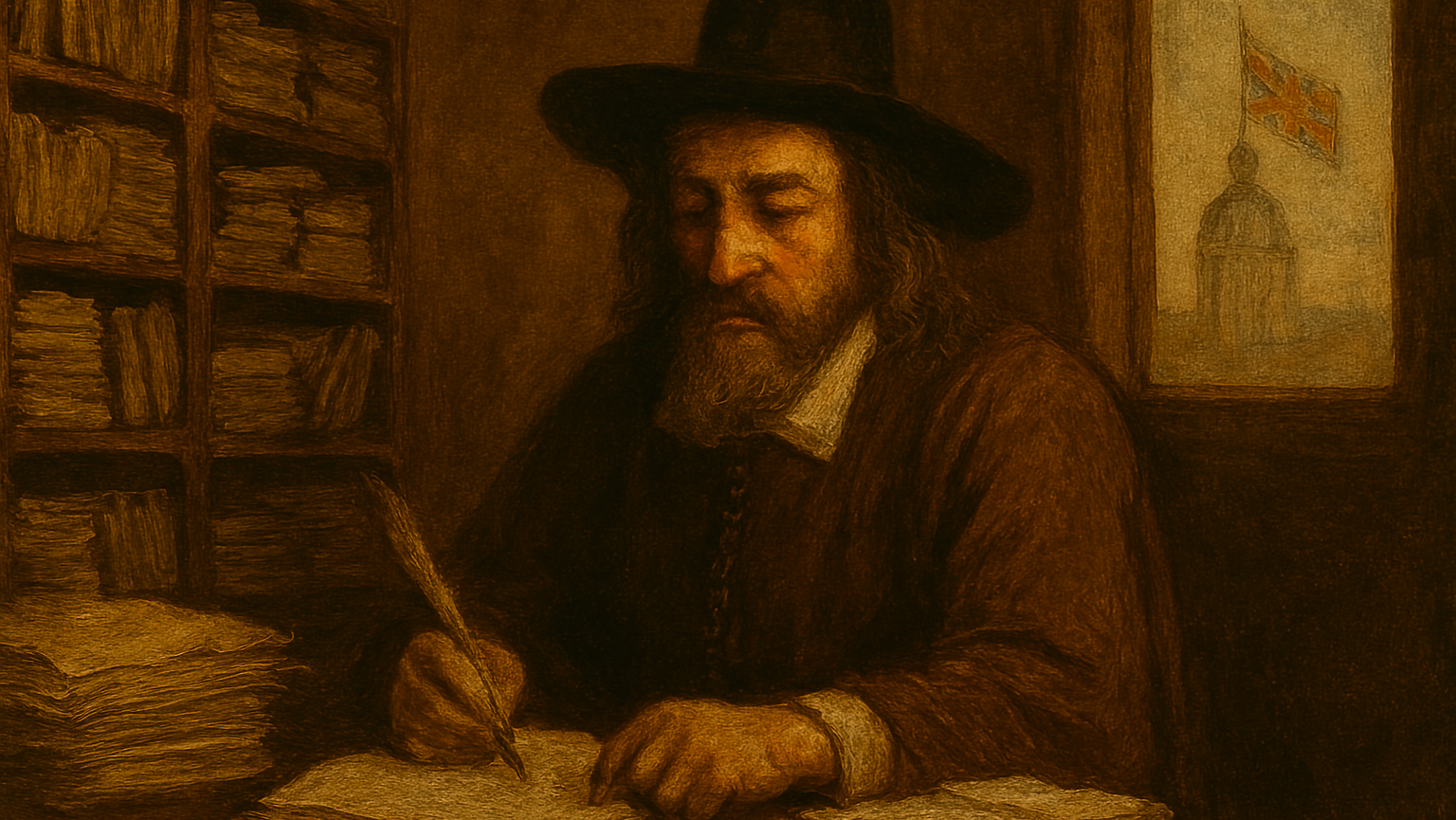
Beginning in the 17th century, paper administration helped the British track and manage population throughout the New World and Asia. Even as early as the Elizabethan period—a time best known for the earthy magical plays of Shakespeare as well as the religious tension of the Reformation—England was developing as an information state. While Siddique’s work is not a hard-edged post-colonial attack on Great Britain, he does point out that in the administrative state, it is difficult to discern the “voices” of those who were colonized. Moreover, Siddique notes that this administrative state tended to dehumanize those who were invaded or trafficked as slaves. This is a point with which conservative readers could very well agree; indeed, there is a strong strand of libertarianism that views bureaucracy as essentially dehumanizing. Nonetheless, those who administered the state thought of themselves as holding an “office” (from the Latin officium), and this office had attendant duties. As Siddique suggests, Cicero’s De Officiis with its stoic notion of duty was the moral basis of the Early Modern administrative state.
Siddique identifies the 1690s as the point at which the British Empire (a term originally coined by the curious Elizabethan magus John Dee) tightened its administrative structure. Records became the basis of authority even for post facto decisions. Physical documents became the basis of political power. Siddique interestingly notes that the British Empire eventually began to use the language of subject peoples in their administrative records. This is especially noteworthy because of the contemporary debate in the West about the use of the language of immigrants in bureaucratic administration. As much as the use of non-Western languages in the West is a mark of demographic change, it also is a sign of the governments adapting to manage new populations.
The author notes that in the 19th century, the increasing prominence of liberal ideas suggested that administrators were also beholden to the people in addition to the sovereign. The increasingly liberalized administrative state thus eroded the power of the sovereign and increased power for the citizens who were able to gain access to administrative information. Siddique tells the curious story of the British historian Patrick Fraser Tytler complaining to Lord John Russell about how difficult it was to access state records. “Literary men,” Tytler noted, should have access to information. There further was an article in Gentleman’s Magazine in 1851 that likewise argued for greater access to state records. Over time, the arcanum imperii fell as government records became more accessible. Moreover, the science of political economy developed as ‘data’ and ‘authentic documents’ became accessible to researchers. In our own day, this access to information has only increased with the internet. Siddique humorously points out that the term ‘bureaucracy’ was originally used as an insult in France of the 1790s, to refer to government overreach. It was again used as a critique of the Napoleonic government of the 19th century in which the state significantly grew in power.
Our own contemporary political milieu is increasingly marked by both left- and right-wing politics that identify as ‘post-liberal. In this post-liberal environment, the constitution, the congress, and common law precedent (and perhaps even the moral order itself) must be sidestepped for the sake of political and even moral ends. It is Machiavelli, not Aquinas, who is the dominant political mind of the 2020s. Moreover, due to the internet, AI, and the culture of surveillance (whether corporate or statist), the power of the information state is greater than it ever has been. There thus seems to be a deadly recipe for totalitarianism. At the same time, our own time is marked by technological malfunction and human and AI incompetence. While some areas of technology are in ascendency, others are stagnating. Our future thus might become very much like the world of the Blade Runner series in which the state is brutally efficient and exercises tremendous technological power, yet, at the same time, is marked by dysfunction and decay. Whether or not such a future is what is in store for the world, we know that the information state has been with us a while and that, regardless of its power, humans will continue to live and thrive.