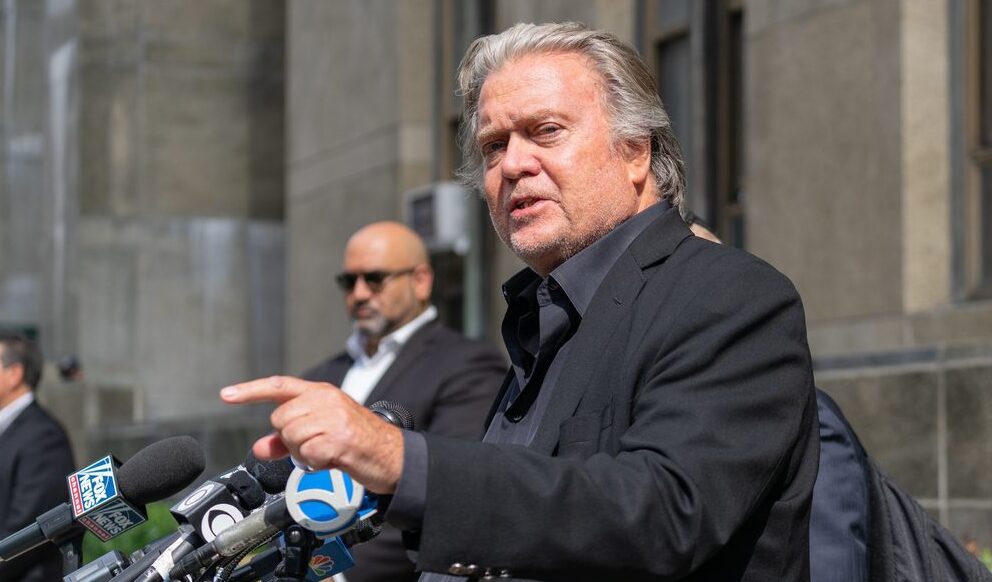
The two sides of the divided West: European Commission President Ursula von der Leyen and U.S. President Donald Trump
euconedit
Mathieu Bock-Côté, Les Deux Occidents Paris, Presses de la Cité, 2025.

Conservatives from the Anglosphere may not be familiar with Mathieu Bock-Côté, the Québec phenomenon who has taken over the French media in the last ten years, becoming a columnist at Le Figaro as well as a commentator on CNews, France’s most popular news channel. Straight from Montreal, this sociologist has established himself as one of the most prolific and cultured conservative thinkers in the French-speaking world, criticizing multiculturalism, political correctness, and wokeness well ahead of the curve.
Some of his insights might come from his peculiar position, having a foot both in Europe and in North America, which allowed Bock-Côté to perceive political trends before most commentators. In his newest book, Les Deux Occidents, he diagnoses the fracturing of the Western world into two distinct blocs, in light of Donald Trump’s 2024 victory and the European elites’ furious reaction. “Two radically different interpretations of democracy are now clashing, as in the days of the two Germanys, or more broadly, during the Cold War, when the Western world was divided between two interpretations of its vocation: liberal democracy and communism.”
In examining “the shock between the rebellion and the Empire that strikes back,” Mathieu Bock-Côté takes inspiration from thinkers such as Jeremy Rifkin (The European Dream, Tarcher, 2004) or John Fonte (Sovereignty of Submission, Encounter, 2011), who also saw a rift between a conservative America and a progressive Europe. However, he describes it not as a plea for one side over the other, but as a change of era that poses a vital threat to the future of Western civilization.
In his view, the 2024 election has been a true political earthquake, signalling the definitive end of the political cycle initiated in 1989. After populists were pushed to the side for thirty years as troublemakers and remains of a bygone era, they now take power in the heart of the Western empire, Washington, D.C. A blatant rejection of progressive elites by an exasperated population, Donald Trump’s second term has had the effect of permanently fracturing the Western bloc. First, because of the visceral horror he inspires in the governments of allied countries, but also because of his aggressive geopolitical America First approach, which clearly demonstrates that the United States is no longer seeking allies, but vassals. As this rift grows, the idea of a unified West is no more.
In the European Union, although populism is rising in most if not all countries, technocratic and liberal progressive parties remain firmly in control, even radicalizing in opposition to Trump’s America. In a brilliant dissection of the political “extreme center,” Bock-Côté shows that liberal technocracy is as much of a threat to freedom as the woke mob. Convinced as it is to defend ‘reason’ and ‘democracy’ against a ‘far-right’ uprising, the center no longer hesitates to cancel elections, as happened in Romania, or forbid populists from running, as is now the case with Marine Le Pen in France, or jail citizens in the name of an ever-broadening concept of ‘hate speech.’
As this ‘illiberal liberalism’ has unfolded in the past years, many conservative intellectuals concluded that liberalism has failed, to quote Patrick Deneen’s famous book. Contrary to this trend, Mathieu Bock-Côté sees hope in the rise of libertarian populism, albeit a very specific kind. Keenly aware that an elitist form of libertarianism has been too complacent with progressivism and has dissolved into sterile neoconservatism, he instead finds inspiration in Murray Rothbard’s ‘paleo-libertarianism’:
It was a form of libertarianism that was “deep-rooted,” rebellious, proudly populist, combining anti-bureaucratic, anti-tax, and identity-based revolt, insofar as it took shape against technobureaucracy and its way of subjecting the people to permanent social engineering, of which the construction of a diverse society has been the dominant feature for forty years, and which is inseparable from mass immigration.
Showcasing a profound understanding of the American Right’s intellectual history, a rare feat among French-speaking intellectuals, he sees the rise of the New Right as the long overdue victory of Rothbard and Pat Buchanan over those who tried to ban them from the Right, rather than a spontaneous uprising like the Tea Party had been. Critical of both Christian postliberalism and the ‘Dark Enlightenment’ straight out of Silicon Valley, Mathieu Bock-Côté thinks the West needs to return to national conservatism and classical liberalism, between which he perceives no fundamental contradiction.
However, the sociologist is not overly optimistic for the future, because he suspects the current moment might mean more than the unmaking of the 1989 consensus. In light of ever-increasing immigration, he worries about the rising interethnic violence in Europe, such as riots in the French banlieues and British protests after the cover-up of the grooming gang affair in Britain. Could this tearing of social fabric signal the end of Western universalism and the idea of a shared citizenship going beyond cultural differences? As Western peoples become less and less the norm in their own countries, could we even see the end of the Western-dominated world order that emerged after 1492?
Even in the face of this bleak outlook, Mathieu Bock-Côté remains faithful to his greatest inspiration, the French liberal-conservative philosopher Raymond Aron. As some defenders of liberalism have lost sight of its conservative and national foundations, a growing number of (often younger) conservatives doubt that liberalism has the resources the West needs to grapple with the current crisis. The Québec sociologist rejects this opposition, asserting that classical liberals and national conservatives still have more common ground than they think. Is this a last gasp of the Cold War matrix or a genuine show of foresight? Only time will tell us.