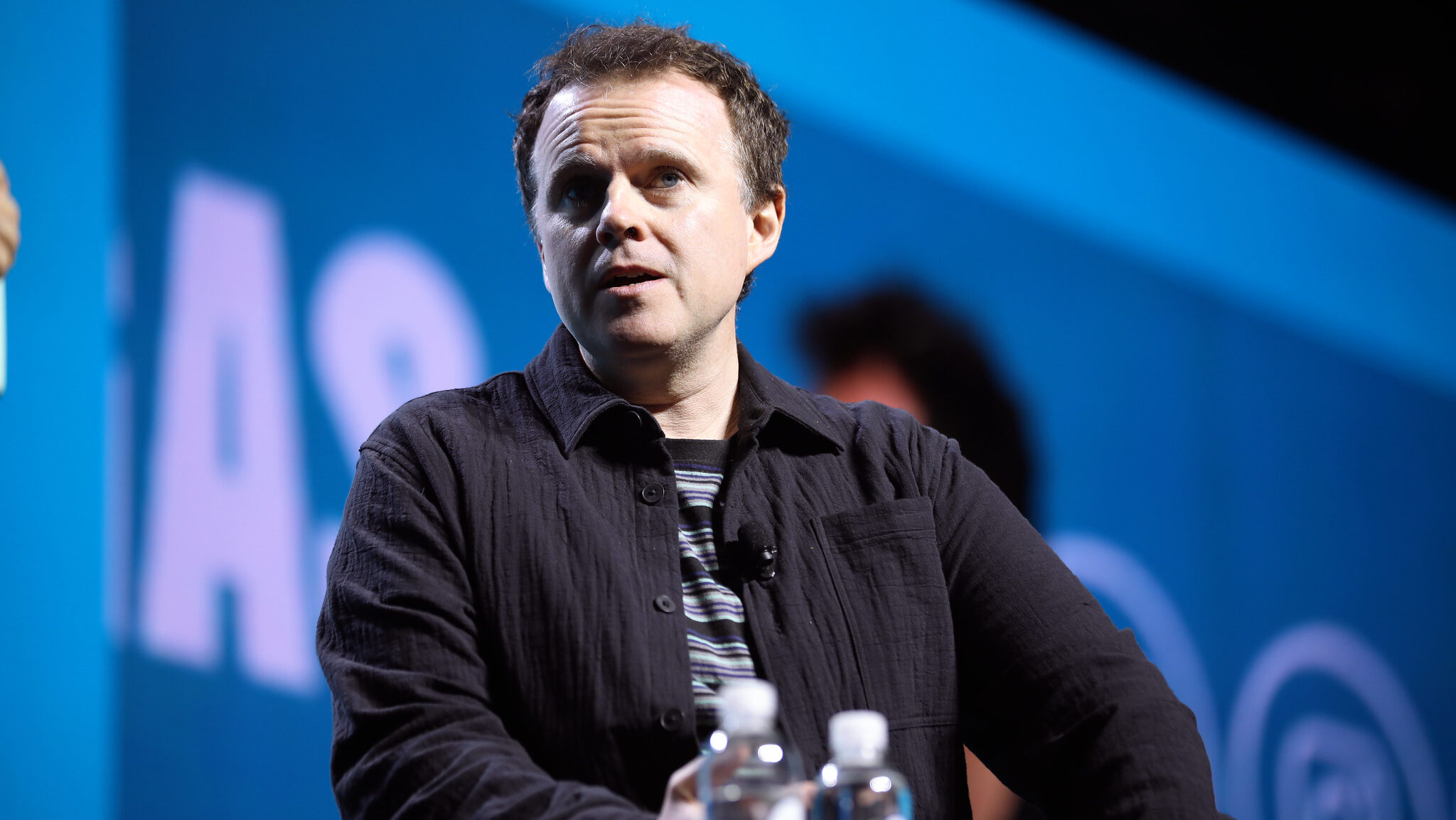
Andrew Doyle speaking with attendees at the 2024 FreedomFest at Caesars Forum Conference Center in Las Vegas, Nevada.

The End of Woke, subtitled How the Culture War Went Too Far and What to Expect from the Counter-Revolution, (Constable, 2025), Andrew Doyle’s 450-page tome with 80 pages of notes, is probably the best explanation of what woke really is—and that, despite the title, it is far from over. The book is replete with examples of the excesses of woke culture: the cancellations, character assassinations, and reputations ruined by those who think they are on the right side of history and the way to deal with opposition is to silence it.
Unlike his last book, The New Puritans, this new book does not explore the origins of woke to the same extent. It does not have a single unifying concept, like The New Puritans did with the Salem witch trials. In that sense, it has no obvious progression between chapters. Each chapter stands alone.
Along with his work in journalism and political satire, especially the creation of his female alter ego Titania McGrath, Doyle is a scholar of literature. And it shows. Many obscure words are resurrected, and copious analogies are drawn with figures from the classics with whom not every reader will be acquainted. I had to take recourse to a dictionary several times and had to read on many times to see the relevance of some analogies. But I was educated in the process.
Doyle has a well-honed sense of the absurd and the ironic. He uses this to good effect in skewering many of the people and their ridiculous claims made in the name of woke. Often these are hilarious. He repeatedly exemplifies how comedy is unavoidably and unapologetically offensive at times. Only the densest intellects or the most hypersensitive of people could confuse a joke about a distasteful subject with approval of the same subject.
That Doyle, who is gay, and comedian Scott Capurro, who is also gay, can be accused of homophobia for mocking the excesses of the LGBT movement demonstrates the extent to which the self-appointed curators of what is acceptable in the public domain can wilfully refuse to contextualise comments or jokes. Frankly, it is as unfathomable that a gay man can be considered homophobic as it is that those who would control the flow of opinion to the masses cannot see how ridiculous they often look.
However, the outcome of woke extremism is not always amusing, and the case of comedy writer Graham Linehan, a close friend of the author, is a perfect example. One of UK television’s most successful comedy writers (Black Books and Father Ted, amongst other things), he found himself ostracised by former writing colleagues, unable to get work, and even being bribed to remove his name from one of his own creations. His crime was expressing the view that sex cannot be changed and children were being damaged by gender transition procedures. That both things are demonstrably true neither saved him, nor has he worked in the UK again. The woke can be vicious.
While Doyle does not spend much time examining the origins of woke, he does explore its nature. In so doing, he exposes very well that woke is not, as many probably think, an overdose of niceness, a concern for others, or a desire, personally, not to offend anyone. Woke is pure authoritarianism. The self-elected guardians of the public square are not concerned about the harm their actions may cause or that they do not want to be exposed to the unacceptable. They wish, and act to the effect, that nobody else should be exposed to or offended by what they themselves consider unacceptable. This is the very essence of cancel culture.
Moreover, it is not sufficient that someone—comedian, script writer, or author—be prevented from saying the specific thing considered unacceptable. They must be prevented from saying anything ever again. Thus, comedians are cancelled from ‘inclusive’ venues, and scriptwriters and authors have contracts cancelled. That these people have a living to earn or families to feed is not the concern of the woke; venues, programmes and publishing houses are sanitised, and that is their only concern.
Some authors, for example, Roald Dahl or Ian Fleming, are too big for their books to be cancelled, so they are republished after being scoured by sensitivity readers and rewriters. Anything considered prejudicial, misogynist, or out of kilter with whatever the latest intersectional fad may be, is redacted or altered to align with current mores. Sometimes such passages are rendered incomprehensible in the process.
It never enters the heads of the committed woke censors that they do not have to attend a show, watch a programme, or read a book they consider offensive. Likewise, those on whose behalf they go to war on words are not obliged to expose themselves or to be exposed to the subjectively distasteful or offensive. Individuals can exercise their own power at the checkout of the bookstore by choosing not to purchase a book or by operating the ‘off’ switch on the television and choosing not to watch.
As Doyle himself says, regarding the disproportionate fury over his proposals to take his controversial Comedy Unleashed show to the Edinburgh Fringe Festival, people did not seem to grasp that attendance was not compulsory. This was the same year the Scottish government introduced its Hate Crime Act, purporting to outlaw hate speech even in people’s own homes.
Under the auspices of the act, it was going to be the duty of the police to arrest comedians overstepping the boundaries of acceptable speech, thus showing that wokeness is not the preserve of individual fanatics—whole governments can be involved. In the end, no action against any comedians was taken by the police, who probably decided Scotland’s massive drug problem was more worthy of their attention. However, Doyle’s show was duly cancelled from one venue and, after an impromptu open-air show, they found a venue where the show was eventually performed.
Doyle takes a few detours, and one of these explores the work of the late Mary Whitehouse, founder of the National Viewers’ and Listeners’ Association, which campaigned against the portrayal of pornography on stage and television. I assume Doyle set out to do a demolition job on this lady, who could, in a sense, be viewed as the progenitor of cancel culture. However, in the process of investigating Mary Whitehouse, Doyle discovers a quite likeable and un-shockable lady who, while she would be unlikely to support his free speech absolutism, was not the ogre she was made out to be.
Nevertheless, I think Doyle misses two points regarding Whitehouse. First, her campaign was mainly focused on one issue, which can be demonstrably harmful. Second, regarding her famous and successful prosecution of Gay News over the publication of the poem “The love that dares not speak its name,” recounting the erotic fantasy of a Roman soldier witnessing Christ’s crucifixion, the law of blasphemy was still on the statute books at that time.
Doyle never says the end of woke is upon us or even nigh. Towards the end of the book, it becomes clear, against the background of censoriousness and book burning—in some cases literally—that when woke does end, we can look back on it all with relief. Although he does not exactly lay out his vision for the post-woke world.
I imagine many younger readers, especially ‘Gen Z’, will have no memory of a world without woke. Those of us longer in the tooth can well recall the halcyon days when ‘it’s a free country’ really meant something. If the end of woke is imminent, or even possible, I cannot help feeling the damage inflicted by the terminally offended is too great. We may never be the same again.
The End of Woke is informative and entertaining, as much as it is infuriating to revisit what has happened to some of the individuals left stranded in the wake of woke. This book is probably the best catalogue of the excesses of the past decade to date.