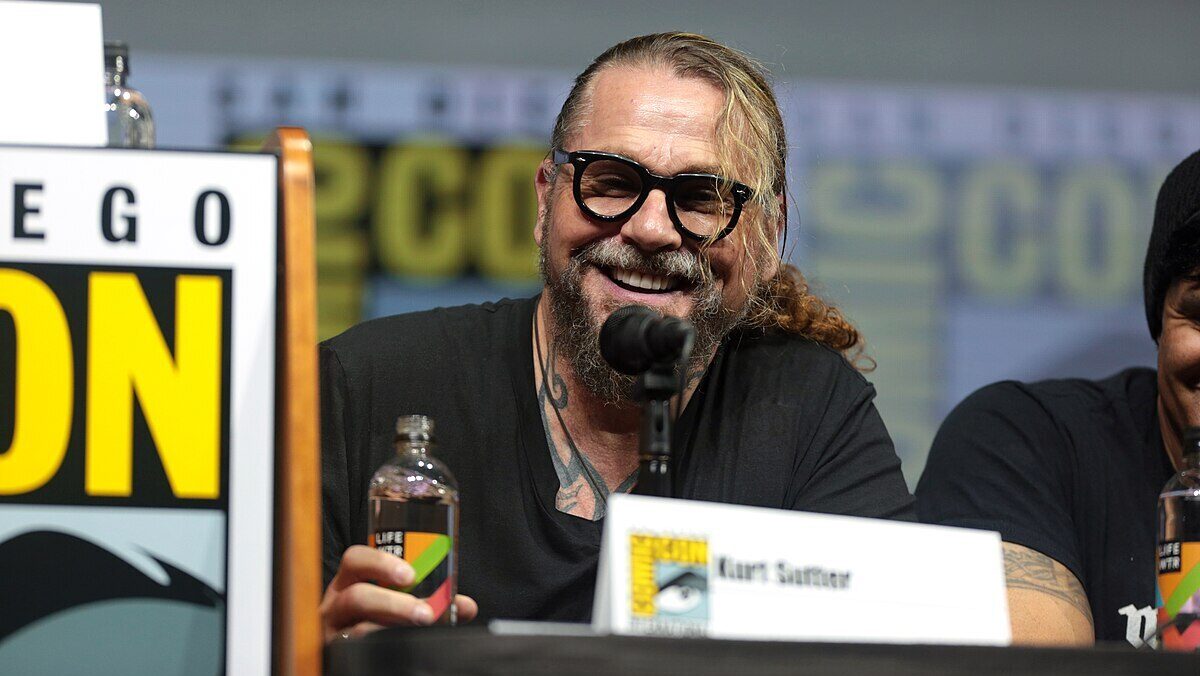
Kurt Sutter speaking at the 2018 San Diego Comic Con International in San Diego, California.
Gage Skidmore from Peoria, AZ, United States of America, CC BY-SA 2.0, via Wikimedia Commons
Streaming video: the headline story is how a newish industry could manage the inevitable collapse in its revenue that went with our release from collective COVID lockdown. Its search for a solution—throwing something at the wall and seeing what sticks—has not stopped subscriptions from going the way of Tiger King and panic-buying hand sanitizer. Even the once unstoppable-looking Marvel comics-based ‘cinematic universe’ is less of a juggernaut, with audiences complaining of ‘superhero fatigue.’
Which brings us to The Abandons. Following a lengthy gestation, Netflix commissioned ten hours’ worth from Sons of Anarchy creator Kurt Sutter. On the surface, this tale of the U.S. northwestern territories in the 1850s had a lot going for it. Sutter is well-established as an edgy showrunner who cut his teeth in the recent ‘golden age of TV.’ Led by genre stars Gillian Anderson and Lena Headey as rival matriarchs, the new show had some rich precedents to draw on, suggesting well in advance its success would be baked in.
The Calgary, Alberta, landscapes meant that beauty on camera could offset the grime, while, post-Deadwood, there was something of the classic and the revisionist western for audiences to get their teeth into. Anderson’s family of old-money WASPs confronted Headey’s Irish widow and her multiethnic orphans and allies in a clash between big silver and smallholders and ranchers. This being streaming, many of us probably binged the seven episodes too quickly to notice the obvious flaws.
Admittedly, this was a troubled production. As with Mayans M.C., Sutter left the production before his story could be completed. The feature-length opening part was split into two, while the overall episode count dropped to seven from the originally planned ten. Of the six of Sutter’s returning players (his spouse Katey Sagal, Clayton Cardenas, Brían F. O’Byrne, Michael Ornstein, Ryan Hurst, and Timothy V. Murphy), only Hurst and Murphy, measured in screen time, appear to have been given much to do. Among the younger cast members, dialogue and character often bounced unconvincingly between the 1850s and the present day.
Underlying what turned out to be a difficult endeavour produced under various clouds is a wider dilemma for the Western. Once, like country music, it could combine entertainment and U.S. national identity seemingly effortlessly. It was a sufficiently broad church to encompass conservative and left-wing messaging, although it can seldom resolve the question of what to do about indigenous populations (one half of the oater’s near-eponymous ‘Cowboys and Indians’: while The Abandons sees actor Michael Greyeyes excel as Jack Cree, his counterparts from rival tribes remain largely anonymous).
Reports of the death of Hollywood’s Western arrive with the frequency of the Pony Express, with films as different as The Searchers (1956), The Wild Bunch (1969), and Unforgiven (1993) being cited simultaneously to signal both the genre’s demise and its revival. As the volume of such movies in production shrinks, not least given the astronomical costs involved, an underlying American attitude will endear the ones that do get made to U.S. audiences. The danger is that streaming now rides an economic ‘long tail’ where the Wild West is treated as just another niche market.
Which brings us back to The Abandons. Despite a cliffhanger finale—and even a couple of character surnames hinting at a familial link to Sons of Anarchy—Sutter’s premature exit from the show means we’ll never know how squarely his vision would have it fall into the traditionalist or revisionist western camps. Indeed, right now we don’t even know if we’ll get a second series.
However, before holding up the abandonment of The Abandons as proof of the death of the Western, it would be wiser to think of it as a symptom of the algorithmic pull of the streaming service industrial complex. It knows that the Yellowstone empire—the TV realm of showrunner Taylor Sheridan, a former Sutter collaborator—attracts eyeballs atop powerful currents of cultural conservatism that no one in legacy media likes to talk about. This nevertheless prompts Netflix and its competitors to try to recreate that particular lightning in a bottle, with uneven results.
At the heart of the process is something cold and mechanical, lacking both the strong pull of the Wild West mythos and the creative push of a Sutter or Sheridan. What remains is an attempt to top up on ‘content’ while accountants and data analysts attempt to divine the success, or otherwise, of allowing a new product to drop that weekend. Then it’s on to the next big thing, abandoning the previous endeavour along the way.