Previous articles:
- Did a Million Pounds Buy a War? Johnson, Harborne, and QinetiQ
- April 9, 2022—The Day Johnson Blew Up Peace in Kyiv
The war in Ukraine not only reshaped Europe’s balance of power—it also redefined Britain’s industrial and political priorities. In a context of sanctions, rearmament, and record public spending, companies like QinetiQ, a historic contractor for the Ministry of Defence (MoD), emerged as clear winners.
Its expansion during the conflict, combined with the political connections of its main shareholder, Christopher Harborne, and the decisions of then-Prime Minister Boris Johnson, reveals a web of interests where foreign policy and private profit move in lockstep.
An analysis of internal British government papers, corporate records, and private contracts signed after Johnson left office—reviewed by europeanconservative.com—traces a clear line between the political decision to support Kyiv unconditionally and the simultaneous expansion of Britain’s leading defence contractors.
The findings reveal a striking synchronicity between political donations, diplomatic travel, military contracts, and private consultancy agreements that followed the former prime minister’s departure from Downing Street.
Since 2022, QinetiQ’s revenues have soared. In its 2023 interim financial report, the company explicitly acknowledged the “positive effect of the geopolitical environment” on its income, driven by the demand for autonomous systems, drones, and electronic warfare solutions. Among its most significant contracts is Project SOCIETAS, awarded in late 2022 and valued at £80 million for the development of joint defence capabilities.
QinetiQ’s flagship products—the Banshee drones, advanced reconnaissance systems, and TALON robots used for mine clearance and urban combat—are part of Britain’s military aid packages to Ukraine. An internal Ministry of Defence document confirms that the UK allocated over £2.3 billion in military support, including “2,000 state-of-the-art drones, 1,600 anti-tank weapons, unmanned aerial surveillance, and 50,000 artillery shells”. QinetiQ is among the key beneficiaries of these contracts.
The company also capitalised on the political environment to expand its international footprint. According to Campaign Against Arms Trade (CAAT) data, QinetiQ holds export licences in 20 countries, with a growing number of contracts linked to air defence and laser programmes. This expansion coincided with a government narrative that framed rearmament not as a commercial opportunity but as a moral duty in the face of Russian aggression.
Defence remains an essential sector in the modern world—few would dispute that. What causes unease among some European partners, however, is that geopolitical positioning may increasingly be driven—or even forced—by private arrangements rather than by purely strategic, defensive, or technological needs.
As detailed in yesterday’s analysis, even the former NATO Secretary-General acknowledged in writing to Boris Johnson his role in securing the Alliance’s firm stance towards Russia. In international politics, reading between the lines is never optional.
The million that shaped British politics
In November 2022, Christopher Harborne—businessman, Conservative donor, and QinetiQ’s largest private shareholder—donated £1 million to Boris Johnson, the largest individual political contribution in recent British history. The timing of this donation, coinciding with the awarding of new defence contracts to British firms, raises legitimate questions about the relationship between political financing and defence decision-making.
Harborne, who owns roughly 13% of QinetiQ’s shares, has been a recurring financier of the Conservative Party and various Brexit-aligned groups. During the months in which his company’s profits multiplied, Johnson publicly insisted on “maintaining military commitment until the end,” stressing that “Ukraine’s victory depends on a constant supply of advanced weaponry”.
According to internal planning documents reviewed by this outlet, Johnson’s team prepared for interviews anticipating questions about “the insufficiency of Western support” and the need to “provide Ukraine with all the weapons necessary to win the war.” The prepared talking points reflected an unyielding position: total support for Kyiv and rejection of any premature negotiation with Moscow. In practice, this political line aligned perfectly with the interests of Britain’s defence contractors, for whom a prolonged war meant sustained demand and record profits.
The alignment between political discourse and economic gain was soon evident in the numbers. In its next fiscal year, QinetiQ reported a 20% rise in operating profits and new contracts worth £160 million for directed-energy weapon systems. The war had turned the UK into a top technological supplier for Ukraine’s war effort. At the same time, its political class consolidated its self-image as the moral leader of Europe’s resistance to Russia.
Trips, decisions, and perfect timing
The internal chronology of trips from April to June 2022 from Johnson’s office reveals a clear correlation between the former prime minister’s diplomatic travel and new military commitments.
His first trip to Kyiv, April 8–10, was organised under exceptional conditions—no phones, no communications, travelling aboard Ukraine’s presidential train. The internal notes state that the main goal was to secure a photograph with President Zelensky “to project leadership and bravery in the face of the enemy.”
Just days after that visit, Downing Street and the MoD confirmed new weapons shipments and an expansion of the training programme for Ukrainian troops. In June 2022, Johnson returned to Kyiv. That same month, QinetiQ and other British defence companies signed cooperation agreements with the government to expand domestic production of drones and reconnaissance systems. The dates coincide with Johnson’s public statements and his NATO Summit speech in Madrid, where he called for the alliance to “maintain economic and military pressure without concessions.”
By September 2022, the UK had already committed to training 10,000 Ukrainian soldiers every 120 days and to supplying heavy weaponry with a multi-billion-pound budget.
The pattern is undeniable: every trip, every announcement, and every new deal reinforced the bond between Britain’s foreign policy and its defence industry. Far from acting solely as Kyiv’s ally, London used the war to reposition itself as a technological power and strategic supplier within the Atlantic alliance.
The private contract: continuity and discretion
After leaving office, Johnson signed a consultancy agreement with the British firm Merlyn Advisors Limited, dated September 20, 2023. The document, obtained exclusively by europeanconservative.com, stipulates that the former prime minister would attend up to eight private meetings per year, for a fee of £200,000 per event, plus travel and accommodation expenses.

More revealing still is Merlyn’s commitment to contribute £35,000 per month to fund a think tank promoting Johnson’s own ideas and vision. Payments, according to the contract, would begin once the entity was registered and a business plan submitted. The agreement spans two years, is renewable, and is governed by English law.
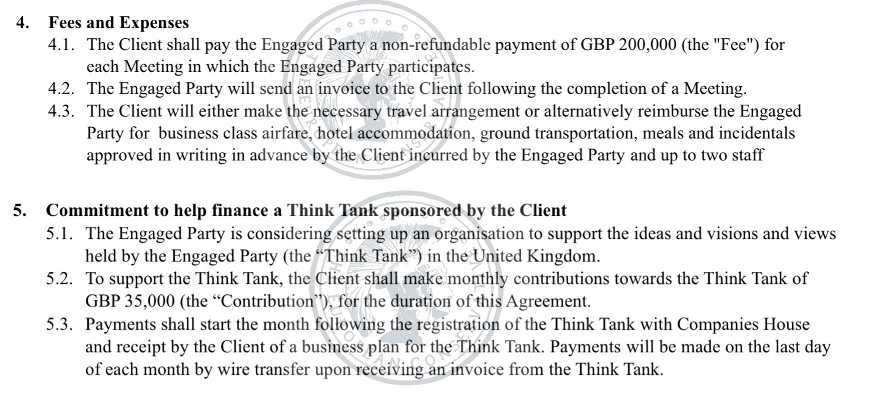
The document also contains broad confidentiality clauses and a non-disparagement provision barring either party from making public statements about the relationship. Although the nature of Merlyn Advisors’ clients is not specified, the firm manages investment funds with interests in the energy and technology sectors—both directly tied to reconstruction and defence programmes.
The continuity between politics and private enterprise remains intact, though now formalised through a lucrative and discreet arrangement. It may not fit the textbook definition of a “revolving door,” but it certainly resembles one.
Between strategy and ethics
In practice, the war has served Britain well, strengthening its economic and diplomatic position in the post-Brexit landscape. Military spending has become industrial policy; Johnson’s diplomacy, an extension of the defence market. The moral imperative to “help Ukraine win the war” has translated into billion-pound contracts for the country’s leading defence companies and the consolidation of British influence within NATO.
None of this necessarily implies illegality. But it does raise an ethical question: how far can foreign policy be used as an economic catalyst without eroding its moral legitimacy? The reviewed documents—governmental, corporate, and private—leave little doubt about the simultaneity of interests. QinetiQ prospered, the government reinforced its international standing, and Boris Johnson found new sources of income and influence.