The European Commission has declined to comment on the recently leaked Spanish police report pointing to Rabat’s involvement in the Ceuta mass incursion, declaring the investigation “a matter for the national authorities.”
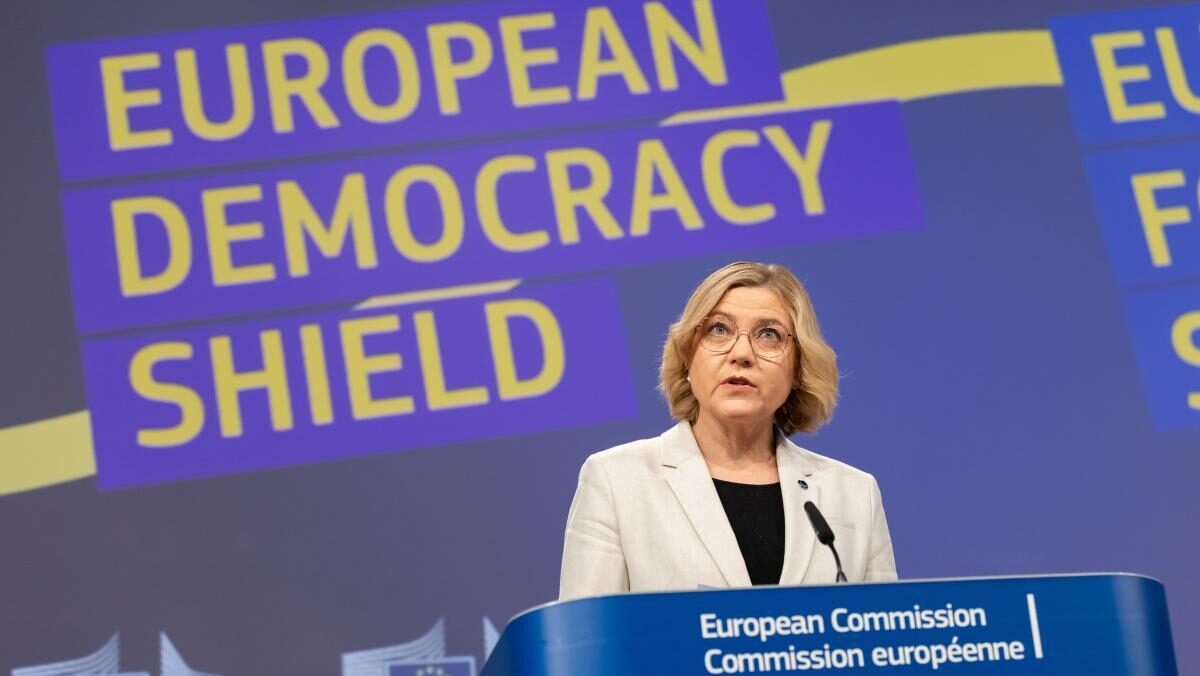
Henna Virkkunen, EU Commission EVP for Tech Sovereignty, Security and Democracy, talks about the EDS in November 2025.
European Commission
The EU’s expanding online censorship regime, spearheaded by the Digital Services Act (DSA), is already being used to pressure social media companies into silencing political opponents—particularly on the Right, especially ahead of elections.
But the 2022 regulation is just the beginning, warns a recently published report by the Polish legal think-tank Ordo Iuris.
The lengthy analysis found that DSA’s much bigger brother, the European Democracy Shield (EDS)—which builds on both the DSA and the AI Act and has been gradually rolled out since late last year—represents a “systemic threat” to freedom of speech and the democratic integrity of European elections.
The report was built upon the findings from the U.S. House Judiciary Committee, which earlier this year provided well-documented evidence that Brussels’ pressure on social media platforms reflects a broader strategy to shape online speech across Europe and has already been used to influence nine European elections since 2023, including the most recent Hungarian vote.
Described with the EU’s typical Orwellian doublespeak, the stated goal of the Democracy Shield is to create a “safe and stable online environment” where citizens are protected from “harmful messages.” It also proposes “safeguarding fair and free elections” by directing taxpayer money to “independent” media and placing content moderation into the hands of EU-financed, “independent” fact-checker NGOs.
Naturally, the opposite is true. Ordo Iuris’ report found that the content moderation efforts often target political speech “diverging from the leftist-liberal orthodoxy,” and service providers are expected to actively engage in fighting “hate speech” and “disinformation,” or even “divisive” or “discriminatory content.” This is ensured through a “multi-layered moderation framework”, meaning a vast censorship regime standing on multiple legs.
Social media platforms are not only mandated to introduce robust notice and takedown mechanisms—effectively censorship—along with algorithmic tools that can be used to stealthily limit or boost the reach of any content, but will soon be required to also label any speech based on how “trustworthy” it is.
And what fits the criteria is determined by Commission-approved and financed ‘fact-checkers,’or so-called trusted flaggers. In other words, Brussels is spending taxpayer money to limit what those very taxpayers can say and see on social media, all while using almost comically Orwellian language to justify it.
Unlike the DSA, the EDS would be enforced through severe sanctions for both the online service providers—social media platforms may face hundreds of millions worth of fines or even be banned in the EU if they refuse to comply—and the member states themselves if they were to try tipping the balance in favor of free speech.
What makes this last bit—the possibility to sanction member states for non-compliance—even more concerning is that this aggressive limitation of free speech is linked to efforts to influence electoral processes across the EU.
According to the report, the EU Commission “is not even trying to hide that one of the main goals of these regulations is to limit voter access to political speech contradicting the views of the Commission and predominantly liberal legacy media, to prevent such speech from influencing elections.”
In practice, however, this disproportionately affects one side over the other, and is employed as a means of “limiting voters’ exposure to the political speech of conservative parties that challenge the liberal status quo.”
✅The European Democracy Shield poses a clear and present danger to the freedom of speech and information within the EU, in particular with regard to conservative speech. It is intended to transform the European internet by making it a safe, heavily moderated space, where the… pic.twitter.com/8SmEhbxrtI
— Ordo Iuris International (@OrdoIuris_Int) April 27, 2026