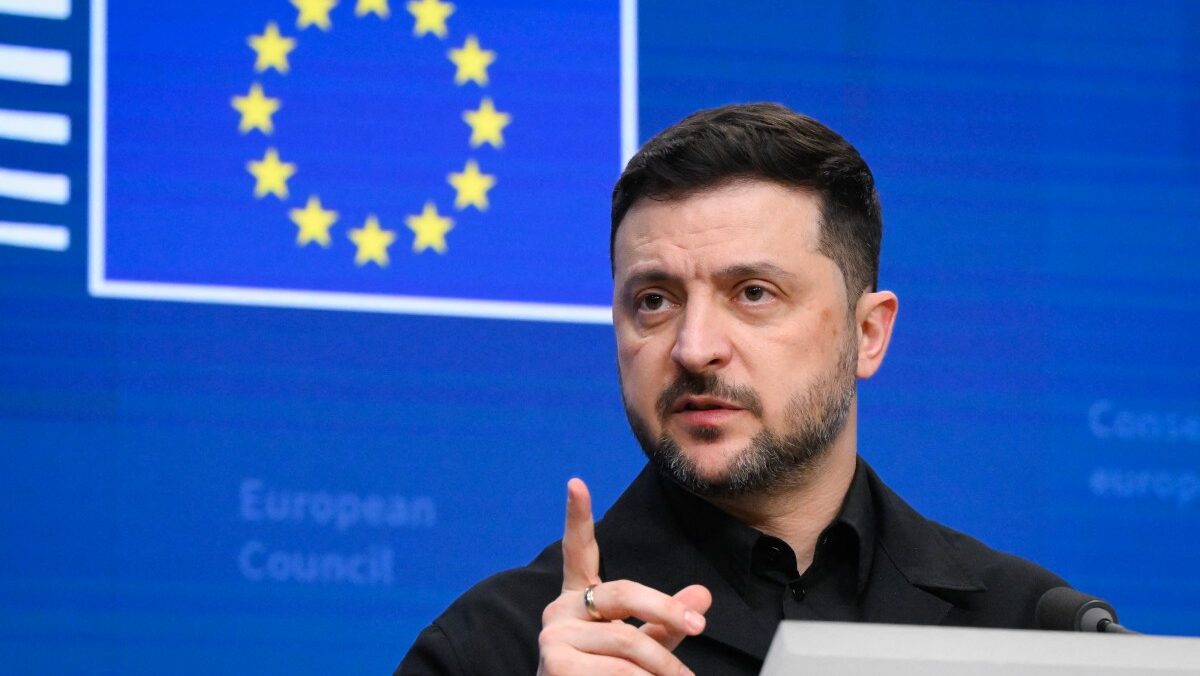
Ukrainian president Volodymyr Zelensky
JOHN THYS / AFP
European Union member states are weighing whether Ukrainian men of military age should be excluded from future extensions of the bloc’s temporary protection scheme for people fleeing the war with Russia.
According to an internal Council of the EU document seen by Euractiv, one of the options under consideration would be to extend temporary protection while narrowing its eligibility criteria. The paper references “the exclusion of men of conscription age” as well as individuals who did not leave Ukraine legally. The current framework is due to remain in effect until March 2027, and any such restriction would apply only to future applicants seeking temporary protection status.
The European Commission has already encouraged member states to begin preparing for a gradual transition away from the temporary protection system. In 2024, the Commission adopted recommendations aimed at creating a “coordinated transition” toward more permanent legal statuses, although implementation across member states has varied.
Several national governments have raised concerns about the profile of more recent arrivals. According to the Council document, some countries believe that “an increasing proportion of recent arrivals consists of men of conscription age.” These governments have argued that the framework should be revised “also in the interest of Ukraine,” both to support the country’s war effort and to aid future reconstruction. With forceful conscription techniques being used in Ukraine, this would send those back to Ukraine who have fled from the terrors of the war, indicating their unwillingness to fight.
Ukraine has faced growing manpower shortages and recruitment challenges as the war with Russia enters its fifth year. In 2024, Kyiv lowered the mobilisation age from 27 to 25 and introduced new measures aimed at improving recruitment and military registration.
Some governments have also moved to tighten support arrangements for Ukrainian refugees. Last week, the Czech government approved a bill that would tighten temporary protection rules and restrict access to certain welfare benefits for Ukrainian refugees, citing concerns about system abuse and pressure on public finances.
The move reflects a broader trend across Europe. Germany has reduced benefits available to newly arriving Ukrainians, while Poland has gradually scaled back some of the special support measures introduced after Russia’s invasion.
As of March 2026, 4.33 million Ukrainians held temporary protection status in the EU. Germany hosted the largest number with 1.27 million beneficiaries, followed by Poland with 961,405 and the Czech Republic with 379,820. Adult men accounted for 26.6% of all beneficiaries.
The future of the temporary protection regime is expected to be discussed by EU migration ministers at this week’s Justice and Home Affairs Council meeting. Ministers are expected to provide political guidance on possible next steps, though any formal extension or modification would require a proposal from the European Commission.