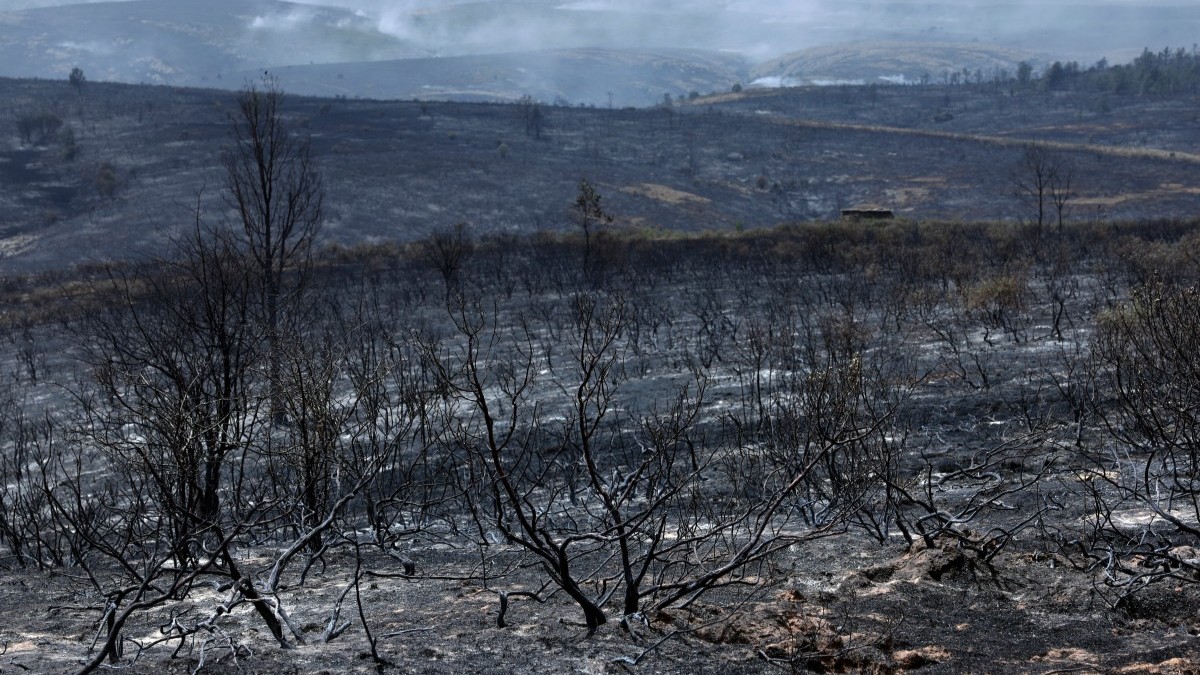
The area near the town of Albendiego, in the Guadalajara province, northeast of Madrid, ravaged by a wildfire, on July 22, 2026.
PIERRE-PHILIPPE MARCOU / AFP
Wildfires burned 172,396.10 hectares in Spain between January 1 and July 27, 2026, according to the latest provisional figures released by the Ministry for Ecological Transition.
The country has also recorded 35 major wildfires—those affecting more than 500 hectares—compared with eleven in the available figures up to July 20 of the previous year. The total burned area is 5.8 times higher than during the equivalent period in 2025.
The largest fire is the one that broke out in Burgohondo, in the province of Ávila. The Government’s preliminary estimate places the affected area at around 50,000 hectares, exceeding the 37,313 hectares attributed to the Larouco, Quiroga and Oencia wildfires in August 2025. Based on those figures, Burgohondo has become the largest wildfire in Spain’s recorded history.
When dealing with fires of this kind, it is important to understand that the source of ignition is one issue, while the capacity of the flames to spread is another. High temperatures, low humidity, wind, and an abundance of dry vegetation can turn any spark into a fire front that is difficult to contain. Investigators must then determine whether that spark was natural, accidental, caused by negligence, or deliberate.
In Burgohondo, one person has been arrested on suspicion of causing the fire while carrying out road-opening work with heavy machinery. In Vall d’Uixó, where around 7,200 hectares have burned, the authorities say there is no evidence that the fire had a natural origin.
It is also important to stress that an arsonist and a pyromaniac are not the same thing. The Spanish Civil Guard’s classification distinguishes pyromania from other deliberate motives, including agricultural or livestock disputes, vandalism, revenge, conflicts over land ownership, hunting interests or attempts to drive animals away. In most cases in which a fire has a human origin, the second pattern—that of the arsonist—applies.
The crisis has also led to political protests. During Pedro Sánchez’s visit to the command post in Vall d’Uixó, several residents greeted the prime minister with whistles, insults and shouted abuse. Sánchez continued with the planned itinerary, while his press statement was moved to another location and delivered without questions from the media.
The central government had already taken command in Madrid, Ávila and Toledo by declaring an emergency of national interest and had requested European assistance. Nevertheless, numerous firefighters have accused the government of preventing them from taking action.
Among those who have lost their homes or livelihoods, or have been forced to leave their towns, the discussion is no longer focused solely on how many aircraft arrived. It is about when they arrived, what preventive measures were taken beforehand and why the political response once again becomes visible only when the countryside is already burning.
The pattern is the same every year: several wildfires strike the country, the government promises assistance that never arrives, as climate and conservation laws prevent citizens from taking individual preventive measures. Then the next year comes, and the cycle begins again.