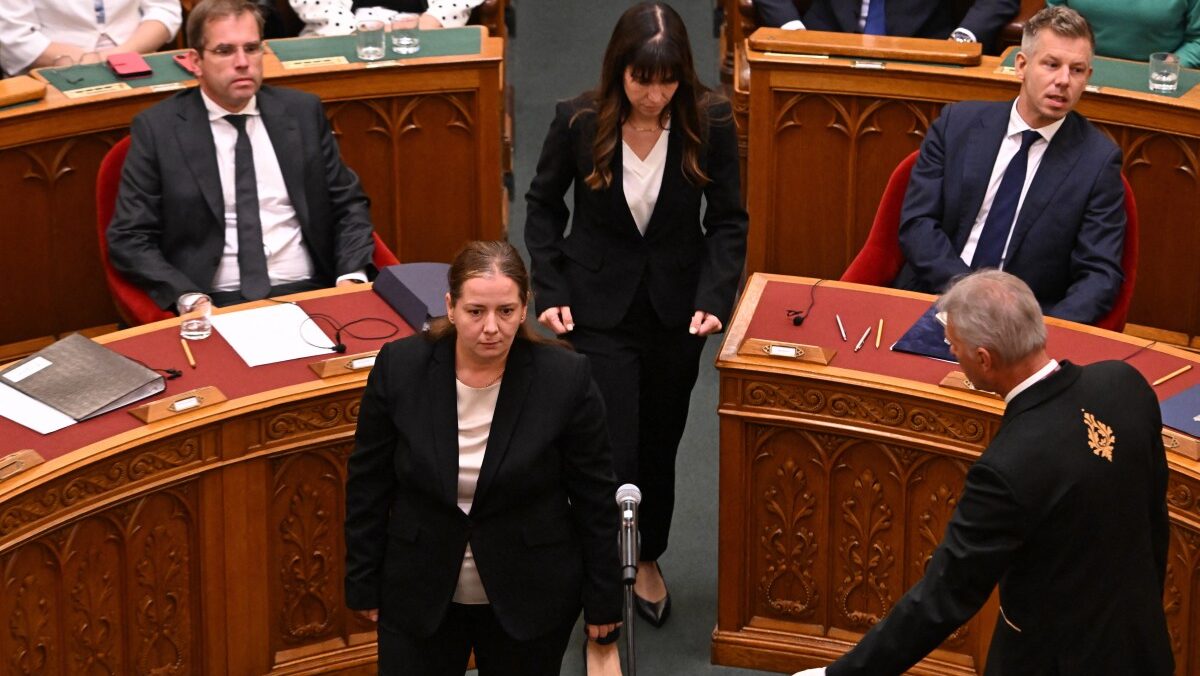
Hungary’s parliament has voted to appoint Anna Unger as head of the newly established National Asset Recovery and Protection Office (NVVH), an institution that could become a tool for political retaliation against the country’s conservative opposition parties.
Unger, a political scientist without any legal expertise, was appointed by Parliament on Friday, August 28th, and is expected to serve a six-year term.
The NVVH was established by legislation passed in July by the governing centrist-liberal Tisza Party, which won April’s election with a two-thirds parliamentary majority, ending conservative Viktor Orbán’s 16-year rule.
Prime Minister Péter Magyar has presented the office as a central element of his so-called anti-corruption campaign, dubbed ‘Operation Purgatory.’
The office’s powers include investigating public assets, accessing documents and electronic records, inspecting premises and financial accounts, and seeking the recovery of assets allegedly removed unlawfully from public ownership under the previous Fidesz-KDNP government.
The authority’s agents can enter private properties and seize documents without prior notice.
The opposition has argued that the legislation grants the NVVH unusually extensive powers with insufficient judicial safeguards. They have compared it to the ÁVH, the political police of Hungary’s communist era, warning that its powers could affect a large number of citizens and businesses that have received state or EU funding.
Fidesz MP Gábor Szűcs has warned that the office would wield extraordinarily broad investigative powers that could ultimately target hundreds of thousands of ordinary Hungarian families.
Opposition politicians have also attacked Anna Unger personally, calling her politically biased. KDNP parliamentary group leader Bence Rétvári questioned whether someone who had described millions of conservative voters as “brainwashed” could credibly head such an institution.
László Torockai, leader of the right-wing Mi Hazánk Mozgalom, accused Tisza of choosing a figure who would refrain from looking into possible corruption cases involving the new government.
The conservative daily Magyar Nemzet argues that the NVVH must be viewed in the context of the new government’s first months in office, accusing Tisza of focusing on political retaliation rather than governing.
Since taking office in May, Magyar’s government has already controversially removed President Tamás Sulyok through a constitutional amendment and introduced retroactive constitutional changes limiting the time an individual can serve as prime minister or MP—measures clearly aimed at weakening Viktor Orbán and Fidesz.
Meanwhile, the EU institutions remain silent—a sign that rule-of-law violations remain undetected when forces aligned with the Brussels establishment win power in any given EU member state.