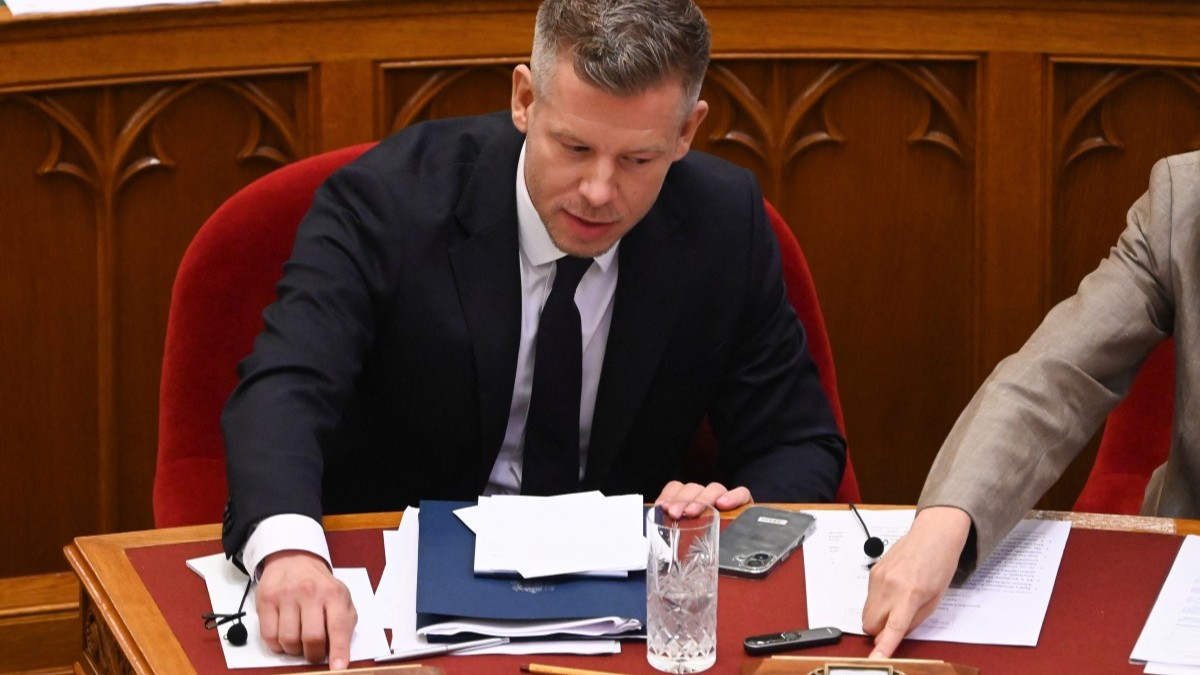
Hungarian Prime Minister Péter Magyar (L) and Foreign Minister Anita Orbán (R not pictured) vote with other members of parliament in the main hall of the Parliament on June 23, 2026, during an extraordinary session of the National Assembly.
ATTILA KISBENEDEK / AFP
A bill proposed by Hungary’s ruling Tisza party to establish the National Asset Recovery and Protection Office (NVVH) has sparked intense political debate in the country.
Fidesz MP Gábor Szűcs has heavily criticized the draft law, comparing the proposed agency to the notorious secret police known as ÁVH that existed under the Communist dictatorship. In the Hungarian daily Magyar Nemzet, Szűcs warned that the proposed office would wield extraordinarily broad investigative powers that could ultimately target hundreds of thousands of ordinary Hungarian families.
Under the draft law, the NVVH would have the authority to audit any individual or business that has received state or EU funds, allowing agents to enter private properties and seize documents without prior notice. Uncooperative parties could face massive fines—up to 50 million forints (€141,000) for individuals and five billion forints (€1,412,000) for businesses. Szűcs cautioned that the lack of procedural guarantees and the slow nature of judicial appeals could leave citizens defenseless against asset seizures during legal disputes.
While the Tisza party presents the NVVH as a tool for public accountability, Paragraph 34 of the bill allows audits of any assets obtained or partially obtained through state funding. This wide scope could bring families who utilized state housing programs like CSOK under investigation. Since 2010, Hungarian households have accessed home-creation and energy-modernization grants over one million times, meaning a vast portion of the public could theoretically face intrusive scrutiny.