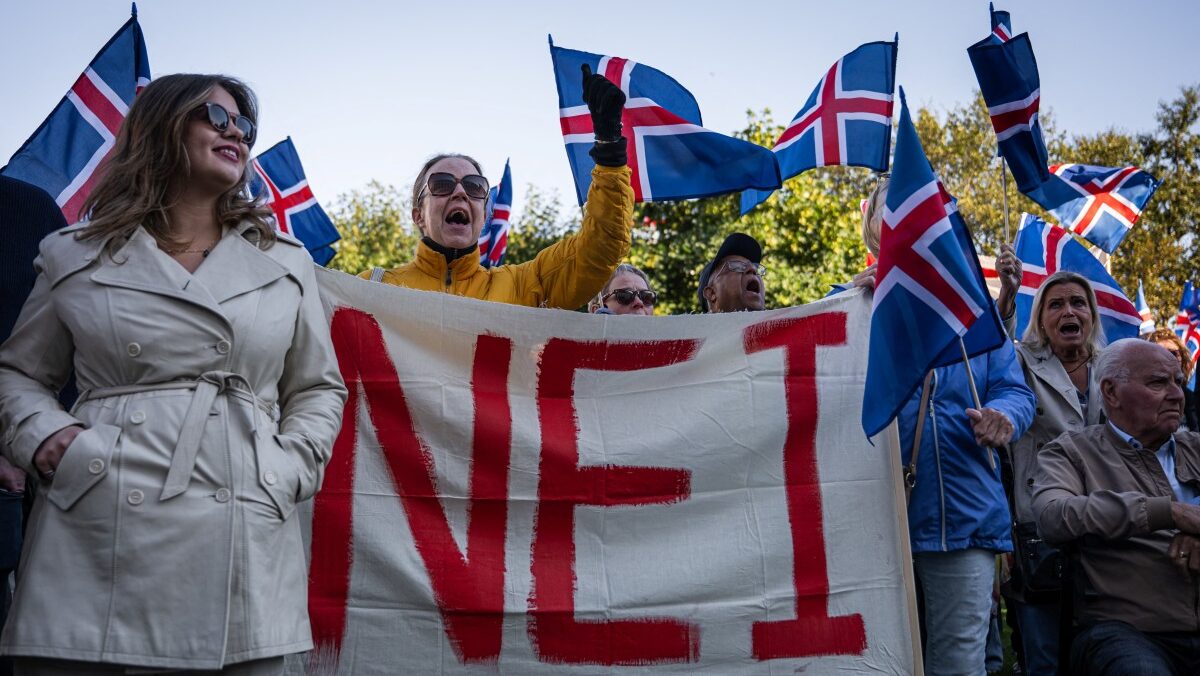
Supporters of the ‘No’ campaign display a banner during a rally against reopening Iceland’s European Union accession negotiations in Reykjavik, Iceland, on August 27, 2026, two days ahead of a national referendum.
JONATHAN NACKSTRAND / AFP
Iceland will vote this Saturday on its future within Europe, although the question citizens will find on the ballot will not yet be whether they want to join the European Union.
The referendum on August 29 will decide whether Reykjavik should reopen the accession negotiations suspended in 2013. A victory for the “Yes” side would restart a process that the government estimates could take between 18 and 24 months.
Any agreement would then have to be submitted to a second referendum before Iceland could become the European Union’s 28th member state.
The vote is almost evenly split. The latest Maskína poll gives 51.3% to those in favour of negotiations and 48.7% to those who want to keep the door closed. In early August, Gallup recorded a 46%–46% tie. Icelanders appear more willing to find out what conditions Brussels might offer than to accept membership outright.
The main obstacle remains fisheries. Fish and marine products account for around 40% of the country’s exports and form part of a conception of sovereignty built over decades, particularly since the so-called Cod Wars. Opponents fear that the Common Fisheries Policy could restrict Iceland’s ability to determine quotas, access to its waters and the conservation of resources.
This is not something that has not happened with other member states, so the concern has a basis.
Added to this is the major question facing every aspiring member: what does it get in return? The country belongs to the European Economic Area and already applies a large part of single-market legislation, but without representation in the institutions that draw it up.
The EU is also its main trading partner: it absorbed 66.5% of Icelandic exports in 2025. Supporters of accession argue that membership would allow the country to move from applying European rules to taking part in drafting them.
Then there is the króna. Its small size exposes Iceland to currency fluctuations, inflation and high interest rates. Membership would, in the medium term, open the way towards the euro. For its supporters, that would provide stability; for its critics, it would mean losing another instrument of economic policy. And of sovereignty.
But behind the economics lies an increasingly strategic reality.
Iceland is a founding member of NATO and the only ally without armed forces of its own. Its position between North America, Greenland and Europe makes the island and the facilities at Keflavík a crucial asset for monitoring North Atlantic routes.
Joining the EU would not alter that military architecture, which would continue to depend essentially on NATO. It would, however, expand Brussels’ political presence in the Arctic at a time of increased Russian activity, growing Chinese interest and uncertainty over how responsibilities should be divided between the United States and Europe. In March, the EU and Iceland already signed a security and defence partnership that explicitly includes Arctic cooperation, maritime security, critical infrastructure, and hybrid threats.
For Brussels, Iceland matters far more because of its geographical position than because of its population of fewer than 400,000. Its accession would strengthen the Union’s northern flank and would also deliver a relatively straightforward success for an enlargement policy bogged down in far more complex dossiers.
For Iceland, by contrast, the question remains the same as ever: how much national power is it willing to give up in exchange for greater influence within Europe?