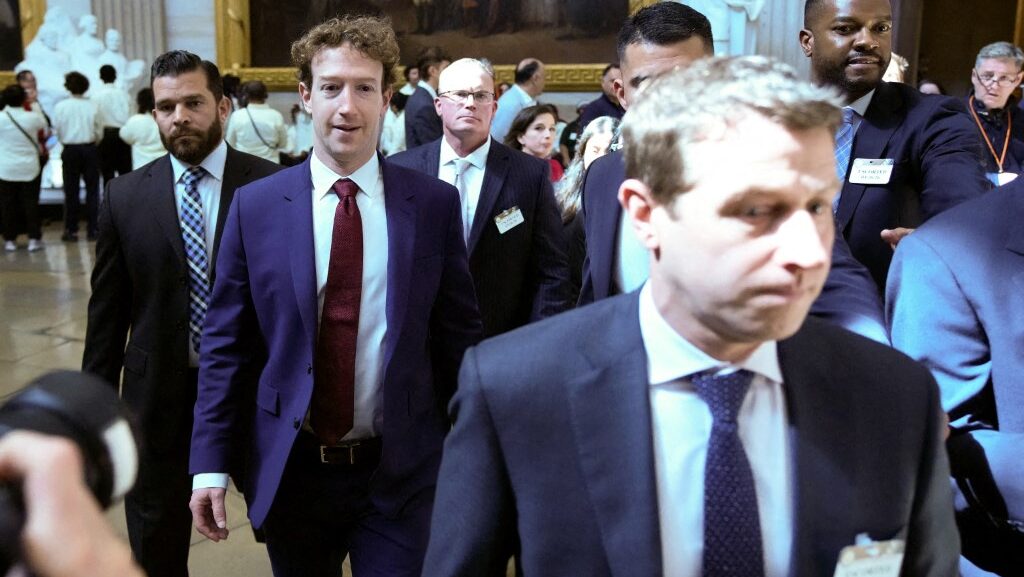
Meta Platforms Chief Executive Mark Zuckerberg leaves after a meeting with U.S. Sen. Majority Leader John Thune (R-SD) on Capitol Hill on March 26, 2026 in Washington, DC.
ANDREW HARNIK / GETTY IMAGES NORTH AMERICA / GETTY IMAGES VIA AFP
The trial that had the potential to upend the business model of social media platforms ultimately lasted only a few days. As a landmark federal case against Meta got underway in Oakland, California, Mark Zuckerberg’s tech giant found a way to cut the trial short by reaching a settlement with U.S. states.
The case was set to shed light on the practices of Facebook and Instagram, which were accused of being designed to make children and teenagers addicted to social media. A coalition of 29 states was seeking billions of dollars from Meta and, above all, far-reaching changes to its products. Rather than risk a lengthy legal battle, the company agreed to modify several features aimed at minors and to pay a fine that was considerably lower than the amounts initially suggested.
The trial, which began on August 18th, was the culmination of several years of investigation. The states accused Meta of having deliberately designed its platforms to maximise the time spent by young users, notably through infinite scrolling, constant notifications, algorithmic recommendations, and reward mechanisms.
They also claimed that the company was aware of the risks associated with these features whilst publicly downplaying them. Meta was further accused of collecting data on children under the age of 13, in breach of U.S. federal legislation designed to protect their privacy.
However, the issue was not merely about securing financial compensation. The states wanted to force Meta to overhaul the very way Facebook and Instagram operate: to strengthen age verification, more effectively prevent children under 13 from accessing the platforms, and restrict certain features deemed particularly addictive.
The case quickly took on the air of a landmark trial. Families of young victims were present in Oakland, some of whom linked social media to cyberbullying, exposure to sexual or violent content, eating disorders, depression, self-harm, and suicide. Internal documents and testimony from former employees were also intended to enable states to demonstrate that Meta had been repeatedly alerted to the problems faced by teenagers.
Among the key witnesses was Arturo Béjar, a former head of engineering at Facebook and former consultant on user well-being at Instagram. He claimed to have alerted the company’s management on numerous occasions and to have had more than a hundred interactions with Mark Zuckerberg. According to him, the protection of minors had been systematically sidelined in favour of growth and engagement targets.
Meta was determined to avoid at all costs a confrontation that would permanently tarnish its image and potentially undermine its business model.
The company agreed to modify its platform for teenagers and to introduce several additional restrictions. The announced changes include, in particular, limits on usage time, a night mode, enhanced parental controls, and restrictions on notifications and certain recommendations.
The compromise therefore allows the states to claim concrete changes to Meta’s products. But it also represents a major strategic victory for the company.
For the real danger for Meta was not the amount of the fine but the possibility that the court might recognise a new legal principle, namely, that a platform could be held liable not only for content published by its users but also for the way in which it designs its products.
Such a ruling could have had far-reaching consequences for the whole of Silicon Valley. TikTok, YouTube, Snapchat, and other platforms could have faced similar legal proceedings.
By reaching a settlement before the trial could run its course, Meta has therefore avoided a court ruling that could have set a precedent. It has also avoided several months, or even years, of exposure of its internal documents and potentially embarrassing testimony.
The ‘Big Tobacco moment’ will therefore not take place. Since the case began, there have been numerous parallels drawn with the tobacco industry. In the 1990s, cigarette manufacturers were accused of being aware of the dangers of their products whilst publicly downplaying these risks. The legal proceedings brought by the states ultimately led to the historic 1998 settlement, which imposed heavy financial penalties on the manufacturers and certain restrictions on their commercial practices.
The comparison with Meta is based on a similar line of reasoning: an industry accused of being aware of certain risks, of prioritising its economic interests, and of failing to take sufficient action to protect consumers, particularly the youngest among them.
But the parallel ends there. As a result of the agreement, Meta will not have to abandon its business model. Its algorithms, its advertising system, and the very principle behind its platforms remain largely intact—an outcome that has been criticised by some of the claimants.
The battle is therefore not over. Other legal proceedings remain open, notably those brought by certain states that have not accepted the settlement. Thousands of claims filed by families, individuals, and other parties are still pending. Some still want to prove that a platform’s legal liability is to be questioned when it concerns not the content published by users, but the very design of the product.