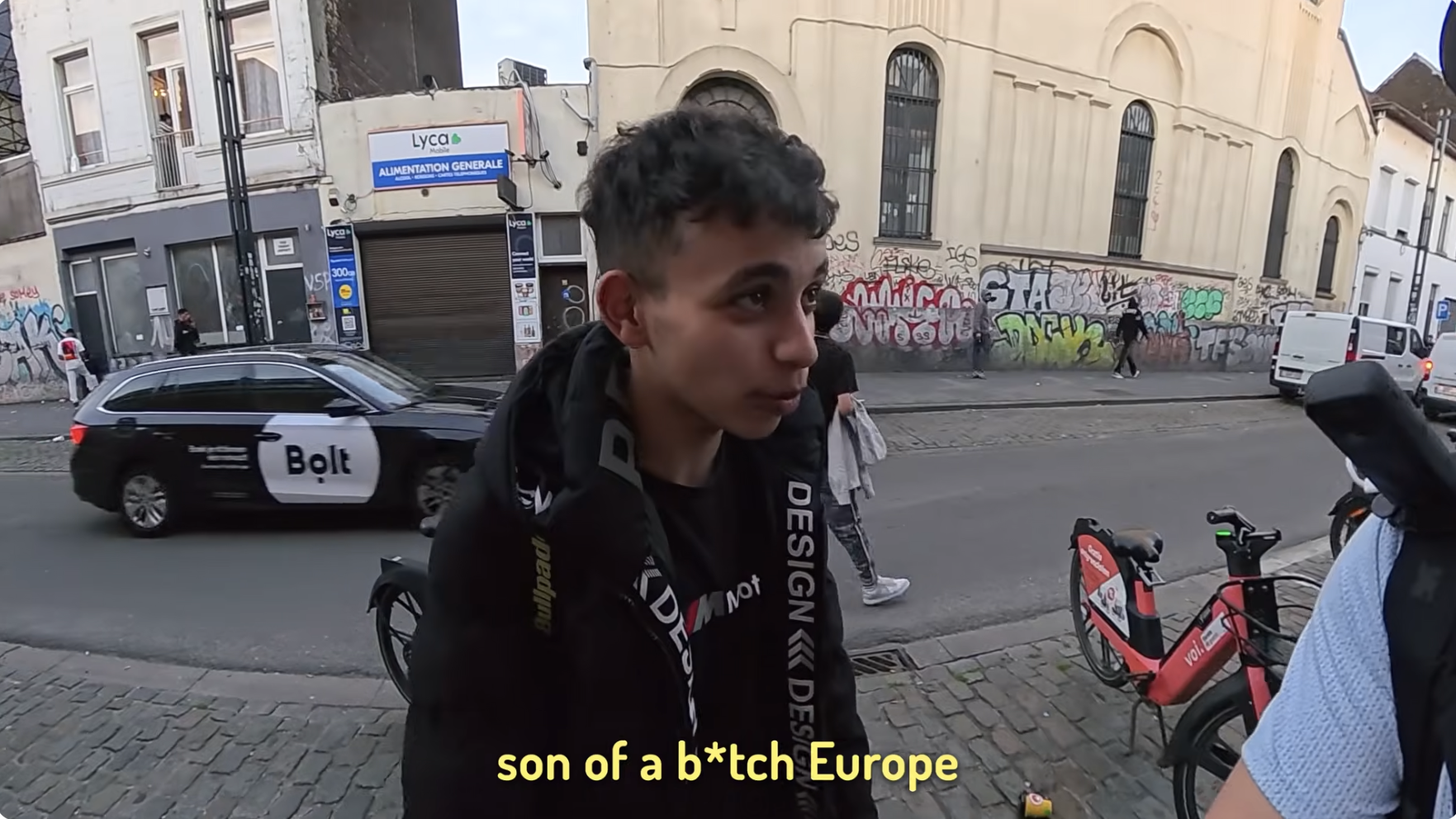
YouTube screenshot
A new documentary by American YouTuber Tyler Oliveira has attracted significant attention online for its portrayal of Brussels as a city transformed by mass immigration, rising crime, and growing integration tensions.
Oliveira, who has built a large online audience through documentaries exploring crime, social tensions, and political controversies around the world, examined life in the Belgian capital in a documentary that runs more than 40 minutes.
His latest documentary focuses not on the Brussels of EU summits and European politics, but on the city’s neighbourhoods, demographic changes, and security challenges.
I Exposed Brussels' Immigrant Invasion… pic.twitter.com/3nyv9iUfE5
— Tyler Oliveira (@tyleraloevera) June 12, 2026
Over the course of more than forty minutes, Oliveira visits different neighborhoods of the Belgian capital alongside Belgian activist Dries Van Langenhove, a prominent figure in debates on immigration and national identity who was recently convicted under Belgium’s hate-speech laws. The report combines street footage, spontaneous interviews, and population statistics to show how the city has evolved over recent decades.
A central theme of the documentary is Brussels’ demographic transformation. According to official Belgian statistics, the population of foreign origin already represents a clear majority in numerous municipalities across the capital region. Oliveira summarizes this reality by stating that more than 75% of residents are immigrants, naturalized citizens, or the children of immigrants. As a result, residents of Belgian origin now form a minority in several parts of the capital.
Brussels has spent decades as one of Western Europe’s main migration hubs thanks to its concentration of European institutions, international organizations, and economic opportunities. However, the pace of demographic and cultural change has increasingly become a central topic in both Belgian and European public debate.
The documentary features a wide range of testimonies. Some interviewees argue that immigration has enriched the city and highlight the cultural, culinary, and linguistic diversity that characterizes Brussels. Others express concern about deteriorating security, a lack of integration, and the rise of certain forms of crime.
One of the video’s most discussed moments features a young woman defending diversity because it allows people to enjoy “food from all over the world.” When Oliveira asks whether she lives in Brussels, she replies that she resides in the Netherlands. The exchange has attracted significant attention online, with many commenters debating whether discussions about immigration are shaped more by ideology than by everyday experience.
Crime and public safety feature prominently throughout the documentary. Brussels recorded more than 163,000 crimes in 2024 and remains at the centre of concerns over gang violence and organised crime in Belgium. Drug-related shootings reached record levels over the last two years, while municipalities such as Molenbeek, Anderlecht, and Schaerbeek continue to appear regularly in police reports linked to gang violence and drug trafficking.
It is precisely this combination of demographic transformation, insecurity, and tensions surrounding integration that explains the interest the documentary has attracted.
The documentary highlights what many residents and commentators describe as a growing gap between Brussels’ international image as the capital of Europe and concerns over crime, integration, and social cohesion within the city itself.
While much of Europe’s immigration debate is conducted through statistics, policy papers, and political arguments, the documentary offers viewers a street-level look at the issues shaping one of the continent’s most important cities.