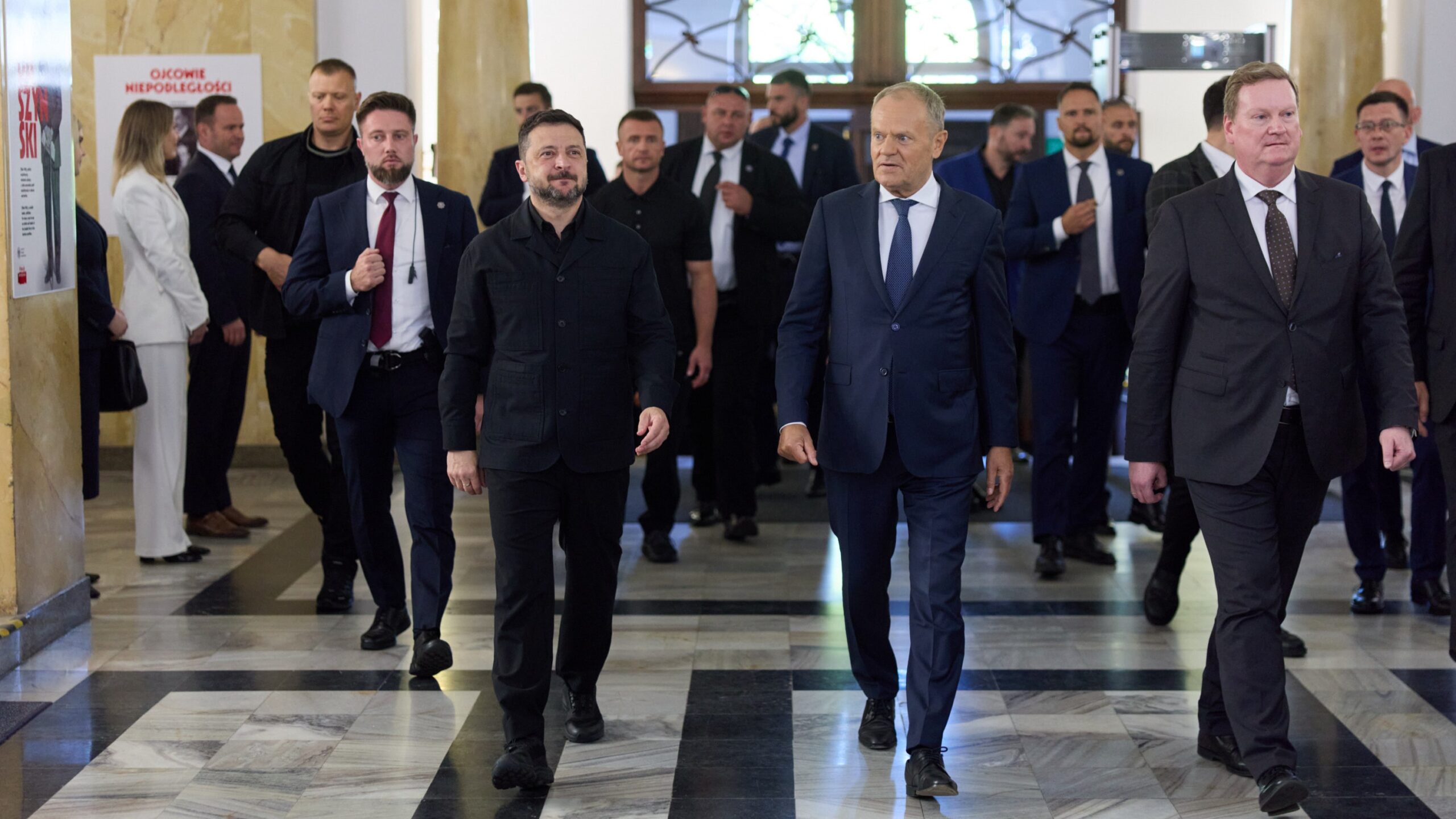
Ukrainian President Volodymyr Zelensky (L) and Polish Prime Minister Donald Tusk in Lublin, Poland, on July 29, 2026
@ZelenskyyUA on July 29, 2026
Ukrainian President Volodymyr Zelensky met Polish Prime Minister Donald Tusk in the eastern Polish city of Lublin on Wednesday, July 29th, in an effort to repair relations as new polling shows a sharp decline in Polish support for Ukraine’s bid to join the European Union.
The visit was Zelensky’s first to Poland since a diplomatic row erupted between the two countries earlier this year.
In May, Kyiv named a serving Ukrainian military unit after the Ukrainian Insurgent Army (UPA), a WWII-era nationalist force regarded in Ukraine as a symbol of the country’s struggle for independence but remembered in Poland for its role in the Volhynia massacres, in which around 100,000 ethnic Polish civilians were killed.
The controversy prompted Polish President Karol Nawrocki to revoke Zelensky’s honorary Order of the White Eagle in June, marking the lowest point in relations between the neighbouring allies since Russia’s full-scale invasion of Ukraine in 2022.
Following talks with Tusk, Zelensky said strengthening anti-ballistic air defence remained the top priority for both countries.
“Ukraine’s security and protection also mean Poland’s security and protection,” he wrote, adding that closer cooperation would strengthen both the region and Europe as a whole.
The leaders also discussed bilateral relations, defence cooperation, historical dialogue, and the safety of the more than one million Ukrainians living in Poland after fleeing Russia’s invasion.
The dispute seems to have had an effect on public attitudes in Poland towards Ukraine.
A new survey has found that support for Ukraine joining the EU has fallen to 50%, down from 74% in late 2023 and 90% shortly after the Russian invasion began in 2022. Opposition has meanwhile risen to a record 40%, with younger voters and those identifying as politically right-wing most likely to reject Ukrainian membership.
Most supporters also favour a gradual accession process, with only 9% backing Ukraine’s earliest possible entry into the bloc—something Zelensky has been demanding of the EU.
Polish opposition parties, including the conservative Law and Justice (PiS) party, have pledged to block Ukraine’s future EU accession unless Kyiv abandons the glorification of the UPA.
The deteriorating mood has been accompanied by a rise in hostility towards Ukrainians living in Poland. Police recorded a more than 30% increase in reported hate crimes against Ukrainians during the first half of 2026 compared with the same period last year.
The issue gained renewed attention after three men allegedly assaulted a Ukrainian couple outside a shop in Wrocław last weekend, reportedly after hearing them speak with a Ukrainian accent. Two suspects have since been detained.
Responding to the incident, Tusk urged Poles to “wage war on violence,” arguing that attacks on Ukrainians ultimately served Russia’s interests.