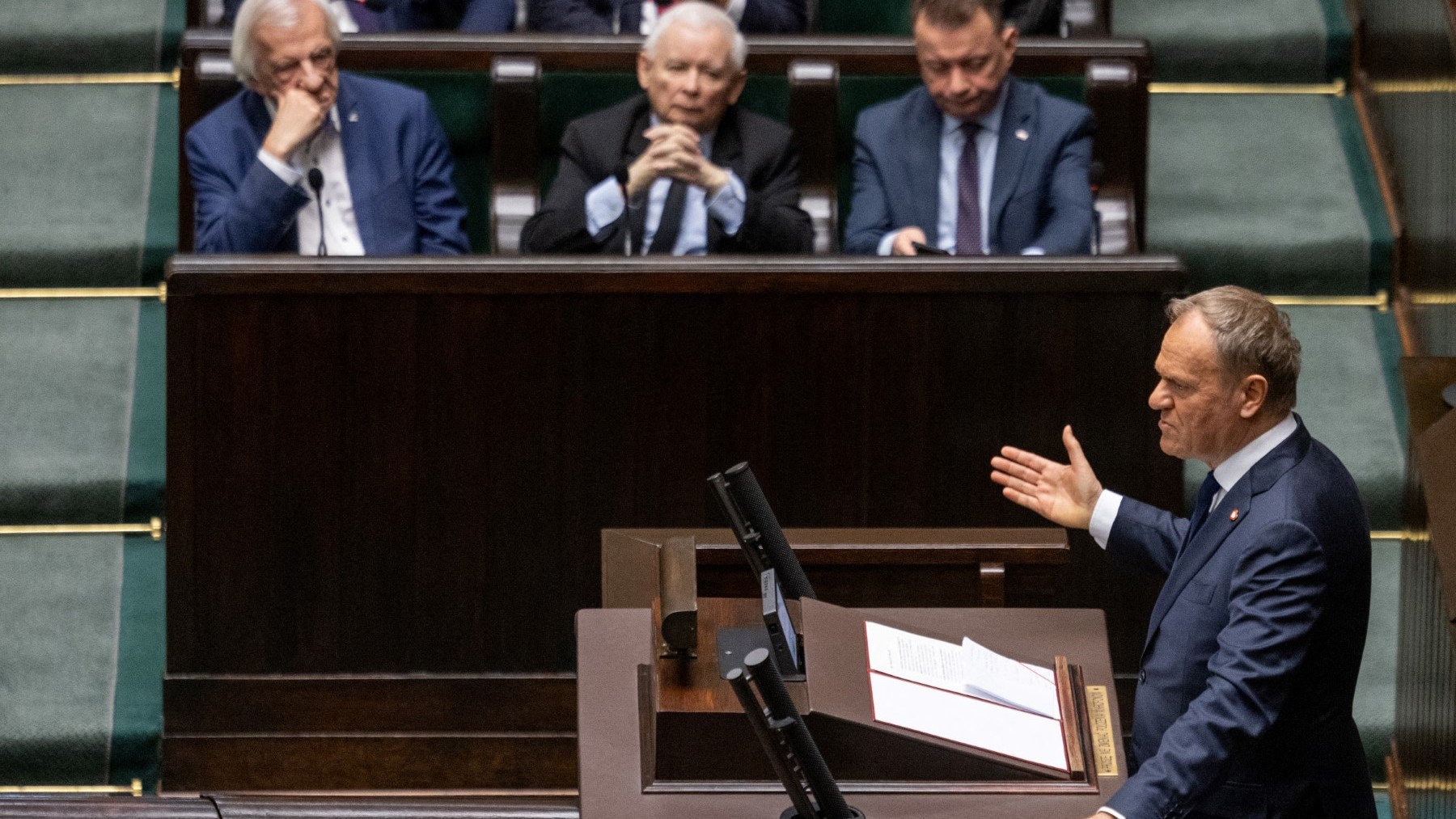
Poland’s Prime Minister Donald Tusk (R) addresses parliament on the situation in Ukraine, as Polish former prime minister and leader of the Law and Justice (PiS) party Jaroslaw Kaczynski (2ndL) listens, in Warsaw, on March 7, 2025.
WOJTEK RADWANSKI / AFP
Poland’s main opposition party has pledged to block Ukraine’s accession to the European Union unless Kyiv changes its approach to the legacy of the Ukrainian Insurgent Army (UPA), as a widening diplomatic dispute continues to strain relations between the two neighbouring countries.
In a letter to members of the opposition conservative Law and Justice (PiS) party, leader Jarosław Kaczyński declared that a future PiS government would refuse to approve Ukraine’s EU membership unless Kyiv abandoned the “cult of Bandera” and the glorification of the UPA and the Organisation of Ukrainian Nationalists (OUN).
Kaczyński argued that Poland “cannot allow Banderism, one of the most criminal and inhuman ideologies,” to enter the European Union. He also urged party members to oppose liberal Prime Minister Donald Tusk’s efforts to integrate Ukraine into the bloc on “privileged terms.”
The UPA remains one of the most divisive issues in Polish-Ukrainian relations. In Ukraine, it is regarded as a symbol of the country’s struggle for independence from Soviet rule. In Poland, however, the organisation is held responsible for the Volhynia massacres, in which around 100,000 ethnic Polish civilians were killed during the Second World War.
Embed:
The dispute intensified in May after Ukrainian President Volodymyr Zelensky named a military unit after the “heroes of the UPA.” The decision prompted Polish President Karol Nawrocki to revoke Zelensky’s Order of the White Eagle, Poland’s highest state honour.
Ukraine has sought to calm the row. Following recent talks in Warsaw, Foreign Minister Andrii Sybiha proposed an “anti-crisis package,” including consultations between the two foreign ministries and meetings between historians.
Sybiha insisted that the military unit’s name had not been intended as an anti-Polish gesture but stopped short of offering to change it. Polish officials welcomed the talks but stressed that declarations alone would not be enough, with Deputy Foreign Minister Marcin Bosacki saying Warsaw expected a “correction” of the decision.
Meanwhile, the controversy has spilled into domestic politics. Krzysztof Bosak, the co-leader of the right-wing opposition Konfederacja party, accused Ukrainian opinion leaders of conducting an organised online information campaign designed to counter Poland’s narrative on the UPA and create a false moral equivalence between wartime crimes committed by different sides.
Poland has been one of Ukraine’s staunchest allies since the Russian invasion in 2022. Warsaw has provided military and financial aid to Kyiv, and has welcomed millions of Ukrainians refugees to Poland.
The diplomatic crisis has reached such a depth that even military assistance is being called into question. Opposition politicians have accused the Polish government of secretly transferring PAC-3 interceptor missiles for Patriot air defence systems to Kyiv without informing parliament or the public.
Krzysztof Bosak said the interceptors had been supplied in March, and that they were among the most valuable assets in Poland’s air defence and the only weapons capable of intercepting Russian Iskander ballistic missiles.
The government initially declined to confirm the reports, however, speaking on Monday, June 6th, Prime Minister Donald Tusk publicly confirmed the transfer. Tusk defended continued military assistance, arguing that every Russian missile intercepted over Ukraine also enhanced Poland’s own security. He also accused the opposition of risking national security by turning military assistance into a domestic political dispute.