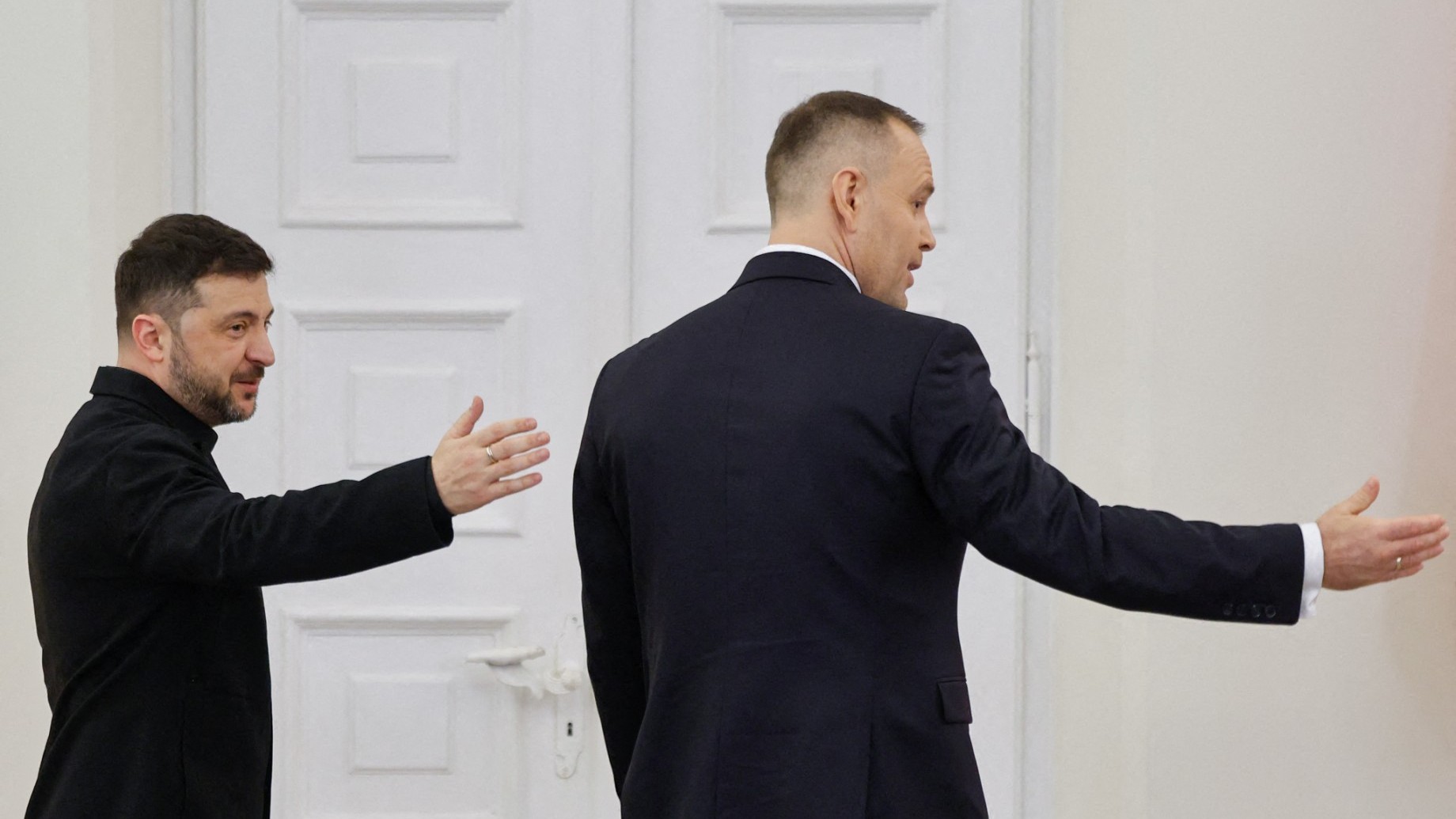
The diplomatic spat between Ukraine and Poland is showing no signs of abating: Polish politicians from across the political spectrum have harshly criticised Ukrainian President Volodymyr Zelensky for his most recent words aimed at Poland, with some suggesting that Warsaw should block Kyiv’s EU accession negotiations.
The backlash came after Zelensky announced on Ukraine’s Constitution Day on Sunday, June 28th, that he had submitted legislation creating a National Pantheon to commemorate Ukrainians who, “across different centuries and eras,” fought for the country:
No one, ever, will dictate how we should live, how we should speak, whom we should love, whom we should be grateful to, or which heroes we should honour.
Zelensky added that the pantheon would permanently enshrine those who fought for Ukraine’s independence, as well as figures who contributed to the country’s statehood, culture, science, sport, civil society, religion, and language.
Although Zelensky did not mention Poland directly, his remarks were widely interpreted as a response to criticism over his decision in May to name a Ukrainian military unit after what he referred to as the “heroes” of the Ukrainian Insurgent Army (UPA).
The UPA remains one of the most contentious issues in Polish-Ukrainian relations. In Ukraine, it is widely regarded as a symbol of resistance against Soviet rule. In Poland, however, it is associated with the massacres of around 100,000 ethnic Polish civilians in the Second World War.
The latest announcement that “no one will dictate which heroes” Ukraine would honour prompted criticism from across Poland’s political spectrum.
Former conservative prime minister Mateusz Morawiecki described it as “another slap in the face to Poland” and called on Warsaw to block the completion of Ukraine’s European Union accession negotiations until historical disputes are resolved.
Robert Kropiwnicki, an MP from Prime Minister Donald Tusk’s governing liberal Civic Coalition, warned that “if Zelensky thinks that by escalating the conflict with Poland, Ukraine will join the EU, he may be in for a major disappointment.”
Politicians from the right-wing opposition Konfederacja party also urged Poland to oppose any form of accelerated EU integration for Ukraine.
A group of Polish members of the European Parliament has meanwhile requested a debate and resolution commemorating Polish victims of UPA massacres. Former Polish ambassador to Kyiv Bartosz Cichocki described the proposed pantheon as “a deliberate signal of escalation,” arguing that Ukraine appeared to be provoking a stronger Polish response.
The dispute escalated earlier this month when Polish President Karol Nawrocki revoked Zelensky’s Order of the White Eagle, Poland’s highest state honour, over the military unit’s name.
Several senior Ukrainian politicians, including former presidents Leonid Kuchma, Viktor Yushchenko, and Petro Poroshenko, subsequently returned their own Polish decorations in protest, while Zelensky cancelled plans to attend last week’s Ukraine Recovery Conference in Gdańsk.
Because Ukraine’s accession to the EU requires the unanimous approval of all member states, Kyiv may find itself unable to move forward with its membership bid.