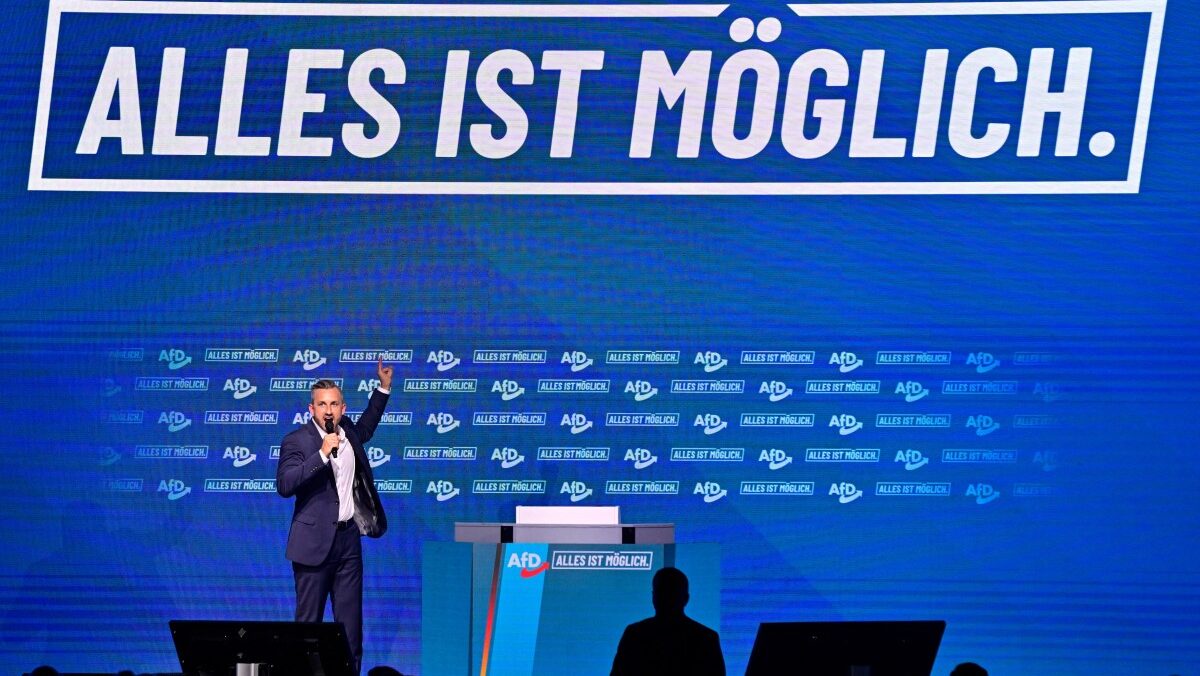
Ulrich Siegmund, AfD top candidate for Saxony-Anhalt, addresses supporters during an election campaign event ahead of the state elections in Saxony-Anhalt, in Magdeburg, eastern Germany on July 18, 2026. The crucial state election in the German eastern federal state of Saxony-Anhalt is scheduled to take place on September 6, 2026.
JOHN MACDOUGALL / AFP
The right-wing Alternative für Deutschland (AfD) has surged to a record 42% in a new poll in Saxony-Anhalt, putting the party 20 percentage points ahead of the governing centre-right CDU just four weeks before the state election.
The Insa survey, published on Monday, August 10th, puts the AfD up one percentage point from its previous result, while the CDU of Prime Minister Sven Schulze has fallen two points to 22%.
Insa chief Hermann Binkert said there is no chance the CDU will overtake the AfD by September 6.
Sonntagsfrage zur Landtagswahl in Sachsen-Anhalt • INSA/BILD: AfD 42 % | CDU 22 % | DIE LINKE 13 % | SPD 6 % | BSW 5 % | FDP 4 % | GRÜNE 4 % | Sonstige 4 %
— Wahlrecht.de (@Wahlrecht_de) August 10, 2026
➤ Verlauf: https://t.co/lMOn56cNLK
🗓️ Landtagswahl: 6. September 2026 #ltwlsa #ltwst pic.twitter.com/SHYaagXPWm
The far-left Die Linke is currently on 13%, while the Social Democrats (SPD) have risen one point to 6%.
The left-wing nationalist Bündnis Sahra Wagenknecht (BSW) is also on the 5% threshold after gaining one point. The Greens and the liberal FDP are each polling at 4% and would currently fail to enter the state parliament.
The new poll once again confirms the declining popularity of the establishment parties, whom voters no longer trust to deal with the most pressing issues, such as the migration crisis, the loss of competitiveness, the declining economy, and high energy prices.
Saxony-Anhalt has been governed by the CDU-SPD-FDP trio for the past five years.
The result in September could have major implications for the formation of the next state government. If only one of the four parties currently hovering around the 5% threshold enters parliament, the AfD could potentially secure an outright majority of seats.
If the party does indeed reach 42% on election day, it would be the AfD’s strongest performance in any German state election.
Even without an absolute majority, the party could have a route to power. Under Saxony-Anhalt’s rules, an absolute majority is required in the first two rounds of the prime minister election, but a simple majority is sufficient in the third. An abstention by BSW lawmakers could therefore potentially allow AfD lead candidate Ulrich Siegmund to become Germany’s first AfD state leader.
BSW has explicitly made removing current Prime Minister Sven Schulze a central election objective. Party founder Sahra Wagenknecht has called for his replacement by a non-party-affiliated prime minister who would end the so-called Brandmauer, the mainstream parties’ refusal to cooperate with the AfD.
The CDU is facing pressure to seek support from Die Linke to prevent an AfD government. Die Linke co-leader Luigi Pantisano has said he would not rule out supporting Sven Schulze in a prime minister vote, arguing that his party had previously helped prevent the AfD from taking power in other eastern German states.
The AfD has already unveiled an ambitious 100-day programme for government, including tougher deportation policies, changes to welfare provision for asylum seekers, cuts to funding for NGOs and party foundations, and reforms to public broadcasting.