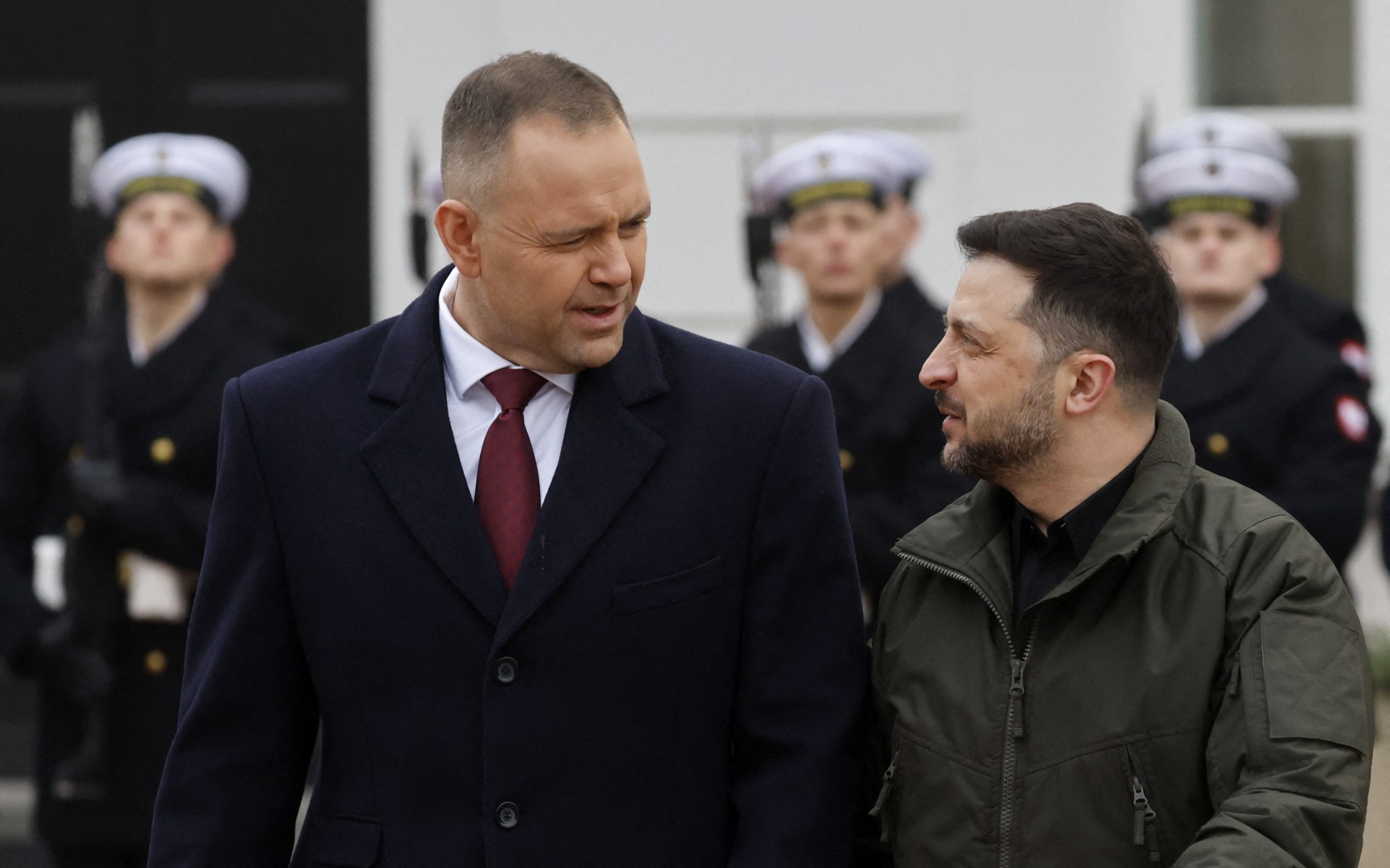
Polish president Karol Nawrocki and Ukrainian president Volodymyr Zelensky
Wojtek RADWANSKI / AFP
Polish president Karol Nawrocki has stripped his Ukrainian counterpart, Volodymyr Zelensky, of Poland’s highest state honor, the Order of the White Eagle, after he named a Ukrainian army unit “Heroes of the UPA”—a reference to partisans who massacred over a hundred thousand Polish civilians during World War II.
“President Zelenskyy has shown that Ukraine, in terms of mentality—glorifying bandits, murderers from the Ukrainian Insurgent Army [UPA]—is not ready to be part of the European family,” Nawrocki explained.
The Polish president stated that although this move does not mean Poland would stop supporting Ukraine’s war effort, it is “not merely symbolic; it is also a warning signal.” Nawrocki stressed: “There are boundaries that must not be crossed in Polish-Ukrainian relations.”
The sensitive question of the UPA falls into this category, even though Zelensky insists he has chosen the name “to restore historical traditions” that many Ukrainians are proud of.
However, while many Ukrainians view the UPA primarily as a force that later fought Soviet rule, Poland mostly remembers the Ukrainian Insurgent Army for allying with Nazi Germany and undertaking a systematic ethnic cleansing of native Poles in Volhynia and Eastern Galicia (what is now Western Ukraine), leading to the massacre of up to 100,000 civilians between 1943 and 1945 as part of an effort to create an ethnically homogenous Ukrainian state.
The peak of the pogrom was the so-called “Bloody Sunday” (July 11, 1943), when UPA combatants attacked nearly 100 Polish towns and villages in a coordinated effort, indiscriminately killing men, women, and children. Other victims included some 30,000 Armenians, Jews, Czechs, Georgians, Russians, and even Ukrainians who opposed their bloody campaign.
Nawrocki’s decision has not united Poland’s political class. PM Donald Tusk, leading a center-left coalition, criticized the move for handing an easy win to Russia and legitimizing Putin’s narrative about Zelensky.
“If we quarrel about the past, someone else will win the future,” PM Tusk warned, suggesting that if Poland and Ukraine continued down this road, “the Kremlin will truly have reason to rejoice.”
Zelensky himself reacted by posting photos of the award, given to him in 2023, as he was preparing to send it back to Poland at a Kyiv post office. At the same time, he didn’t admit he made a mistake nor did he reverse his decision, but suggested the dispute stemmed from “conflicting interpretations” of historical events.
“Ukraine will remain open to all meaningful formats of engagement with Poland in order to try to avoid conflicting interpretations of the difficult and painful chapters of our shared past,” Zelensky wrote, while adding he was grateful for Poland’s financial and military support.
In a later interview, however, the Ukrainian president adopted a more confrontational tone. Zelensky referred to UPA fighters as “great historical figures,” and suggested Nawrocki should focus on maintaining good relations with a country that is “defending Europe today, including Poland.”
🇺🇦🇵🇱 Zelensky took a swipe at Polish President Karol Nawrocki, opening with "Karol, that's his name, right?" as if he isn't sure, before lecturing Poland that it "doesn't have a monarchy, it has a democracy."
— DD Geopolitics (@DD_Geopolitics) June 21, 2026
Rich coming from a man who hasn't held an election since his own term… pic.twitter.com/6gYdtJmGp3