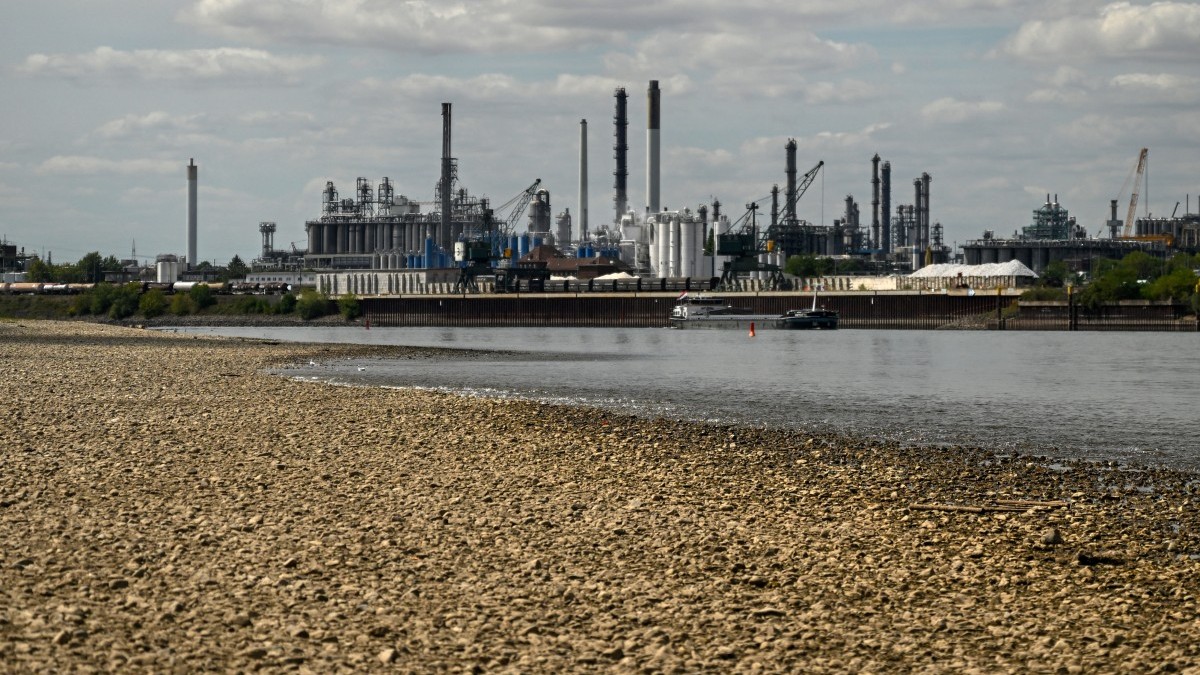
A vessel sails past the partially dried-up river bed of the Rhine at the Shell Energy and Chemicals Park Rheinland – Nord in Godorf near Cologne, Germany on August 7, 2026, following exceptionally hot weather.
INA FASSBENDER / AFP
Europe has so far avoided a widespread blackout, but the summer of 2026 has exposed a vulnerability that until recently was associated almost exclusively with winter: extreme heat can also put the electricity system under severe pressure.
The European Commission convened an extraordinary meeting of the Electricity Coordination Group on August 11 after drought and high water temperatures reduced power generation in several member states.
Brussels ruled out immediate adequacy risks, although it acknowledged that the situation would remain “tight.”
The warning came barely two and a half months after the European Network of Transmission System Operators for Electricity (ENTSO-E) published its Summer Outlook 2026. The report did not foresee widespread risks for most of Europe, but it had already identified potential problems in poorly interconnected markets and anticipated higher peak demand, lower hydropower availability and 12 GW less available thermal capacity.
At the same time, the EU had added more than 90 GW of renewable capacity compared with the previous summer and doubled its installed battery capacity.
The contrast does not show that European planning has failed, but rather that installed capacity is not the same as real resilience.
The Commission itself acknowledges that high solar output has eased pressure on prices during the middle of the day, but also that storage remains essential to shift that electricity towards the evening peak, when solar generation falls away while cooling demand remains high. And that relief can only come from electricity generation by plants such as nuclear facilities, which had previously been demonised.
Poland provides one of the clearest examples. Its electricity system operator, PSE, activated extraordinary capacity-market measures in August for the second time in three days and the third time over the summer. Two coal-fired power plants cooled with water from the Vistula reduced operations, leaving around 1.1 GW of capacity unavailable. Before this summer, the mechanism had been used only twice since 2018.
The pressure does not discriminate between technologies either. Le Monde reported reductions or shutdowns at power plants in France, Italy, Poland, Hungary, Romania and Slovenia because of low river levels or excessively high water temperatures. Nuclear power is not immune to drought and higher water temperatures. But the opposite conclusion—that renewables alone can replace all firm capacity—cannot be drawn from what has happened either. The International Energy Agency argues that solar and wind must be complemented by dispatchable resources and points to nuclear power, where it is accepted, as a technology capable of contributing to grid stability and security of supply.
Despite policies hostile to nuclear power that were driven by environmentalist ideology, the European Commission has in recent days strengthened its commitment to nuclear energy through new investment, support measures, and regulatory changes intended to guarantee competitiveness, energy security, and independence from gas and oil. The total amounts to almost €200 billion over the coming years.
The conclusion Brussels is beginning to accept is less ideological than the one that has dominated until now: a system exposed to heat, drought, consumption peaks and hydrological constraints requires a diversity of energy sources, storage, networks and backup infrastructure. No single technology can address all of those variables on its own.
European interconnection, by contrast, has demonstrated its usefulness. According to the Commission, cross-border electricity exchanges made it possible to move power to the areas where it was most needed.
The lesson is that Europe needs cooperation that must be distinguished from uniformity: sharing capacity between neighbouring countries does not require every country to build the same energy system.