President of Ukraine Volodymyr Zelensky and Prime Minister of the United Kingdom Boris Johnson walked around the center of Kyiv, 9 April 2022,
President Of Ukraine from Україна, CC0, via Wikimedia Commons
Previous articles: Did a Million Pounds Buy a War? Johnson, Harborne, and QinetiQ
Kyiv, April 9, 2022. The Ukrainian capital woke up amid ruins and rumors. After weeks of fighting and discreet mediation, diplomatic circles were abuzz with talk of a possible ceasefire under international supervision. Russian and Ukrainian delegations, with Turkish mediation, had advanced on a draft agreement combining neutrality with international security guarantees.
That same day, Boris Johnson landed in Kyiv. Officially, his visit was intended to express British support for the government of Volodymyr Zelensky. In practice, it was much more than a gesture. Internal documents, diplomatic itineraries, and subsequent testimonies indicate that this trip marked the point at which diplomacy gave way to strategy. What might still have been resolved at a negotiating table was transformed, from that moment on, into a war of attrition.
Between late March and early April 2022, the possibility of a political solution was real. The talks in Istanbul had produced a preliminary text that included a neutrality clause for Ukraine, overseen by international guarantors such as Turkey, Germany, or even the United Kingdom. Moscow, according to sources close to the negotiations, was willing to consider a partial withdrawal if Kyiv pledged not to join NATO. The draft also envisaged a special status for Crimea and a postponement of the Donbas issue.
It was neither a surrender nor a victory, but an imperfect framework that could have halted escalation. “There was room for understanding,” admitted a European diplomat involved in the talks months later. “Both sides were exhausted, and Turkey was moving fast. But what was missing was political will in the West.”
In that fragile context, Johnson’s visit added pressure. Documents from the Foreign Office hint at the directive behind his trip: to prevent any premature deal that could be seen as a concession to Moscow. In other words, to do everything possible to make the peace framework collapse.
The British mission arrived with an unambiguous mandate. Johnson told Zelensky that any ceasefire without total victory would have consequences: an immediate freeze on Western financial and military support. The British prime minister argued that negotiating at that point would amount to legitimizing the invasion. His line was clear: “Putin must fail, and he will fail.” Ukraine, in his calculus, was little more than a broken tool against Russia.
Johnson’s stance was not improvised. Official briefing documents from his own office between February and April 2022—obtained by europeanconservative.com—repeated the same mantra: “The only way to end this war is for Ukraine to win—and to win as fast as possible. The sooner Putin fails, the better for Ukraine and for the whole world.”
The April visit was therefore not an exception but the opening act of a diplomatic campaign designed to erase any trace of negotiation from Western discourse.
Diplomatic sources agree that Johnson did not act alone. His message reflected the consensus of the Atlantic bloc—Washington, London, Warsaw, and the Baltic states—which saw in the war an opportunity to weaken Russia structurally. France and Germany, though more cautious, did not challenge that line publicly. In Brussels, some officials called it “strategic realism”; others, more skeptical, saw it as the definitive end of diplomacy.
This coordination is confirmed in British government documents dated 21 September 2022, in which Downing Street stressed that “the UK’s military aid to Ukraine will be maintained or exceeded in 2023” and that “Putin must fail.” The tone of those papers reveals that Johnson’s mantra had been institutionalized as official policy for both the United Kingdom and NATO.
The reaction in Kyiv was immediate. In the days following Johnson’s visit, Zelensky hardened his rhetoric. On April 12, Foreign Minister Dmytro Kuleba declared that Ukraine would not sign “any document that does not entail the complete withdrawal of Russian forces.” The next day, Zelensky told parliament that the country would fight “until every centimeter of our territory is regained.”
The tone of Ukraine’s official communications changed. Messages to NATO and internal reports began to reflect a stark dichotomy that persists to this day: total resistance or defeat. Joint statements issued by London and Washington erased any reference to “negotiations” or “dialogue.” In their place appeared the new language of “victory,” “unity,” and “liberation.”
Johnson’s decision cannot be understood without its political and strategic context. In the spring of 2022, his government was facing a dual crisis. The Partygate scandal was eroding his domestic authority, and the United Kingdom was eager to reclaim international prominence after Brexit. Being the first Western leader to visit Kyiv offered Johnson a double opportunity: to reinforce his moral leadership image and to consolidate British influence in Eastern Europe, a region traditionally dominated by Germany.
On the industrial side, London had tangible interests. Companies tied to Britain’s defense sector were already preparing for an expansion of the Ukrainian arms market. In that sense, prolonging the war meant consolidating a new economic and strategic axis: the United States–United Kingdom–Eastern Europe. What leaked documents help clarify is whether this was a planned scenario—or simply an opportunity that quickly became profitable.
In Brussels, the reaction was ambivalent. Officially, EU institutions praised Johnson’s visit as a demonstration of “unity and leadership.” Privately, several diplomats expressed concern. Italy and Hungary warned that a prolonged escalation could jeopardize the continent’s economic stability—as indeed it has. France, then holding the EU Council presidency, tried to maintain an open line with Moscow but was sidelined. Germany, under pressure from its Eastern allies, eventually aligned with the Atlantic stance.
From that April onwards, the conflict entered a new phase. Military logic replaced diplomacy. Political objectives were submerged under an epic narrative that justified endless sacrifice. The flow of weapons increased exponentially, and with it, Europe’s dependency on the United States and the United Kingdom.
Sanctions against Moscow—intended to “strangle the aggressor”—also triggered an unprecedented energy crisis within the European bloc itself. By the end of 2022, the total cost of the war had exceeded €600 billion, while inflation surged and Europe’s strategic industries faced closures and relocations. Few in Brussels dared to admit that this shift—sealed by Johnson’s visit—had redefined not only the course of the war but Europe’s role within it.
In light of the available evidence, the British prime minister’s visit was not an improvised gesture but a political decision with structural consequences. The message he brought to Kyiv was clear: do not negotiate, resist, and prolong. That directive turned a limited war into an open-ended conflict that still shapes European politics and the global balance of power today.
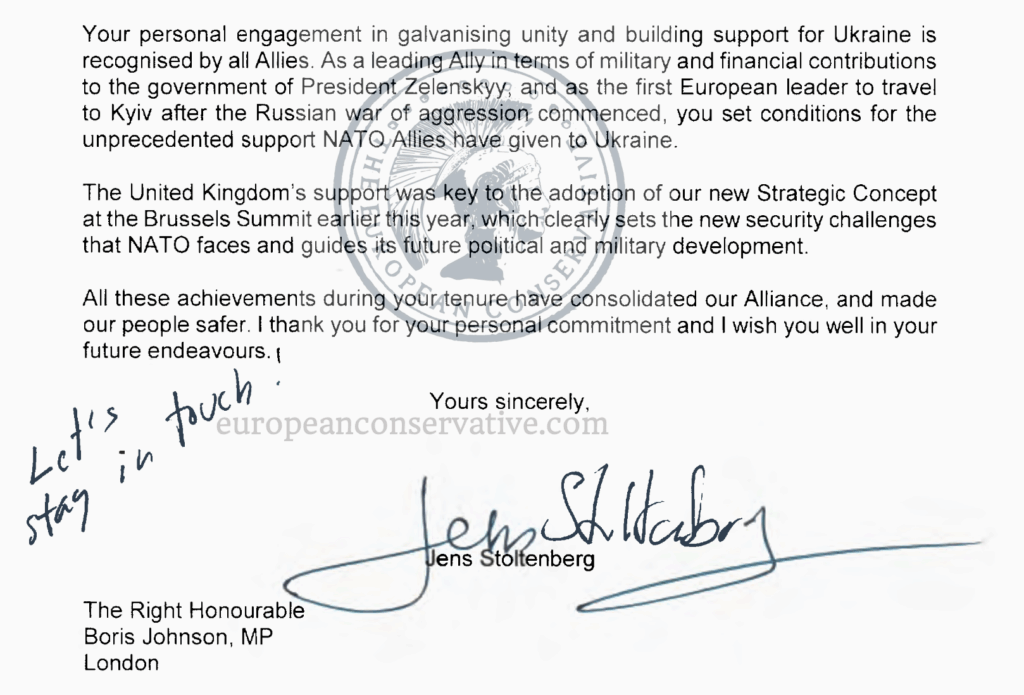
Even after leaving Downing Street, NATO explicitly acknowledged Johnson’s role in this strategic shift. In a personal letter dated September 9, 2022, seen by this publication, former Secretary-General Jens Stoltenberg thanked Johnson for his “leadership in galvanising unity and building support for Ukraine,” noting that his visit to Kyiv had “set conditions for the unprecedented support NATO Allies have given to Ukraine.”
The letter, printed on NATO letterhead and signed in Stoltenberg’s own hand, confirms that the April trip was not merely symbolic—it formed part of a political design validated and celebrated by the Atlantic alliance itself.
It was not a miscalculation but a deliberate strategy: to sacrifice immediate peace in the name of a broader goal—weakening Russia, strengthening NATO, and reaffirming Anglo-American influence over Europe. Three years later, the results are clear. Ukraine endures, but is devastated; Russia has adapted; and Europe bears the economic and social cost of a war it no longer controls.
On April 9, 2022, Kyiv expected news of a possible agreement. What it received was a mandate for resistance. That day, the decision was not military but political: a strategy was chosen that made war permanent and peace a suspect word. Johnson was not the only architect, but his visit symbolized the moment when negotiation became unacceptable. Since then, Europe has lived under the consequences of that choice—more dependent, more divided, and less sovereign.