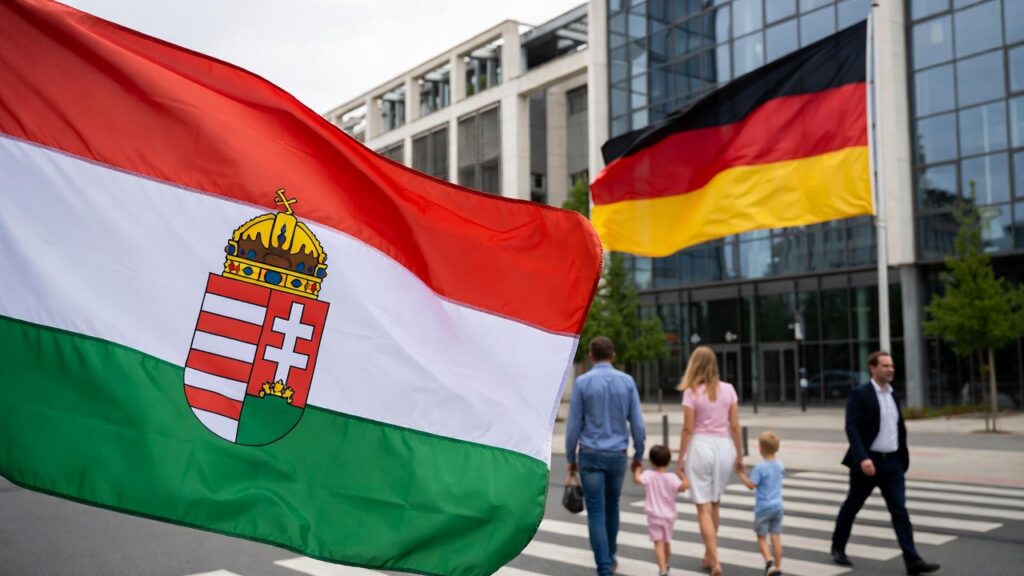
For the past 15 years, Hungary has stood as a beacon of successfully implemented conservative policy in Europe. Under Prime Minister Viktor Orbán, the country has demonstrated that conservatism is not just a set of ideas but very much a conduit for making people’s lives better.
Thanks to the Fidesz leadership, Hungary has transformed itself from a fledgling social democratic welfare state to an accomplished example of family-friendly conservatism. The results have materialized on many fronts, from consistently high economic growth and plenty of foreign direct investment to low crime and rising fertility rates.
So far, the rest of Europe has balked at following Hungary’s example. This is unfortunate, of course, but that might be about to change. A debate has emerged in Germany over the so-called Sozialstaat, the elaborate German version of the traditional socialist European welfare state. It started last summer when Chancellor Merz explained that he no longer thought the welfare state was affordable.
Whether Merz is aware of it or not, the reason why his country can no longer sustainably fund its welfare state is that it is designed according to the same socialist ideology that has dominated Europe since the 1930s. These welfare states emphasize economic redistribution: their fiscal mechanics take from the ‘rich’ and give to the ‘poor.’
By contrast, the Hungarian welfare state emphasizes the formation, growth, strength, and longevity of the nuclear family.
Merz fails to realize (or at least acknowledge) that the redistributive welfare state is inherently fiscally unsustainable—its very design undermines its own longevity. Making minor cuts to welfare programs while raising taxes to pay for what is left only amounts to ‘rearranging the deck chairs on the Titanic’; the unaffordability of the socialist welfare state is not a bug, but a feature.
The German chancellor has run into several problems getting even minor fiscal adjustments done and set the stage for angering voters. Austerity does not reform the socialist welfare state; it only makes the welfare state more expensive through higher taxes and weaker benefits. Imagine going into a car dealership to buy a new Audi, and the dealer offers you one made in 2024 but wants you to pay the same price as for a 2026 model.
So far, the chancellor has strong popular support for his view that the German Sozialstaat is unaffordable, but that support is unlikely to last when it goes up against a two-pronged challenge:
Since the effects of austerity only gradually work their way into the economy, at present Merz’s biggest challenge is the unabashedly socialist opposition. Ideally, Merz would counter it by using Hungary as a good example of how Germany could reinvent its Sozialstaat and make it affordable, efficient, and a true companion for German families.
Unfortunately, it is unlikely that Merz will invoke Hungary, at least not in the short run. This puts him at a disadvantage in the face of the Left’s all-out efforts to defend their socialist construct. In a commentary last September for the Rosa Luxemburg Stiftung, Ines Schwerdtner, co-chair of the ultra-left Die Linke party, explains that Chancellor Merz’s welfare state reform plan does not necessarily lead to a situation where
there will be no more government aid or assistance for the needy. What it does amount to is an abandonment both of the fundamental idea that society should protect individuals from risks to their lives and of basic rights to social participation and care regardless of individual circumstances or misfortunes. People are to face the welfare system as petitioners and receive only the bare minimum.
Back in November, Cansin Köktürk, a member of the German parliament for Die Linke, offered an even more pointed comment. The goal with the CDU’s welfare-state reforms
isn’t saving money; it’s all about power and propaganda. The government keeps people in a state of fear and weakens their solidarity, because those who are worried about being able to pay their rent every month generally have less bandwidth to make demands.
The German Left uses ideology not only to defend the welfare state but also to formulate solutions to the unaffordability problem. As I noted in my first article on Chancellor Merz’s ‘unaffordability’ comment, the go-to policy response is to raise taxes on the rich; the leftist myth behind this idea is that “those who have the most are asked to pay the least.”
German conservatives must step up to the plate here. They can start with dispelling the myth that the ‘rich’ in Germany do not pay their ‘fair share’—or confront the Left with the facts and force them to define what they really mean by ‘fair.’’
In a report from 2016, the German Institute for Economic Research, DIW, provides insightful data on the distribution of personal income and of tax burdens across income deciles. Figure 1 reports their numbers, which reveal the degree of fairness in a tax system. It shows how much of all direct taxes—i.e., taxes on personal and corporate income—that fall on each income decile. That tax responsibility is then compared to their share of total personal income.
Consider two examples. The income earners in Decile 4 earn 5.7% of total taxable income in Germany, but they pay only 1.1% of all direct taxes. If we divide 1.1 by 5.7, we get a fairness score of 0.19 for the income earners in Decile 4. By contrast, the income earners in Decile 10 make 32% of all income but pay 59% of all direct taxes, rendering them a fairness score of 1.84.
Figure 1
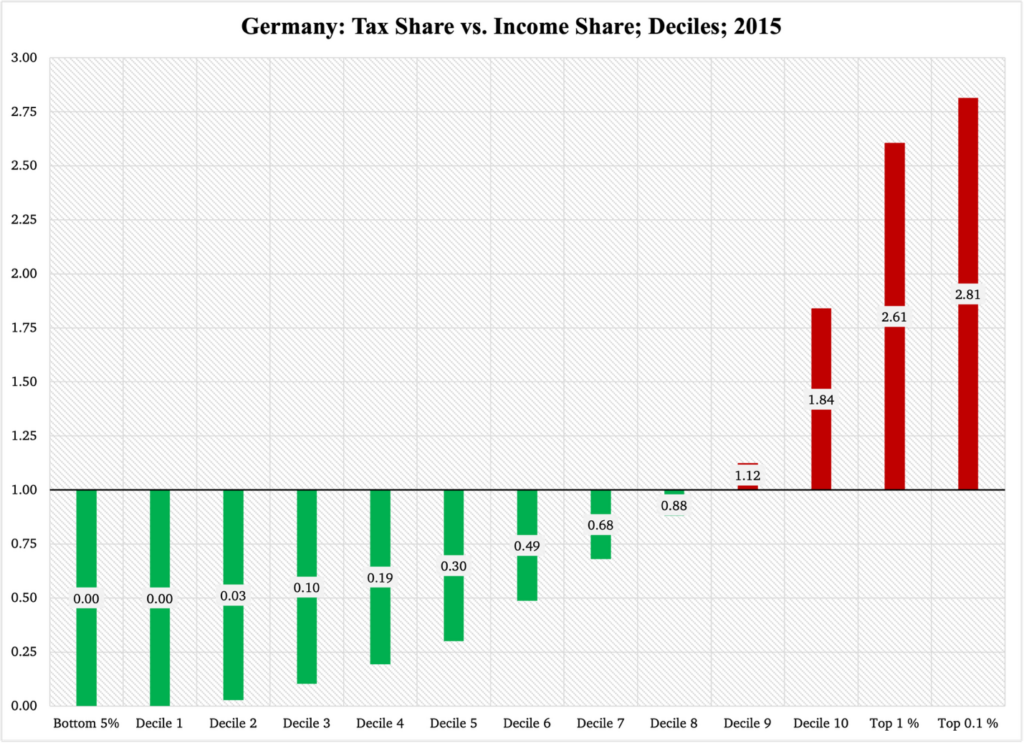
A fairness score of 1 or higher means that the income earners in that particular group are overtaxed; by contrast, a fairness score below 1 shows income earners who do not pay their fair share of income taxes. A fairness score of exactly 1 means the income group is evenly balanced between income and taxes.
Since the numbers in Figure 1 are more than a decade old, here are similar figures, this time from the German federal statistics agency, DeStatis, and grouped by actual income levels. Everything else is the same:
Figure 2
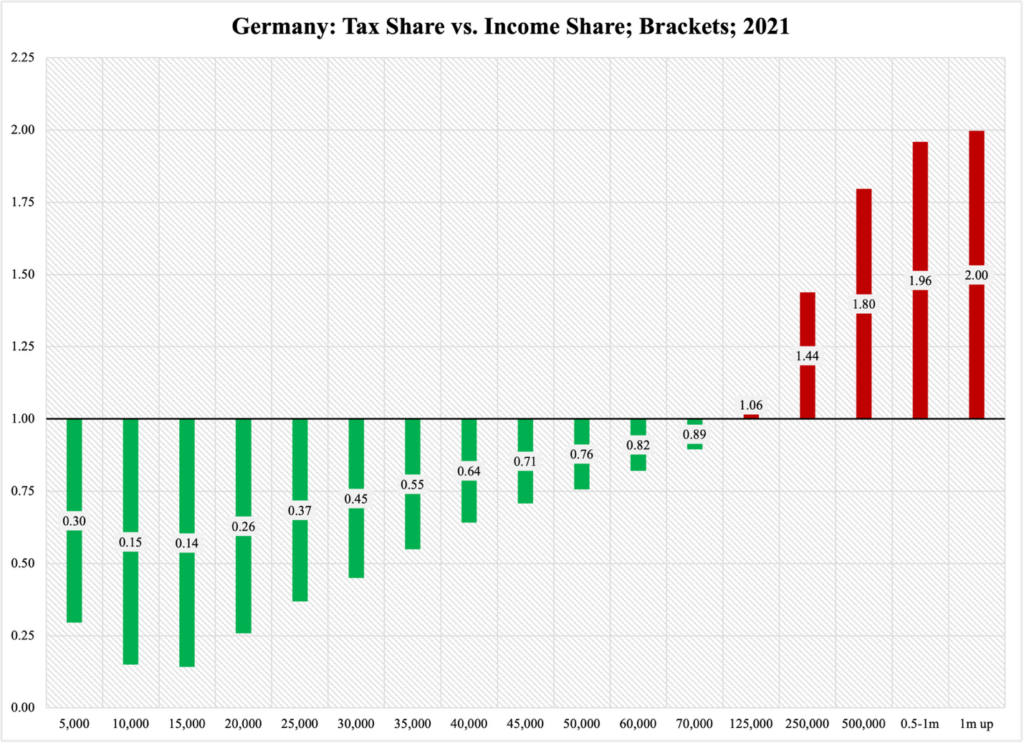
Figures 1 and 2 unambiguously show us how progressive the German income tax system is. This also means that it is redistributive: it asks ‘the rich’ to pay a lot more out of every euro they make than ‘the poor’ do—and to carry a much larger share of the total tax burden than they would if the system were fair.
This means, of course, that the left has no case to make by suggesting that the most productive German income earners should pay ‘their fair share’ in taxes to the welfare state. More than that, though, it means that the conservatives can conquer one of the pet arguments from the left and make it work for them: the progressive, redistributive tax system is actually not fair in the first place. Increasing the progressivity would only exacerbate the unfairness.
Only a proportionate tax system, which applies the same tax rate to all income brackets, can guarantee fairness. That is, of course, not the concept of fairness that the Left is working with, but by seizing the initiative in the tax policy debate, conservatives can call the Left out and force them to define just how much more taxes they want higher-earning citizens to pay.
A conceptual quest of this kind would be a good starting point for a conservative counterstrike to the Left’s well-rehearsed ideological defense of the welfare state. From there, it is natural to expand the ideological argument into a defense of the nation and its quintessential building block: the traditional family.
That argument, in turn, conveniently loops back to the original point about the welfare state’s fiscal sustainability. As Hungary has proven for well over a decade, a welfare state that focuses on the family, not on economic redistribution, is economically, fiscally, and socially sustainable.
Germany is not the only country with an unaffordable welfare state. The rest of Europe will be watching closely how Germany handles this affordability crisis. This puts a lot of responsibility on the conservatives in Germany to deliver—and also opens enormous opportunities for them to provide leadership and guidance to conservatives in other European countries.