Volkswagen, one of the world’s most famous product brands, is the second-largest car manufacturer in the world. Its reputation was built in no small part by such iconic models as the Type 1, a.k.a. the Beetle, and the Golf.
For decades, the ‘people’s car’ company has stood as a beacon of German engineering, industrialism, and business acumen.
Now, though, with its centenary just over a decade away, it looks like the industrial saga of this grand corporation is entering its twilight:
The Volkswagen group had a bruising year in profits and plans to cut 50,000 jobs in Germany by 2030—a dramatic escalation of its cost-cutting programme after net profit slumped 44% to €6.9bn in 2025, the carmaker’s worst result since the diesel emissions scandal nearly a decade ago.
These job cuts come on top of the 32,000 jobs that VW eliminated in 2024. If the current trend persists, by the end of this decade the VW group will have fired more than 12% of its workforce compared to the 2023 top number.
Although the reductions will have repercussions across VW facilities in several countries, the cut of 50,000 jobs will no doubt deal a blow to the German economy. Since 2021, Germany has lost approximately 381,000 manufacturing jobs; a large part of the 50,000 jobs now slated for the VW’s chopping block will hit their facilities in Germany.
It is tempting to brush off the overall decline in manufacturing jobs with some reference to economic evolutionary inevitability; conventional wisdom also tends to blame ‘globalization’ for the decline. However, during the same period that Germany lost 4.7% of its manufacturing jobs, the American economy created 537,000 new manufacturing jobs—a 4.4% increase.
Practically all those jobs were added before President Trump’s campaign to rewrite trade tariffs, reinforcing the point that the decline in the German manufacturing industry is not driven by exogenous forces—it is a domestic problem.
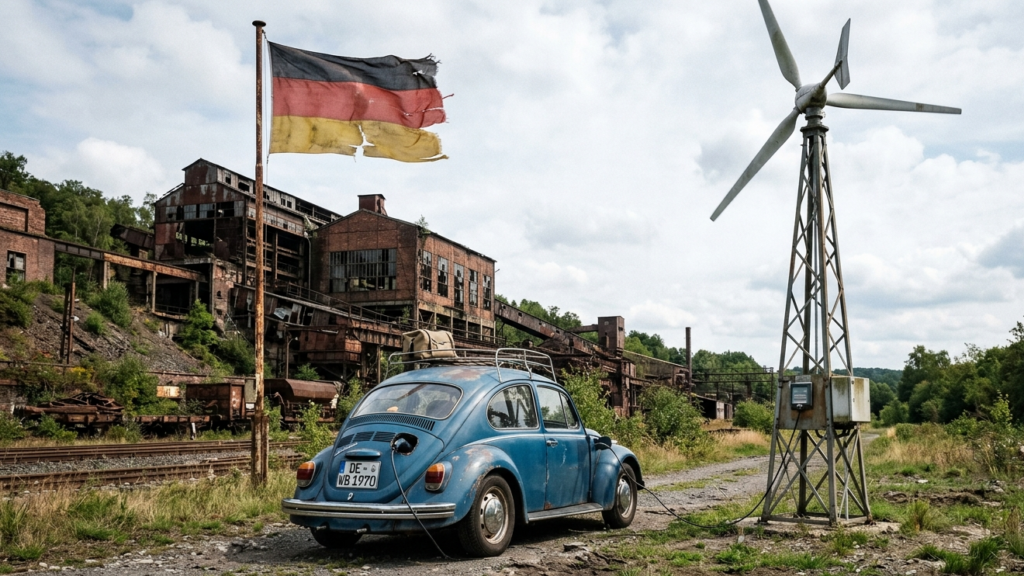
In the case of Volkswagen, its rise and slow demise are depressingly symbolic of Germany’s increasingly self-destructive industrial policy.
Although the exact history of how Volkswagen was born varies a little bit depending on the source, there is generally consensus around the notion that the company was born from a request for an automobile prototype from the German government in the mid-1930s. The government wanted an affordable, family-friendly passenger car that, among other things, could transport a family of five at 100 km/h (62 mph). It should also sell for less than 1,000 Reichsmark.
According to most history sources, no established auto manufacturer was able to produce the requested prototype within a budget that permitted a sales price at the level the government envisioned. In response, the German government allegedly ordered a state-owned production plant to be built in Wolfsburg, where production began in 1937 of a car designed by Ferdinand Porsche.
After World War II, the simple, reliable VW Type 1 earned a global market. From those humble beginnings, Volkswagen grew over the decades; in 2024, the VW Group was the world’s second-largest automobile manufacturer with a brand portfolio that includes the prestigious Audi, Bentley, Lamborghini, and Porsche.
However, no success is ever guaranteed. Volkswagen is now in a precarious financial situation. Reports Yahoo Finance:
The German carmaker reported that FY25 earnings after tax fell 44.3% year-on-year to €6.90bn ($8.04bn), a result that multiple reports described as its weakest performance in nearly a decade.
This is not just a bad-luck year. It is part of a trend. Figure 1 reports (courtesy of Macrotrends) VW’s net income—what is left after all revenue and expenses have been accounted for—as a share of gross profits, i.e., earnings minus variable production and sales costs:
Figure 1
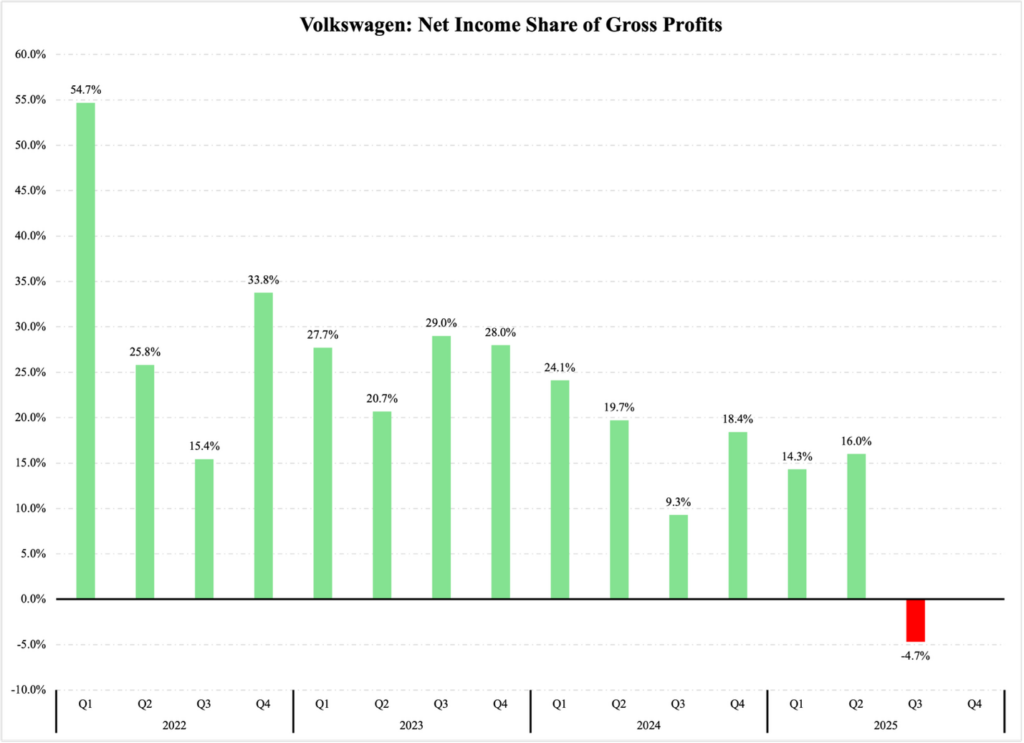
The slow decline in the ratio of net income to gross profits is revealing. It suggests that VW has a long-term problem with costs intrinsic to its current vehicle products. Volkswagen has been one of the most compliant car manufacturers in the world when it comes to phasing out internal combustion engines for electric vehicles:
Volkswagen Group recently hit a milestone: its 4 millionth electric vehicle. The company now ranks among the top-five EV manufacturers worldwide and No. 1 in Europe, where it accounts for 27 percent of the market. Volkswagen produced its first all-electric car in 2013. … Today, VW boasts an electrified lineup that features more than 30 all-electric vehicles ranging from compact cars to luxury SUVs.
It is important to distinguish between two major types of electric vehicles: the PHEV and the BEV. The former is the plug-in hybrid with both electric and internal combustion motors; the latter is the electric-only variant. Although Volkswagen has pursued leadership in both segments, their emphasis has been on BEVs. This has contributed to their challenges with staying profitable: a BEV needs much more of the comparatively expensive battery components that keep electric propulsion out of the market mainstream.
Car buyers worldwide say they like electric vehicles generally, but sales figures do not reflect that interest. While plug-in hybrids appear to be slowly establishing themselves as a legitimate option to internal combustion-only vehicles, the outlook for the BEV segment is increasingly problematic.
Overall, the EV share of car sales reached a peak in 2023; in 2024, their share of new vehicle sales fell in the European Union. The positive sales outlook from previous years, again defying survey-documented consumer preferences, shifted into the negative.
In 2024, car dealer lots in the United States began overflowing with unsold EVs.
There are practical reasons for consumer resistance to, in particular, BEVs. When they are really put to the test, they prove inferior to their traditional internal combustion competitors. The Austrian federal police has just wrapped up a test of EVs in patrol duty. The test resulted in a demotion of the EV fleet, from regular patrol duty to secondary functions. The EVs proved to be structurally unsuitable for pursuits and other forms of high-intensity police usage.
The vehicles that the Austrian police used were from Volkswagen. This does not mean that VW’s electric vehicles are worse than available alternatives—there is no reason to believe that EVs from a competitor would have fared better. On the contrary, if the Austrian police experiment shows anything, it is that electric propulsion is inherently unsuitable for general automotive applications.
Volkswagen has been among the most aggressive proponents of the phase-out of internal combustion. This ambition is in turn motivated by a worldwide ideological ‘climate change’ campaign. Herein lies an almost epic irony. The automotive manufacturer that was born from a government decree is now suffocating as a result of another government decree; the German government has taken a lead role in making the ‘green transition’ happen.
As if that was not bad enough, while VW fights for its corporate survival, the German economy is slowly sinking into industrial poverty. If the ‘people’s car’ is supposed to live on for another decade, its leadership will have to break the curse of being born from, and slowly bled to death by, government decree.