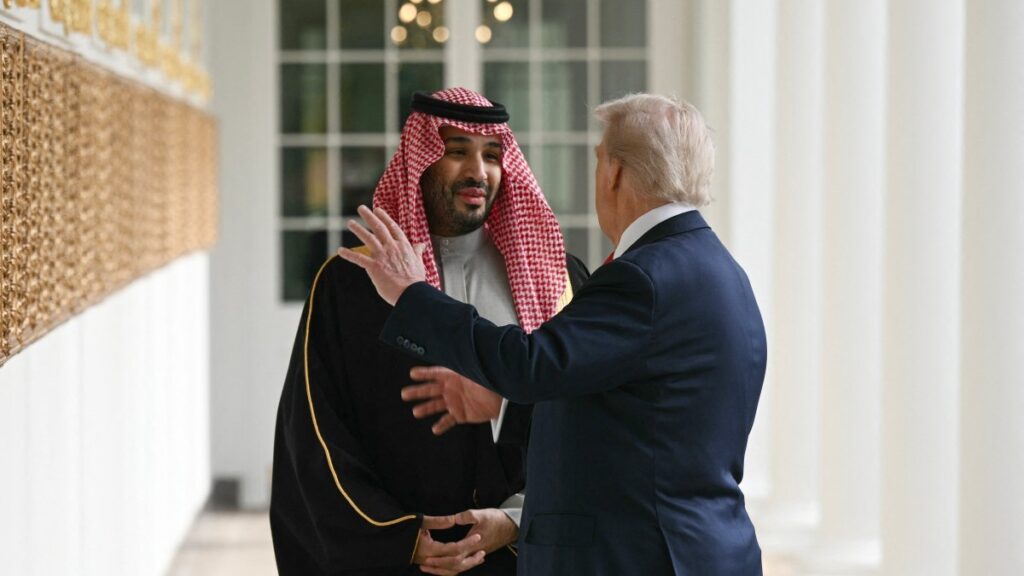
U.S. President Donald Trump and Crown Prince and Prime Minister of the Kingdom of Saudi Arabia Mohammed bin Salman converse as they walk down the Colonnade on the way to the Oval Office of the White House in Washington, D.C., on November 18, 2025.
BRENDAN SMIALOWSKI / AFP
The obligation to guarantee the peaceful use of nuclear energy while concurrently preventing the proliferation of nuclear weapons is not merely a moral duty; it is also essential for our own existence. Few issues in international relations hold as much weight as nuclear proliferation. A single decision made in a private context can significantly alter the security landscape of an entire continent.
At present, nine countries collectively possess around 12, 241 nuclear warheads, and the long-term reduction of these arsenals since the Cold War is now reversing as nations modernize and expand their stockpiles. It is vital for anyone involved in the study of global politics to understand the reasons behind the challenges in regulating these weapons and the ongoing difficulties in achieving disarmament.
Last week, President Donald Trump finalized a pivotal agreement to initiate a civilian nuclear program in the Kingdom of Saudi Arabia, which may also permit uranium enrichment within its territory. This contract, spanning thirty years and worth billions, positions American companies at the forefront of developing the kingdom’s nuclear capabilities while sidelining foreign competitors.
A key element of the agreement is the establishment of a uranium enrichment facility in Saudi Arabia, which is dependent on a joint study conducted by both the United States and Saudi Arabia that determines the necessity of such a facility. This stipulation provides Washington with a level of oversight over the Saudi nuclear program, and officials from the Trump administration argue that it acts as a safeguard against potential military misuse.
“The agreement could help revitalize the U.S. nuclear industry, strengthen U.S.-Saudi ties, and deny Russia and China a strategically important role in the Saudi nuclear program,” said Robert Einhorn, a former longtime senior State Department official who advised both Republican and Democratic administrations on nonproliferation issues.
“But unless it contains adequate constraints, including on enrichment, it could increase nuclear proliferation risks in the Middle East and beyond,” Einhorn added.
Despite the President’s statement on Truth Social indicating that the deal would not proceed until Saudi Arabia acknowledges Israel as a legitimate nation-state and asserting that the agreement allows for “no enrichment of material,” there are significant concerns with it. Notably, contrary to Trump’s assertion, it does permit enrichment.
Uranium enrichment is capable of producing fuel for both nuclear reactors and nuclear weapons. This is why, for the past fifty years, Washington has consistently excluded nuclear fuel production from any civilian nuclear agreements with nations that do not possess nuclear weapons. In recent years, other prominent nuclear supplier nations such as France, Russia, China, Japan, and South Korea have adhered to America’s precedent.
This agreement, while it would undoubtedly fortify America’s presence in the Middle East as Einhorn indicated, it would at the same time complicate efforts to persuade Iran to limit its nuclear program, thus setting a negative precedent and incentivizing other nuclear suppliers to act irresponsibly.
More significantly, it is likely to alarm neighboring countries of the kingdom. U.S. negotiators have conceded that Iran may, following a moratorium, resume its uranium enrichment activities. The U.S.-Saudi agreement grants Riyadh a similar entitlement. The U.S. successfully persuaded the United Arab Emirates to abstain from producing nuclear fuel, with the understanding that if Washington offers any neighboring country more favorable terms, the UAE would have the option to renegotiate. Why then has the Trump administration reversed its policy?
The primary motivation for a country to seek nuclear weapons is security. If confronted by a hostile and more powerful neighbor, as in the case of Iran, a nuclear deterrent can serve as the only dependable safeguard against invasion or coercion. This underscores the importance of deterrence theory in the discipline; the premise is that no rational adversary would launch an attack on a state capable of inflicting catastrophic retaliation.
Another significant factor is prestige and status. Historically, the possession of nuclear weapons has displayed membership in an elite group of major powers, and this would surely increase the Saudis’ clout towards their Israeli neighbors.
Saudi Arabia is not there yet, and, there is no guarantee that the deal will go through since the Saudis are not in a rush to recognize the State of Israel as a legitimate, sovereign and independent country.
The U.S. Energy Department has assured that it will implement a “black box” system for any nuclear fuel production facility in Saudi Arabia to avert military diversions. This, however, is unrealistic since no such system has been created, nor has it been publicly detailed. In other words, it does not exist. And even if were to be put in place, it would complicate the detection of Saudi attempts to establish a secret facility, potentially with the help of its nuclear-capable ally, Pakistan. Furthermore, a black box cannot safeguard against the potential sovereign appropriation of its contents by Saudi Arabia.
There is a clause in the proposed agreement that would not guarantee the immediate transfer of uranium enrichment technology; instead, it commits to a two-year examination of the concept. Yet, much can happen in a two-year span to realize that this nuclear deal is not good for anyone.