As we reported, Chinese group SAIC may soon establish a factory in Ferrol, next to some of Spain’s most sensitive naval infrastructure. The news has opened a debate that goes far beyond Galicia.
The project brings together several of the contradictions in Europe’s strategy towards China: investment, electric vehicles, economic security, and a growing Chinese industrial presence within the European Union itself.
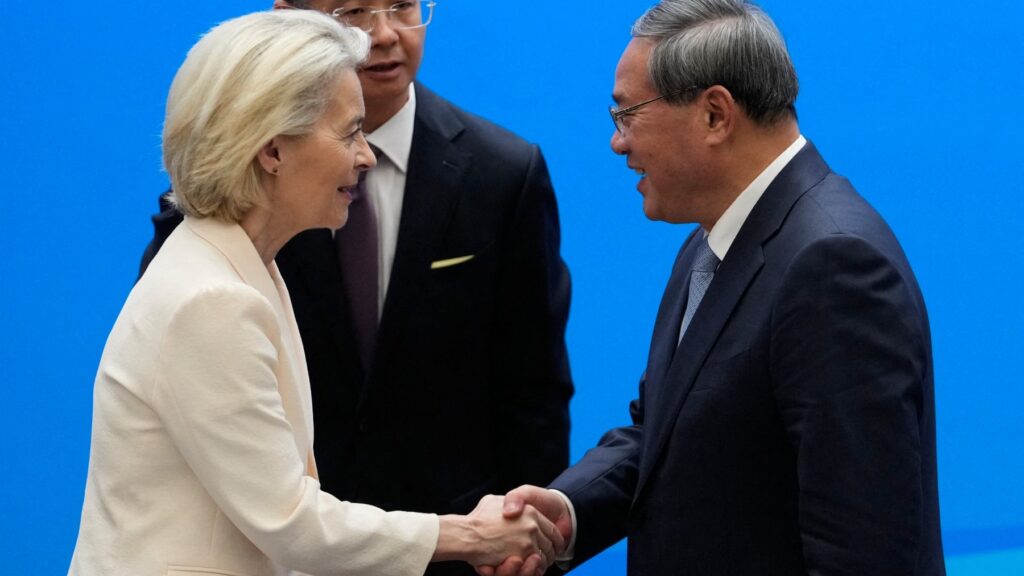
Brussels has insisted for years that it wants to reduce strategic dependencies on Beijing. Ursula von der Leyen has made de-risking—reducing risk factors that could put the system under strain—one of the central concepts of her trade policy and, in June, announced new legislation intended to require European companies to diversify the sources of certain critical supplies.
The figures, however, show that the level of dependence remains considerable.
Imports from China increased by 45% over the past five years, and the EU ended 2025 with a record trade deficit of around €360 billion with the Asian giant, close to €1 billion a day. Von der Leyen herself has described the imbalance as “unsustainable.”
The problem is not simply how much Europe buys from China, but the conditions under which those imports compete with companies producing inside the single market.
European companies face rising regulatory and administrative costs. According to BusinessEurope, more than 60% see regulation as an obstacle to investment, while 55% of SMEs identify the administrative burden as their main difficulty.
The Commission itself has also acknowledged that innovative companies struggle to grow because of “inconsistent and restrictive” regulations.
At the same time, Brussels continues to struggle to guarantee equivalent controls on all imported products.
Electric vehicles provide the most visible example. After investigating subsidies granted by Beijing, the Commission imposed countervailing duties on several Chinese manufacturers. But it also opened the possibility of replacing those tariffs with minimum-price commitments and of taking into account investments made by those companies within the EU.
The formula is intended to contain market distortions without triggering a trade escalation, but it also allows Chinese manufacturers to maintain and even expand their presence in Europe.
Sales of Chinese cars in the EU rose by 63% during the first half of 2026, from around 338,000 vehicles to nearly 549,000, according to ACEA data included in the document. They now account for close to 10% of the market. Rhodium Group has also warned that China’s high production capacity, combined with slower growth in its domestic market, is likely to keep export pressure on Europe high.
But the broader regulatory imbalance is even clearer outside the automotive sector.
For years, Chinese platforms took advantage of the de minimis customs exemption to send huge volumes of products worth less than €150 directly to European consumers, avoiding certain import duties and making regulatory checks more difficult.
The sheer volume of small parcels makes it impossible to inspect more than a fraction of the goods. In practice, a company producing in Europe must comply with the rules before placing its products on the market, pay taxes, and undergo inspections, while certain goods arriving from abroad can pass through a border system that is far harder to monitor.
The e-cigarette market illustrates that difference. Around 90% of European vape imports come from China, with approximately 70% manufactured in Shenzhen. OLAF has warned about the growth of illicit trade, while authorities have found products containing excessive nicotine levels, banned flavours, and other regulatory violations.
The issue takes on a strategic dimension when it comes to batteries. Chinese companies account for more than 80% of Europe’s residential energy storage systems market and close to 88% of lithium-ion battery imports, according to Wood Mackenzie data.
Europe is therefore electrifying its economy while depending on China for a substantial share of the technology required to do so.
That is the inconsistency at the heart of von der Leyen’s industrial policy. Brussels wants to reduce risks linked to Beijing, protect European manufacturers, and rebuild productive capacity, yet it maintains a system in which producing inside Europe can become increasingly expensive while Chinese companies continue to gain market share and industrial capacity within the single market.