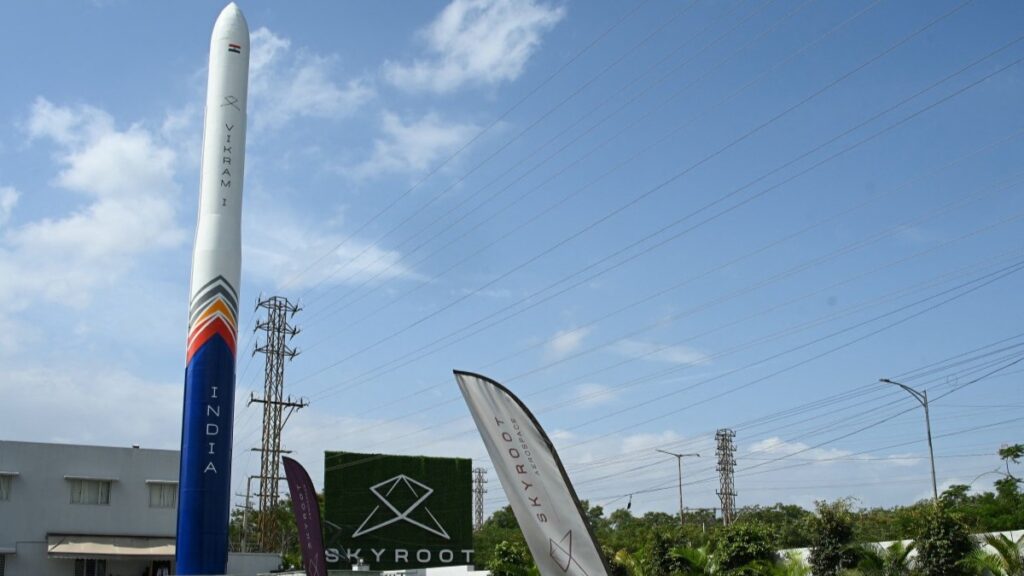
A Vikram-1 orbital rocket model displayed at Skyroot Aerospace facility on the outskirts of Hyderabad on July 7, 2026
NOAH SEELAM / AFP
India has just crossed a threshold that Europe has yet to overcome. On July 18, Skyroot Aerospace’s Vikram-1 lifted off from the Satish Dhawan Space Centre and placed several payloads into orbit around 450 kilometres above Earth.
It was the company’s first orbital attempt, and it succeeded.
Skyroot thus became the first Indian private company to reach orbit with a rocket developed in the country.
The achievement is significant despite the vehicle’s relatively modest size compared with launch systems operated by competitors in China, Russia, or the United States.
Vikram-1 is a relatively small launcher designed to carry up to 350 kilograms into low Earth orbit. It uses three solid-fuel stages and a liquid upper stage and incorporates carbon-composite materials and engines manufactured using 3D printing.
Its commercial target is the small-satellite market, a sector expanding rapidly with the proliferation of communications constellations, Earth-observation systems and military applications.
But the key question is who built the rocket.
For more than half a century, India’s space programme was almost entirely dominated by the state. ISRO took the country from its first experiments in the 1960s to developing indigenous launch vehicles, reaching Mars in 2014 and landing near the Moon’s south pole with Chandrayaan-3 in 2023.
That model began to change in 2020, when New Delhi opened the sector to private companies and created IN-SPACe to facilitate their access to public facilities, testing infrastructure and launch sites. The 2023 space policy completed the reform by separating ISRO’s research role, public commercial activity and the emerging private ecosystem.
That long-term strategy is already beginning to bear fruit. India now has more than 400 space startups and aims to expand the value of its space economy from around $8.4 billion in 2022 to $44 billion by 2033, including $11 billion in exports.
For now, Skyroot is the country’s main showcase. Founded in Hyderabad in 2018 by former ISRO engineers, the company raised another $60 million last May and reached a valuation of close to $1.1 billion.
One flight, however, does not make an industry.
SpaceX needed four attempts before Falcon 1 reached orbit in 2008. Its current dominance came from what followed: continuous production, a high launch cadence and lower costs. Skyroot will now have to prove that it can do something similar on a smaller scale.
In this industry, operators compare costs, schedules, insurance and reliability. Vikram-1’s success demonstrates technological capability, certainly, but its commercial viability will have to be proven over the coming years.
So where does that leave the European Union?
Europe carried out eight orbital launches in 2025, up from three in 2024, thanks to Ariane 6 and the return of Vega-C. Even so, it remains only a small fraction of a global market overwhelmingly dominated by the United States and China.
The European Space Agency itself is warning of a capacity problem. Between 2029 and 2031, new requirements from Galileo, Copernicus, IRIS², military programmes and national constellations could exceed the launch capacity available from Ariane 6 and Vega-C.
Europe is trying to create new private operators through the European Launcher Challenge. Member states have committed around €900 million to five projects, with support of up to €169 million per company.
So far, none has demonstrated an operational orbital launch service.
Germany’s Isar Aerospace lost control of its Spectrum rocket around 30 seconds after lift-off during its maiden flight in March 2025. Rocket Factory Augsburg lost a first stage during a static-fire test in 2024, while Orbex was eventually shelved despite the public money it had received.
Failures are part of the development of any launch vehicle; that is not in dispute. The problem in Europe’s case is that it has funded capacity that still has to be demonstrated. India, by contrast, has just demonstrated a capability that it now has to turn into a business.
Despite concerns in parts of the aerospace sector about the state of the European market after four years of war in Ukraine and amid pressure from Washington, this does not necessarily make India a rival to Europe. It could instead become a necessary partner.
ESA already used an Indian PSLV rocket to launch Proba-3 in December 2024, a European mission worth around €200 million involving more than 40 companies from across the continent. Cooperation between ESA and ISRO also continues in Earth observation, exploration and other scientific fields.
The emergence of private companies adds another possibility—and could provide considerable breathing room in Europe’s suffocating public regulatory environment. European operators could turn to India for certain commercial, university or scientific payloads, diversifying an international launch market that remains heavily dependent on the United States.
There is, however, an important caveat: space autonomy requires Europe to preserve its own ability to put strategic systems such as Galileo, Copernicus, IRIS² or future military satellites into orbit. Replacing dependence on the United States with dependence on India would not amount to autonomy—it would simply mean changing suppliers, something Europe has done with relative frequency in recent years.
India can offer competition, additional capacity and a new reference point that few had previously considered for the European space industry.
The commercial space race is no longer being fought only between the United States and China. India has now entered it with its own hardware, and Europe has every reason to pay attention.