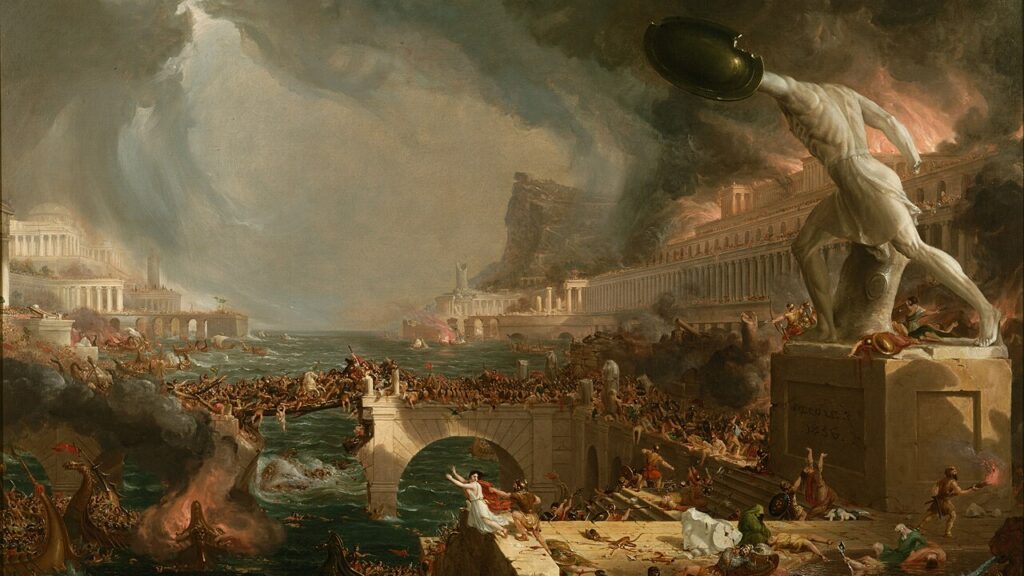
Europe today resembles a civilization that has forgotten not only what it once was, but why it ever existed. There is something tragic, Shakespearean, about watching the slow eradication of nations that produced Aristotle and Aquinas, Dante and Da Vinci, Newton and Einstein, the Renaissance and the industrial age. Andre Rieu playing the violin while the continent burns.
Spoiled by prosperity generated by their entrepreneurs. Lulled into a deceptive sense of safety created by the rise of America’s military power after WWII. Deceived by their elites into seeing their shared cultural values as embarrassing relics of pre-globalist times. Opening the gates to migrants from dysfunctional societies, with no opportunities or demands for assimilation.
That’s not compassion. It’s civilizational malpractice. Trump has sounded a rude but life-saving wake-up call. It will, of course, give Europe’s intellectuals one more reason to hate “orange man.” It’s a klaxon their ruling class prefers to muffle. Europe risks “civilizational erasure!” The warning is not hyperbolic. It’s a factual account of a tragedy of biblical proportions.
European leaders are appalled that Washington finally said out loud what their citizens whisper to one another at kitchen tables, pubs, and churches: “We are being replaced.” Replaced not by race or ethnicity. Such superficial markers don’t determine the fate of nations. Replaced by cultures shaped by political corruption, violence, misogyny, and contempt for human rights.
Uncounted multitudes have fled the misery of their homelands only to bring with them the very attitudes and habits that produced the cesspools they are leaving behind. It’s not that European elites embrace the uninvited illegal aliens’ values. They just despise their own. A civilization ashamed of itself cannot ask others to assimilate into anything meaningful. And so they don’t.
What are the consequences of handling immigration as virtue signaling? Neighborhoods transformed into lawless zones where police fear to patrol. Women and girls who must rethink their safety in public spaces that were once secure. Parallel societies that reject European norms instead of joining them. Cities burdened by criminal networks imported from collapsed states.
It’s easy to blame the EU governments. The deeper problem is the voters who supinely accept the tyranny of their bureaucracies, outsourcing everything that shapes their present and future to people who neither love their nations nor understand them. Europeans have become spectators in their own homes, sedated by comfort, terrified that resistance could make them seem impolite.
Europe’s decline cannot be reversed by adjusting migration quotas or rewriting climate regulations, by another summit, a different directive, or new bureaucracy. Europeans must choose public servants who believe that their civilization is worth defending. The greatest weakness of Europe’s conservative movement is not a lack of ideas, but a lack of unity.
In Britain, the fault lines on the right are plain to see. The Conservative Party has Kemi Badenoch. Nigel Farage leads Reform. The face of Restore is Rupert Lowe. Each appeals to a different instinct within the broader conservative electorate, yet each competes for the same pool of voters. The consequences are fragmentation and weakness.
Badenoch’s measured style is winning her respect among mainstream Conservatives. For some Reform and Restore supporters, restraint is too often mistaken for lack of principles. Some Conservative voters see Farage as the man who has spent years dismantling the center-right. Reform voters view Lowe as a rival who threatens to divide their movement, etc., etc.
Across Europe, the right has repeatedly demonstrated that its greatest adversary is often itself. In Austria, coalition negotiations between the ÖVP and the FPÖ collapsed amid disputes over power and strategy. In Germany, the CDU faces pressure from the AfD and internal tensions over how far it should move to the right without sacrificing its broader electoral appeal.
France has long witnessed competition between the traditional Gaullist right and Marine Le Pen’s National Rally. That rivalry has repeatedly fragmented the conservative vote and handed victory to socialists and globalists. In the Netherlands, Geert Wilders’ PVV, the VVD, and newer right-wing movements have likewise competed as much with one another as with the Left.
Political movements seldom fail because they lack conviction. More often, they fail because ambition eclipses principles. Rivals on the same side spend more energy attacking one another than persuading the wider electorate. Voters rarely reward perpetual civil war. They prefer clarity and the confidence that those seeking power are capable of exercising it together.
While the center-right remains divided by personalities and party rivalries, the progressive establishment continues to expand the power of the state, weaken national sovereignty, push woke policies, and burden enterprise with rules and taxes. Elections cannot be won by fighting those who share your principles more fiercely than those who oppose them.
The West gave the world free markets and the rule of law. It is now plagued by interventionism and redistribution. This is where Europeans can learn a lesson from the countries that endured decades of Marxist propaganda aimed at homogenizing all ethnicities. That’s where healthy nationalism and traditional conservatism were resurrected in the ruins of socialism since 1989.
When U.S. officials warned that some NATO members may soon be “majority non-European,” commentators shrieked about “far-right talking points.” But statistical projections are not ideological. They are math, convenient or not. A civilization can survive economic hardships, wars, and plagues. What it cannot survive is the belief that it is evil and has no right to exist.
America has adopted the ‘tough love’ approach: rebuild your militaries. Reclaim your identity. Relearn the moral confidence that once made the West the envy of the world. NATO must be saved before it collapses under the weight of Europe’s own doubts. Europe must shoulder its responsibilities, not hide behind American power while sneering at American values.
Europe’s modern ideology, post-national technocracy, is a fantasy. It insists that culture is interchangeable, borders are outdated, data analysts can plan our lives, and values are optional. It assumes that the millions imported from authoritarian or tribal societies will be singing kumbaya because people are inherently good. Millennia of human experience, however, beg to differ.
A continent that no longer reads the Bible, pays only lip service to the rule of law, sabotages the family, tries to erase national identity, suffocates free enterprise, and denies personal responsibility cannot magically transform newcomers into citizens who believe in those things. But, as Hayek reminds us, “In social evolution nothing is inevitable but thinking makes it so.”
Decline is not destiny. Civilizations fall when they choose to. Europe may be sleepwalking toward disaster, but it has not yet crossed the point of no return. The seeds of renewal are visible. Germany, Austria, France, Italy, and the Netherlands are turning against their woke elites. Millions of ordinary Europeans are rediscovering their heritage and rejecting multiculturalism.
The movie Citizen Vigilante, promoted by Elon Musk, shows one possible scenario. Unsurprisingly, it got 20 million viewers in a single day. We should do everything in our power to avoid it. If Europe finds the courage to embrace its identity rooted in Christianity, reason, liberty, and the dignity of the individual, the recent cultural decline could turn into the next Renaissance.