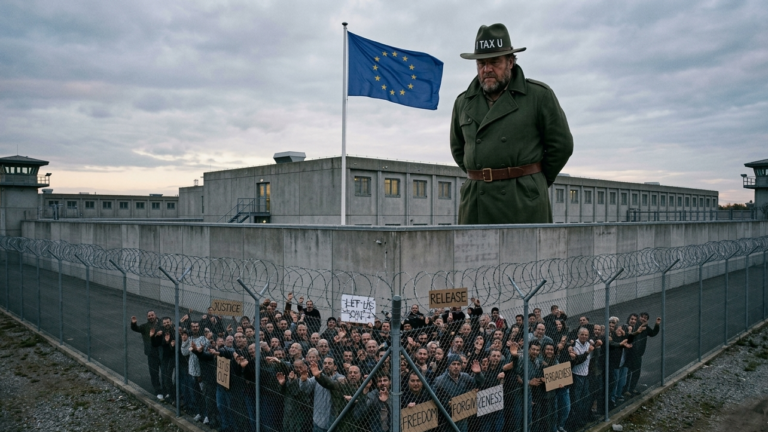
Boris Johnson speaks onstage at the Fortune Global Forum on November 11, 2024 in New York City.
Jemal Countess / GETTY IMAGES NORTH AMERICA / Getty Images via AFP
Previous articles:
When Boris Johnson left Downing Street in September 2022, few imagined that his political reinvention would become so deeply intertwined with an external cause—the war in Ukraine. The former British prime minister, now one of the most prominent Western advocates of Kyiv, has maintained a tireless international agenda blending moral activism, private interests, and a refined strategy of self-promotion. What initially appeared as an ethical commitment to the “freedom of Ukraine” has increasingly revealed itself as a sophisticated network of political and personal profit.
Since leaving office, Johnson has faced repeated scrutiny from the UK’s Advisory Committee on Business Appointments (ACOBA)—the official body overseeing the post-government activities of former ministers—for multiple breaches of the revolving-door rules. He ignored deadlines and mandatory procedures before accepting paid positions in private consultancies, along with contracts with media outlets and international agencies.
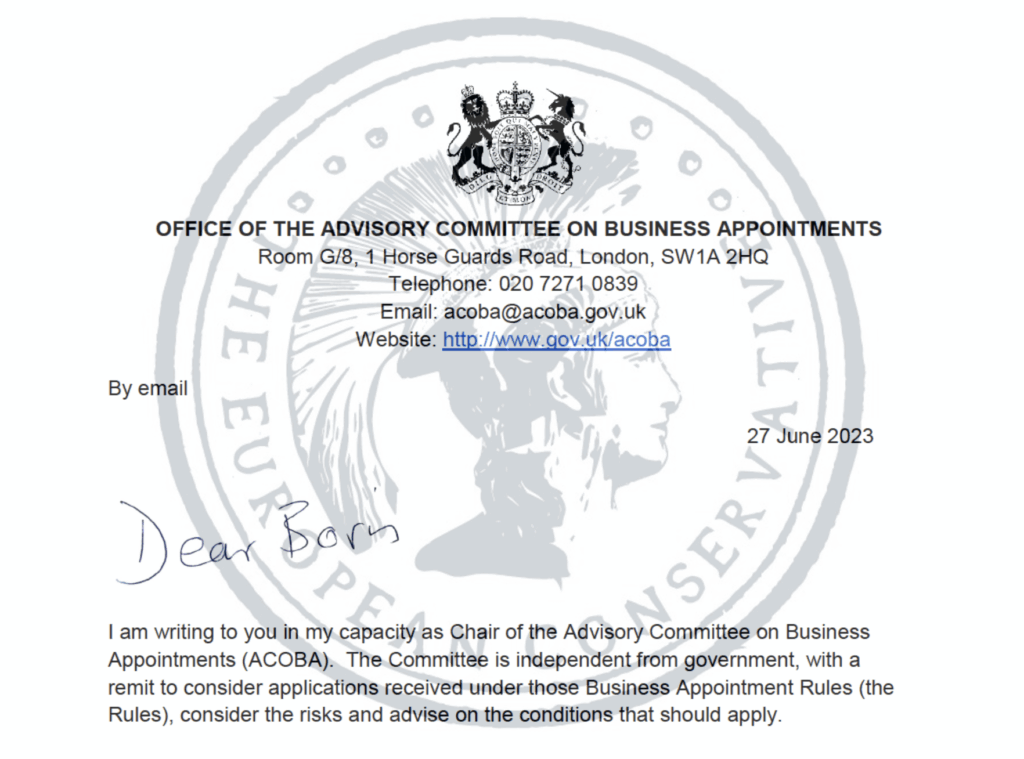
In one of the exchanges obtained by europeanconservative.com, his office acknowledged in June 2023 that he had begun his collaboration with the Daily Mail before receiving ACOBA’s formal approval. Shelley Williams-Walker, Johnson’s assistant, wrote to the committee:
You are right that I have written an article for the Daily Mail, though at this moment it has not yet been published. I have not yet signed any contract or been paid. If you have any objection to my signing a contract in the next few weeks, perhaps you could let me know.
That admission confirmed that Johnson had announced his Daily Mail column before obtaining the required clearance. ACOBA reminded him in writing that “former Ministers must ensure that no new appointments are announced, or taken up, before ACOBA has been able to provide its advice.”
In parallel with his regulatory troubles, Johnson built a global circuit of conferences and policy forums centred on the defence of Ukraine. Since 2023, the Harry Walker Agency has managed his speaking engagements—an activity that has yielded him millions in revenue. In documents sent to ACOBA, Johnson justified these activities in January 2024 as an altruistic mission:
This unpaid appointment will allow me to put my knowledge and influence to good use for the long-term benefit and security of Ukraine, and European security more broadly.
The same moral language reappears in his consultancy filings. Explaining his role as Principal Adviser at Bia Advisory, Johnson wrote, “To provide strategic advice to Bia Advisory, occasionally attending client meetings and visiting projects.” He added:
I firmly believe that achieving net zero carbon emissions by 2050 is a vital goal, and I am keen to play a role in achieving that through the work I undertake.
Yet the structure of Bia Advisory raised immediate concerns at ACOBA. In a letter to Johnson’s office, the committee observed, “There is a lack of information about the company on the BIA Advisory website … there is no registration on Companies House for BIA Advisory, nor is Mr Roach listed as Director of the company.” It concluded bluntly: “It is difficult to see how Mr Johnson, as the former Prime Minister, could work with government without it being seen as lobbying.”
The Bia case encapsulates what could be called the “Johnson model”: the ability to operate simultaneously within politics, lobbying, and moral advocacy—all under the language of public service.
Another example is Better Earth, the new firm where Johnson became co-chair in early 2024. In his ACOBA application, he described it as a “new company involved in the emissions reduction and carbon markets sector … I firmly believe that achieving net zero carbon emissions by 2050 is a vital goal.”
This phrasing fits neatly within his broader narrative about Britain’s “green leadership” and moral duty, yet documents suggest that Better Earth and Bia Advisory function primarily as vehicles for personal projection rather than environmental impact.
The agreement with Merlyn Advisors, signed in September 2023, reveals the financial dimension of this network. According to the Engagement Letter signed by both parties: “The Client shall pay the Engaged Party a non-refundable payment of GBP 200,000 for each Meeting in which the Engaged Party participates.” Moreover, “To support the Think Tank, the Client shall make monthly contributions towards the Think Tank of GBP 35,000, for the duration of this Agreement.”
The contract shows that Merlyn Advisors committed not only to paying Johnson per private event but also to financing a think tank “to support the ideas and visions held by the Engaged Party.” In essence, an institutional vehicle designed to extend his influence under an intellectual guise.
In January 2024, Johnson also formalised his participation in the International Working Group, co-chaired by former NATO Secretary General Anders Fogh Rasmussen and Ukrainian presidential advisor Andriy Yermak. In his application to ACOBA, he stated that his role would be to “provide recommendations on European security architecture ahead of the June 2024 NATO summit, including around the issue of NATO membership for Ukraine.”
He concluded the form with a characteristic line: “This unpaid appointment will allow me to put my knowledge and influence to good use for the long-term benefit and security of Ukraine.” Prestige becomes symbolic capital; symbolic capital becomes access.
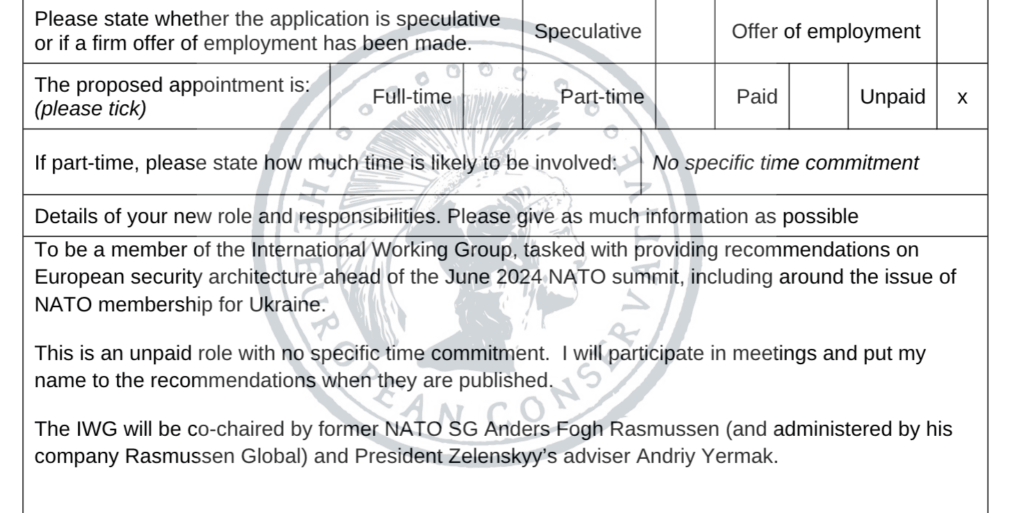
That a former British prime minister now sits in a group co-chaired by a former NATO chief and a top aide to President Zelensky raises legitimate questions about the ethical boundaries of lobbying within the Alliance itself. Johnson’s presence strengthens not only his international visibility but also the symbiosis between politics, consultancy, and transatlantic influence.
The Johnson case exposes the structural fragility of the UK’s ethics-oversight system. ACOBA, designed to ensure that former ministers do not monetise their public office, has repeatedly admitted in its own correspondence that it lacks the authority to sanction violations. Its only weapon is public exposure: “Given the public interest in knowing whether the former Prime Minister has complied with the government’s Rules … we will be publishing our correspondence in due course.”
The absence of enforcement renders these rules largely ceremonial. Johnson maintains that his work “serves the freedom and prosperity of Western democracies.” But the documents analysed reveal a consistent overlap between his pro-Ukraine activism and the expansion of his private ventures. His rhetoric of freedom doubles as a framework for influence—a narrative that blurs the line between public mission and personal gain.
The “Johnson model” epitomises the fusion between the moral language of war and the economy of prestige. In his world, supporting Ukraine guarantees contracts, visibility, and access. The defence of democracy merges with the sponsorship of interests. His trajectory—from Downing Street offices to international conference stages—mirrors a new form of power that no longer needs elected office to exert influence.
Official ACOBA documents, correspondence between Johnson’s office and the regulator, and private contracts reviewed by this outlet reveal a clear pattern: Boris Johnson has turned his political capital into an infrastructure of influence. His rhetoric about freedom and Ukraine’s reconstruction coexists with payments, appointments, and consultancies that expand his private network while the war continues to claim lives.
The Johnson case is less an indictment of one man than a reflection of the system that demands transparency yet rarely practises it and that transforms the noblest of causes—the defence of freedom—into a perfectly legitimate business.