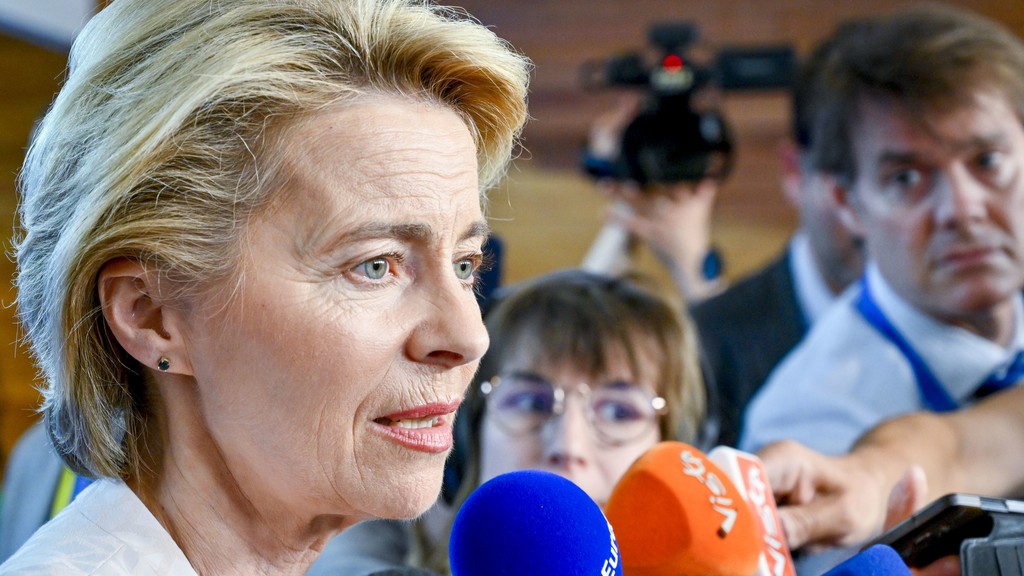
Commission President Ursula von der Leyen on January 13, 2024
Multimedia Centre – European Parliament
Europe once prided itself on being a continent of inventors, engineers, and entrepreneurs. Today, it is a continent of compliance officers. Under the weight of endless regulations—from climate targets and digital rules to corporate due diligence—innovation has become secondary to survival.
The European Commission calls it “responsible growth.” For small and medium-sized enterprises, it feels more like slow suffocation. Every new directive brings more paperwork, higher costs, and a fresh layer of bureaucracy. The problem is not only quantity but complexity: Brussels now produces more than 2,000 pages of new regulation each month, a legal maze that even large corporations struggle to navigate.
For the giants of the European economy —multinationals with vast legal departments and global supply chains— compliance has become a manageable cost of doing business. They can afford the consultants, the audit, and the certifications. For the rest, it’s an existential burden.
From packaging restrictions to carbon accounting, the cumulative effect is devastating. A bakery in Spain, a machinery producer in Poland, or a textile factory in Portugal now spends thousands of euros each year on reporting requirements that have little to do with their real environmental or economic impact.
The Green Deal, once sold as an engine of innovation, has become a bureaucratic trap. To prove sustainability, companies must fill forms, hire consultants, and track emissions across their entire supply chain. The irony is that most of these costs fall on local firms, while competitors in China, India, or the United States face no equivalent rules. The result: European products become more expensive and less competitive in global markets, while imports produced under lower standards flood EU shelves.
In theory, these measures aim to create “a level playing field.” In practice, they tilt it decisively against Europe. The Commission insists that strict regulation will drive green innovation—but innovation needs risk, flexibility, and reward, not red tape. Venture capital investment in Europe has fallen sharply compared to the U.S. since 2020. Entire sectors, from biotech to clean tech, are relocating to more agile environments like Texas, Singapore, or Dubai, where regulation is clear and predictable.
Even within the EU, frustration is mounting. A report by Business Europe showed that 75% of medium-sized firms consider EU regulation their biggest obstacle to growth. In France, small manufacturers complain that environmental paperwork consumes more time than production itself. And in Eastern Europe, entrepreneurs quietly say what others think aloud: “Brussels is killing our competitiveness.” The European political groups European Conservatives and Reformists (ECR), Patriots for Europe (PfE) and Europe of Sovereign Nations (ESN) agree on this analysis and on their proposals.
The Commission’s answer is more of the same. Von der Leyen’s ‘Simplification Agenda,’ launched with fanfare, has barely scratched the surface. Instead of repealing redundant directives, it has introduced new reporting obligations under the guise of transparency.
The deeper problem is philosophical. The EU has come to equate control with progress. Every crisis —financial, health, environmental— triggers another wave of legislation. Each time Brussels intervenes, it justifies itself by promising protection: of the climate, of consumers, of democracy. But in protecting everything, it is destroying the dynamism that made Europe prosperous in the first place.
Small and medium-sized enterprises represent 99% of EU businesses and provide two-thirds of private employment. Yet their interests are consistently sacrificed to the political theatre of green targets and social agendas. When they fail, Europe’s competitiveness fails with them.
Brussels’ policymakers often discuss “strategic autonomy.” But autonomy is impossible without competitiveness, and competitiveness cannot exist in an economy where innovation is criminalized by compliance. Europe’s future will not be decided in the corridors of the Berlaymont or in the language of new directives, but in whether its entrepreneurs are still willing —and able— to create, risk, and build.
If that freedom disappears, no amount of regulation will save the European project.