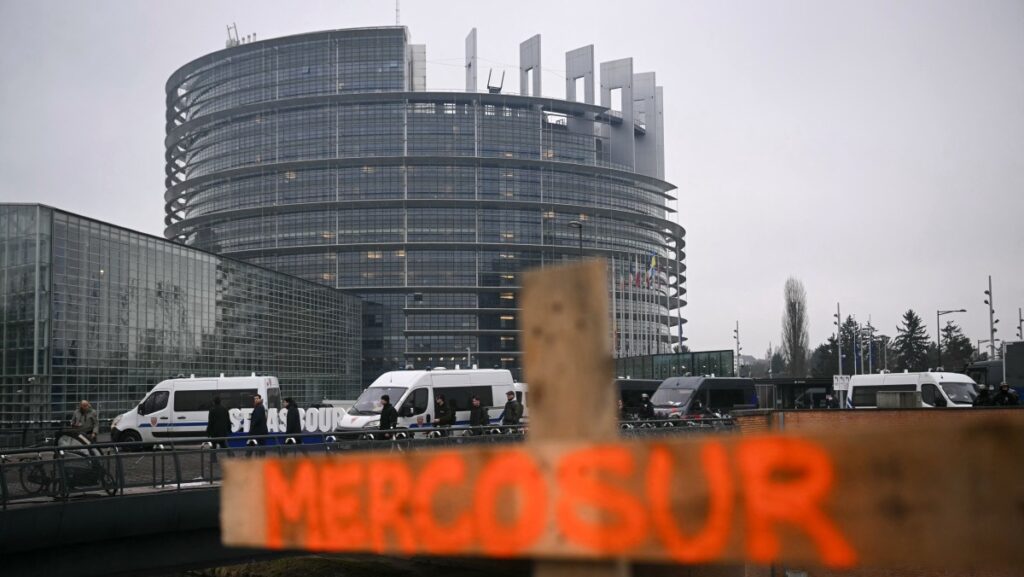
The word MERCOSUR is written on a wooden cross during a protest by European farmers following the signing of the free trade agreement between the European Union and the Mercosur countries and on the eve of a vote on a referral to the courts, in front of the European Parliament in Strasbourg on January 20, 2026.
NICOLAS TUCAT / AFP
Members of the European Parliament voted on January 21, 2026, to refer the EU–Mercosur file to the Court of Justice of the European Union (CJEU), asking the judges to test the agreement’s compatibility with the Treaties and, crucially, the strength of its legal basis. In the Brussels bubble, nerves immediately frayed. Trade policy remains one of the few areas where the single market still carries real weight globally and where the union of 27 can still credibly claim an unmistakable ‘European added value.’ Touch that lever, and the technocratic machine starts to wheeze.
The EU–Mercosur package is a ‘new generation’ mixed agreement. Its commercial chapters sit at the core of the EU’s exclusive competence, exercised by the Commission; its broader political provisions are shared and therefore also fall within member state competence. The architecture is convenient in a very Eurocratic Brussels culture: accelerate where you can, bypass where you want, and then promise provisional application so as not to ‘lose momentum.’ One is entitled to wonder whether this complexity blinded MEPs who wanted to bite but settled for barking.
And this is where Brussels has found its neat workaround and where the Luxembourg court provided the logic that makes it possible. Think of trade deals as a long train. Some carriages are ‘pure trade’: selling cars, machines, chemicals to third countries. Other carriages are ‘politics’: who decides disputes, how far rules reach, what powers member states keep, and how much of the ‘motherhood-and-apple-pie’ language of corporate responsibility is meant to be binding rather than decorative. The Court’s message in Opinion 2/15 (May 16, 2017) was, in essence, that the EU can drive the trade carriage alone, but if a deal begins to touch national competences in a meaningful way, the member states must be on board too.
So the Commission increasingly splits one big agreement into two papers: a fast ‘trade-only’ part it can roll out quickly, and a slower ‘mixed’ part that needs national ratifications across roughly forty parliamentary bodies once you count national and certain regional parliaments, including Wallonia. Legally, it looks tidy. Politically, it feels like sleight of hand. The fast train leaves the station while citizens and forty parliamentary entities are still looking for their tickets, and the sensitive questions are parked on a siding with a sign that reads: ‘we’ll deal with this later.’ Brussels’ Eurocratic bureaucracy learned how to move the deal forward even when the 27 member states have not truly agreed on the whole thing.
To be clear, a referral to the Court for an opinion is not a coup; it is a parliamentary act foreseen by the Treaties. Yet it was carried by an alliance contrary to nature—one that, for once, loosened the cordon sanitaire—under the pressure of mostly French farmers’ protests, sometimes violent, right up to the EU parliament’s doors. The referral was sold, with theatrical certainty, as a heroic rescue of French agriculture. It is nothing of the sort. Farmers targeted the wrong building and the wrong door, and, more importantly, they were betrayed by the very elected officials who claim to shield them.
Here is the inconvenient truth behind the triumphal messaging: the CJEU referral does not prevent the immediate provisional application of the commercial elements bundled into the interim trade agreement. So why the loud celebration of a ‘setback for Ursula von der Leyen’? Because the story is emotionally satisfying. The EU parliament ‘stands up’ to the Commission; democracy ‘pushes back’ against Brussels. But the institutional reality is colder; remember the train. The Commission remains the central actor for external trade. It receives a negotiating mandate from the member states, in Council, and implements it with substantial autonomy. The division of the Mercosur deal into two parts—one purely commercial free-trade pillar and one broader political pillar—was a tactical Commission choice, shaped by the Court’s jurisprudence and doctrine 2/2015 since 2017, accepted by Latin American partners, and approved by the member states. Parliament does not negotiate. That is not a scandal; that is the system.
This is where the supposed ‘parliamentary victory’ dissolves into procedure. If MEPs genuinely wished to stop conditions they claim are harmful to European agriculture, they would have had to follow the political logic to its end: vote for the motion of no confidence against the Commission tabled by Rassemblement National MEPs and their allies. Yet, the cordon sanitaire constrains those who invoke it. It freezes the common base of the von der Leyen ‘grand coalition,’ a majority willing to dramatise oversight but unwilling to impose sanctions. And because the Court referral does not block provisional application of the trade pillar, reserved to the Commission alone, only a no-confidence vote would have stopped the implementation of the contested trade rules. The betrayal, from the farmers’ perspective, lies precisely there: the vote of no confidence did not happen.
This episode exposes a familiar Eurocratic contradiction. Brussels speaks the language of accountability, yet prefers accountability in slow motion: after the text is stabilised, after the package is signed, after political costs are already sunk. Oversight becomes a ceremonial moment: high on symbolism, low on consequences. Parliament, lacking the steering wheel, reaches for the emergency brake. But an emergency brake is not a strategy; it is a last resort. Used too late, it slows the train without changing its destination.
The EU Commission, for its part, is not acting in a vacuum. It operates within a system that treats trade as an exclusive EU competence precisely to prevent 27 national vetoes from paralysing external economic policy. The problem is political: when citizens feel exposed, when sectors feel abandoned, and when protests erupt, the Union’s reflex is to substitute mechanics for politics. It offers monitoring, safeguard language, procedural reassurance. It gives the impression of control, while the underlying choice remains intact.
In the end, we are watching procedures being marketed as courage. A referral to the Court is presented as a blow struck when it is merely a question asked. The trade pillar can still move; the Commission still holds the pen; the ‘protective’ coalition avoided the one sanction that would have mattered. Oversight, yes. Bravery, no. And that is how Eurocracy ‘discovers’ control: not as a democratic safeguard, but as a disruption to something to endure, contain, and reframe.